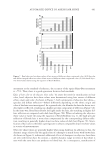
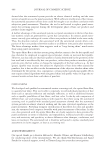
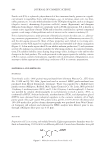
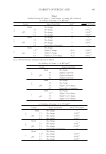
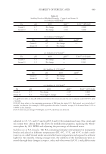
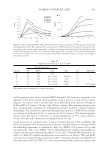
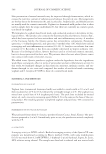
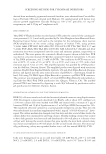
AUTOMATED DEVICE TO ASSESS HAIR SHINE 455 cooled CCD camera is used. A further system add-on, called luca.color, enables the mounting of up to ten arbitary different fi lters between the lens and the camera chip in a motorized fi lter wheel. The fi lter wheel can be equipped with color but also with polar- ization fi lters. In the opsira Shine-Box setup, the camera is equipped with color fi lters to be able to measure according to the CIE color-matching functions x(λ), y(λ), and z(λ) to gather the color of the hair tresses. It is also equipped with a horizontal and a vertical polarizer to separate the refl ected light coming from the hair into the polarization com- ponents. All fi lters are positioned during one measurement procedure automatically by the operating software of the opsira Shine-Box. To realize the polarization analysis it is also necessary to illuminate by polarized light. This is done by a fi xed polarizer in front of the thin and long shine illumination light source. The sparkle illumination is realized with a toroidal fl uorescence light source equipped with a motorized ring cover plate blocking 340 degrees of the light source. By the remaining and rotating aperture of 20 degrees, different incident angles to the hair tresses can be adjusted to measure the angu- lar life time and thus the sparkle. The system "opsira Shine-Box" is commercialized by opsira GmbH, Leibnizstrasse 20, D-88250 Weingarten, Germany, (www.opsira.com). RECORDING PARAMETERS Objective shine value. On illumination an individual hair either refl ects light directly on its surface (surface refl ection) or the light enters into the hair and is refl ected at the second hair surface (transmission - refl ection – transmission, TRT). The light refl ected at the fi rst hair surface retains its original optical properties (spectral composition = color, state of polarization) (3), whereas the transmitted and refl ected light changes both its spectrum (color) due to absorption effects—mostly via melanin (see Figure 2) and its state of polar- ization (depolarization inside the hair). In the newly developed device the refl ection prop- erties of hair tresses mounted on the cylindrical carrier are recorded using a horizontally polarized light source. To separate fi rst-surface from second-surface refl ection, one picture is recorded with a horizontally positioned polarization fi lter (polarized fi rst-surface com- ponent = specular) and one picture is recorded with a vertically positioned polarization fi lter (depolarized second-surface component = diffuse). Figure 1. (A) Setup of the Shine-Box with carrier. (B) Details of mounted hair tress on carrier with slit aperture.

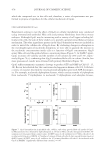
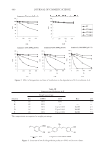
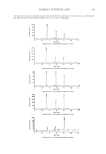
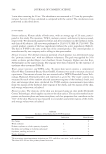
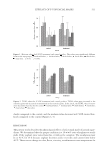
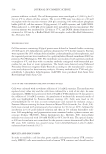
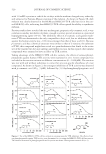
JOURNAL OF COSMETIC SCIENCE 456 The refl ective properties of surfaces are most generally and completely described by the bi-directional refl ectance distribution function (BRDF), which is a function of the direc- tion of light incidence, the direction of observation, the wavelength of light, and its state of polarization. Assessment and evaluation of the refl ective properties of surfaces can be realized (usually) by motorized scanning of a range of observation directions with a pho- tometric or spectroradiometric receiver for one direction of light incidence. This can be done with complex and bulky high-precision mechanisms called goniophotometers or goniospectroradiometers. An alternative way of scanning the directions of observation without moving parts, which is also realized in the opsira Shine-Box, is given by analysis of the spreading of a point or line source of illumination. The variation of the scattering properties of a fl exible specimen with an angle of observation within a fi xed plane of ob- servation (in-plane BRDF) can most conveniently be evaluated in a cylindrical geometry (as used in the opsira Shine-Box, see Figure 1B) by analysis of the spread of a linear illu- mination source. In that confi guration, the angle of light incidence and the angle of obser- vation both vary with their position on the circumference of the cylinder, thus generating a wide range of angles between incident and refl ected light beams. As a consequence, this cylindrical geometry can be used to evaluate the in-plane BRDF of a roll of hair fi bers in one single image of an adequaltely calibrated camera (imaging photometer or colorime- ter). From such images, e.g., the sheen (luster) of the hair can be determined, or with some modifi cations in the geometry of illumination, other characteristics like sparkle can also be measured and evaluated. Using BRDF, it is also possible to determine the half width (HW), or more precisely, full width at half maximum, of specular refl ection (Figure 2). The objective shine value or luster (L) is characterized by the equation of Reich/Robbins (4) as standard specular RS×HW L RD×HW (Eq. 1) where RS is the integrated intensity of specular refl ection • RD is the integrated intensity of diffuse refl ection • HW • standard is the half width of an optimally refl ecting area (representing the carrier without mounted hair tresses HW • specular is the half width of specular refl ection of the mounted hair tress Figure 2. Specular and diffuse refl ection of a human hair mounted on the carrier of the Shine-Box. HW denotes the half width of specular refl ection, or more precisely, full width at half maximum.
Purchased for the exclusive use of nofirst nolast (unknown)
From: SCC Media Library & Resource Center (library.scconline.org)