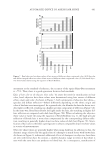
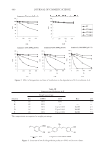
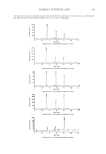
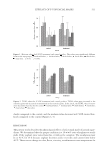
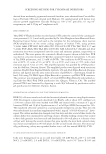
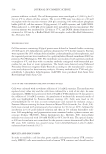
AUTOMATED DEVICE TO ASSESS HAIR SHINE 457 Thus, the higher the contrast between specular refl ection and its background (i.e., the lower diffuse refl ection and the half width of specular refl ection), the higher the shine value. By inclusion of the standard half width of a black metal cylinder into the above equation, the calculated objective shine value L has no dimension. Objective sparkle value. Sparkle effects are characterized by a short angular lifetime. The sparkle effect results from a total refl ection of the incident light within the hair fi ber in the direction of the observer, who perceives this light as a bright spot. The effect strongly depends on the angle of the incident light, the actual geometry of the hair, and the posi- tion of the observer. Therefore, hair seems to sparkle due to the movement of the head or the observer. Since dark hair absorbs most of the incident light, sparkle is most promi- nent with blond hair and contributes to the subjective perception of hair shine. In the opsira Shine-Box, sparkle is quantifi ed by illuminating hair tresses via a segment of a ring illumination device (see Figure 1A) from slightly different angles (±5.6° and ±2.8°) and recording pictures for each individual illumination angle. According to the defi nition of sparkle, a sparkle spot must only occur under one illumination angle. To identify sparkle spots using the opsira Shine-Box, means and standard deviations of in- tensities of corresponding pixels from four pictures (taken under different illumination angles) are calculated, and sparkle spots are defi ned as pixels with a very high standard deviation (i.e., exceeding a defi ned threshold of standard deviation). The number of spar- kle spots is counted for each individual hair tress and makes up the sparkle value. A typical series of four pictures and the calculated results picture are shown in Figure 3. Parallelism. To allow an accurate determination of shine and sparkle, a hair tress to be evaluated has to be well combed and parallel. Using the opsira Shine-Box, parallelism is routinely assessed as a quality control, and tresses with insuffi cient parallelism are ex- cluded from analysis until better parallelism is gained by additional combing. Under ideal conditions of a perfectly cylindrical body (e.g., the carrier without a mounted hair tress), the vertical intensity distribution follows a bell-shaped distribution, and the hori- zontal intensity distribution at a given position has a constant value. This horizontal and vertical distribution pattern changes when the surface is altered, e.g., by mounting a hair tress on the carrier. To quantify the parallelism of a given hair tress mounted on the car- rier, the entire object is divided into a defi ned number of vertical columns. At each posi- tion in a given row, the average horizontal intensity is calculated (Figure 4). Averaging is done to not give individual hairs in a given row too big a weight. In an ideally combed tress, the vertical distribution of the average horizontal intensities of all rows should be identical. In contrast to this, the vertical distribution of uncombed tresses can be expected to be different in each individual row. The variance of intensity distribution between in- dividual rows contains the information about the parallelism and quality of combing. RESULTS HAIR SHINE Correlation of objective shine values with subjective panel results. According to the equation of Reich/Robbins (eq. 1), the objective shine value can be increased by increasing the inte- grated intensity of specular refl ection (RS) in the numerator of the fraction, or by decreasing

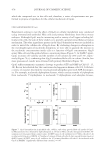
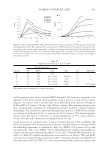
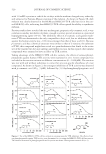
JOURNAL OF COSMETIC SCIENCE 458 either the integrated intensity of diffuse refl ection (RD) or the half width of specular re- fl ection of the mounted hair tress (HWspecular) in the denominator of the fraction. Figure 5 shows the increase of the objective shine value achieved with a leave-in hair care prod- uct (care and style treatment) on blond hair tresses, as well as the effect of treatment on the single components—half width of specular refl ection, integral specular refl ection, and integral diffuse refl ection—that make up the objective shine value according to Figure 3. Determination of sparkle. The upper four photographs show the absolute intensities recorded for the same hair tress under four slightly different incident angles. The lower picture shows the standard devia- tions of the means of all individual pixels from the upper four pictures.
Purchased for the exclusive use of nofirst nolast (unknown)
From: SCC Media Library & Resource Center (library.scconline.org)