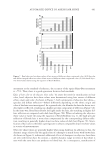
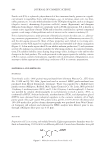
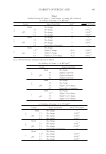
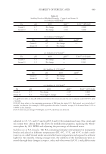
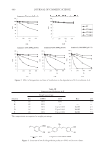
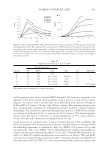
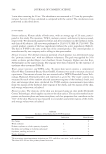
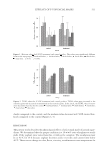
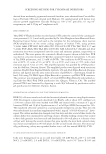
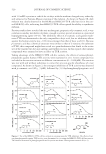
STABILITY OF FERULIC ACID 493 the ones at pH 7.5, neutralized by NaOH and TEA (solutions H, I, and J see Table V). Solution H was respectively neutralized to pH 9.0 by NaOH and TEA (solutions K and L see Table V). PVG (1%, w/w) was added to the basal solution (solution M see Table VI) and to solution E (solution N see Table VI). NaCl (5.85%, w/w) was added to the solution and further neutralized to pH 7.5 by TEA (solution O see Table VII). Addition of Vitamin C (0.2%, w/w) was added to the solution, together with a sweeping oxygen fl ow (solution P see Table VII). A nitrogen (N2) atmosphere was obtained through nitrogen Figure 7. Accumulation and/or consumption of PVG and its dimer in tested solutions. Solutions were incubated at 75° for three days. The PVG consumption% was calculated according to its initial con- centration (1%, w/w), and the PVG and dimer accumulation% here were calculated in the same way as in Figure 4. Table VI Composition of Solutions A, E, M, and T Solution Weight percentage Base pH F.A DPPG PVG H2O A 1% 30% — 69% — 3.0 E 1% 30% — Up to 100% NaOH 7.5 M 1% 30% 1% 68% — 4.2 N 1% 30% 1% Up to 100% NaOH 7.5 The compositions are expressed as weight percentage.

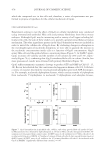
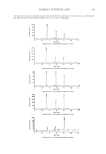
JOURNAL OF COSMETIC SCIENCE 494 fl ow within solutions F and L (solutions Q and R see Table VII). An oxygen atmosphere was obtained by oxygen fl ow within solution F (solution S see Table VII). The fi rst fi ve solutions (solutions A–E) were incubated at either RT, 45°C, 60°C and 75°C, and the concentration of F.A in all samples was determined by HPLC (conditions were the same as above) at various time periods up to four weeks. Other samples of the 19 solutions were incubated at 75°C for speeding up the degradation processes. Hence, con- centration of F.A and its derivatives (see below) were analyzed by HPLC at different time periods under the following technical conditions: Hypersil BDS-C18 (4.6 mm × 250 mm, 5μm Dalian Elite) mobile phase, 0.167 M acetic acid (solvent A) and methanol (solvent B) gradient applied, increasing solvent B from 40% to 65% within 3 min, hold- ing 8 min fl ow rate: 1.2 ml⋅min−1, then increasing solvent B from 65% to 100% within 1 min, holding 5 min fl ow rate: 2.0 ml⋅min−1, decreasing solvent B from 100% to 40% within 1 min, holding 5 min fl ow rate: 1.2 ml⋅min−1, end column temperature, 30°C UV detector fi xed at 254 nm injection volume, 10 μl. Characterization of products from F.A degradation. A moderate amount of oil-like precipita- tion was observed during the incubation period. These precipitates were separated by fl ash column chromatography, eluted with hexane and ethyl acetate mixture, starting with 100% hexane, with a later decrease in the ratio of hexane/ethyl acetate (v/v) to 80:20, 75:25, 67:33, to 100% ethyl acetate. The separated and purifi ed fractions were then further identifi ed by LC-MS and NMR analysis and kept as standard samples. RESULTS AND DISCUSSION STABILITY OF F.A IN DIFFERENT COSMETICS FORMULAE In our work the eight representative formulae were specifi cally designed through the re- quirements of our internal sensory evaluation panel (textures close to those of a whitening product). We evaluated different types of formulations for enlarging the scope of factors prone to infl uence the stability of F.A. The compositions of these eight formulae are shown in Appendix I and Appendix II. The eight formulae were prepared without F.A, as blanks. Table I summarizes changes in ACO status, ΔpH, and % of F.A. As shown in Table I, none of the tested formulae appeared stable compared to their re- spective blanks. Most formulae turned yellowish, together with odor changes, illustrat- ing the two major stability problems encountered in F.A-based formulae. A strong increase in pH and a signifi cant F.A degradation were observed in most cases. Two formulae, cream 3 (pH 4.5) and serum 4 (pH 5.0) appeared somewhat “stable”. These were selected for further modifi cation. Two new formulae, cream 9 and serum 10, were created (compositions are in Appendix III). Their stability results shown in Table II Figure 8. Proposed mechanism for the formation of dimer from F.A in tested solutions—Step two: addi- tional reaction.
Purchased for the exclusive use of nofirst nolast (unknown)
From: SCC Media Library & Resource Center (library.scconline.org)