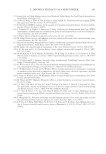
L. JAPONICA EXTRACTS AS A MOISTURIZER 205 (11) Korea Food and Drug Administration, Food Standards Codex (Korea Food and Drug Administration, Seoul, Korea, 2005), pp. 1267. (12) Y. Wu, X. Wang, Y. Zhou, Y. Tan, D. Chen, Y. Chen, and M. Ye, Correlation between stinging, TEWL and capacitance, Skin Res. Technol., 9, 90–93 (2003). (13) E. Berardesca, EEMCO guidance for the assessment of stratum corneum hydration: electrical methods, Skin Res. Technol., 3,126–132 (1997). (14) J. Pinagoda, R. A. Tupker, T. Agner, and J. Serup, Guidelines for transepidermal water loss (TEWL) measurement. A report from the standardization group of the European Society of Contact Dermatitis, Contact Dermatitis, 22, 164–178 (1990). (15) T. Fisher, The art of patch testing, Contact Dermatitis, 23, 221–223(1990). (16) M. Lodén, Barrier recovery and infl uence of irritant stimuli in skin treated with a moisturinzing cream, Contact Dermatitis, 36, 256–260 (1997). (17) Korea Food and Drug Administration, Cosmetic standard and experimental method (Korea Food and Drug Administration, Seoul, Korea, 2007), No. 2007-45 [in Korean]. (18) M. Lodén, The clinical benefi t of moisturizers, J. Eur. Acad. Dermatol. Venereol., 19, 672–688 (2005). (19) I. R. Davison and G. A. Pearson, Review: Stress tolerance in intertidal seaweeds, J. Phycol., 32(2), 197–211 (1996). (20) M. M. Kim, Q. V. Ta, E. Mendis, N. Rajapakse, W. K. Jung, H. G. Byun, Y. J. Jeon and S. K. Kim, Phlorotannins in Ecklonia cava extract inhibit matrix metalloproteinase activity, Life Sci., 79, 1436– 1443 (2006). (21) C. S. Lobban and P. J. Harrison, Seaweed ecology and physiology (Cambridge University Press, Cam- bridge, United Kingdom, 1994), pp. 366. (22) G. W. Lee and J. Y. Lee, The effect on skin deposition and moisturizing of ursolic acid in hydrogel sys- tem containing wood vinegar, J. Korean Pharm. Sci. 38(2), 87–92 (2008) [in Korean]. (23) C. W. Blichmann, J. Serup, and A. Winther, Effects of single application of a moisturizer: evaporation of emulsion water, skin surface temperature, electrical conductance, electrical capacitance, and skin surface (emulsion) lipids, Acta. Derm. Venereol., 69, 327–330 (1989). (24) J. Serup, A. Winther, and C. W. Blichmann, Effects of repeated application of a moisturizer, Acta. Derm. Venereol., 69, 457–459 (1989). (25) M. Yokota and H. I. Maibach, Moisturizer effect on irritant dermatitis: an overview, Contact Dermatitis, 55, 65–72 (2006). (26) J. S. Choi, Y. M. Ha, S. H. Shin, Y. C. Kim, T. B. Kim, S. M. Park, I. S. Choi, H. J. Song, and Y. J. Choi, The nutritional contents and biological activities of dried sea tangle (Laminaria japonica) from Gijang and Wando, Korean J. Life Sci., 18(4), 474–481 (2008) [In Korean]. (27) J. S. Choi, B. B. Lee, C. U. Joo, S. H. Shin, Y. M. Ha, H. J. Bae, and I. S. Choi, Inhibitory effects of seaweed extracts on growth of Malassezia furfur and Malassezia restricta, J. Fish Sci. Technol., 12(1), 29–34 (2009). (28) J. Wang and P. Li, Potential antioxidant and anticoagulant capacity of low molecular weight fucoidan fractions extracted from Laminaria japonica. Int. J. Biol. Macromol., 46(1), 6–12 (2010). (29) J. Y. Cho, J. Y. Kang, MNA Khan, N. H. Park, S. K. Kim, and Y. K. Hong, Anti-infl ammatory activi- ties of Undaria pinnatifi da and Laminaria japonica (Phaeophyta), J. Fish Sci. Technol., 10(3), 127–132 (2007).

Purchased for the exclusive use of nofirst nolast (unknown)
From: SCC Media Library & Resource Center (library.scconline.org)