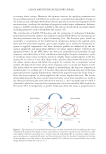
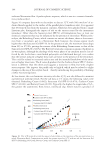
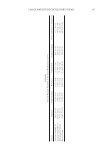
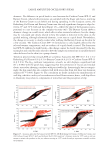
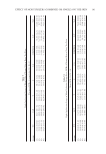
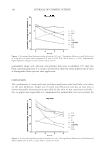
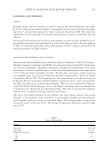
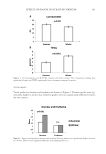
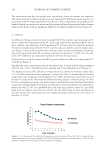
JOURNAL OF COSMETIC SCIENCE 132 rate), as well as the trajectory of loops at subsequent strains (or shear rates). Dynamic frequency sweeps were done to assess the time-dependent behavior of each formulation— where time dependence is related to the intrinsic relaxation behavior of the composite sample. Frequency sweeps in the LVR were compared to those commenced at 50 rad/s, which, in combination with larger strain amplitudes, results in large increases in the os- cillatory shear rate. Unless specifi cally mentioned, the rheological outcomes relate to 25°C, smooth surface data. The Sunscreen Gel SPF-50. It is an alcohol-based sunscreen gel that is thickened with lightly crosslinked poly(vinyl pyrrolidone) and packaged as a pump. Standard rheology shows that the Sunscreen Gel SPF-50 exhibits an apparent yield stress (14 ± 1 Pa) and shows slight thixotropy after yield, as evidenced by steady torsional and preshear and recovery experiments with both sandpaper and smooth surfaces. The smooth surface results differ slightly with the sandpaper data, indicating the presence of minor wall slip (below γ = 2.5 s-1), which is visible only at very low stresses (τ0). The transient stress growth overshoot maximum was 239 and 206 Pa for the rough and smooth sur- faces, respectively, suggesting a slight wall slip/shear banding process. Using a marker to monitor the deformation, it was diffi cult to visualize wall slip however, it was clear that at postyield the sample begins to shear band, meaning that the sample volume fl ows in the gap, and that there is also a region near the center of the gap that fl ows at a higher shear rate than the bulk. Plotting the I2/I1 harmonic ratio in the dynamic strain sweep shows that I2/I1 decreases from 0.27 (0.25 s-1) to 0.01 (5.0 s-1). One pos- sibility is that yielding of the microstructure is somewhat random, temporarily form- ing blobs of gel in a matrix of structured fl uid, or that nonperiodic shear banding affects the low shear rate data. At 32°C isotherm, the I2/I1 harmonic ratio values ranged from 0.44 (0.25 s-1) to 0.02 (5.0 s-1) the uptick in I2/I1 at 32°C may be related to heterogeneous solvent evaporation (ethanol). At each isotherm, the I2/I1 ratio bottoms out at 0.008 before the end of the LVR. As indicated in Figure 3, the length of the LVR plateau at 32°C is not highly affected by dynamic shear rate. Post yield, I3/I1 increases monotonically for both 25° and 32°C isotherms. Further, once the gel yields, it readily fl ows at both low and high shear rates (which is mimicked in vivo). The ZSV and yield stress outcomes are not signifi cantly affected by temperature. At 1% strain, the fre- quency sweep data conveys that G’ G” over the entire tested frequency range, indicat- ing the stability of the physical network however, unlike the Refreshing Gel Cream, tan δ rises at higher frequency, demonstrating a shear rate dependence of the micro- structural strength. The Refreshing Gel Cream. It is an oil-in-water gel cream that is packaged as a pump. The standard rheology suggests the presence of minor wall slip (see below), along with the possibility of plug fl ow (i.e., the system moves as a discontinuous domain), which may exist before complete yielding (τ0 = 66 ± 3 Pa). Observations with a marker did not reveal the presence of slip at the edge, but it is probable that the cohesive sample plug fl ows at lower shear rates, especially below the yield stress (as noted in dispensing product from its pump chassis). The transient stress growth overshoot maximum was 294 Pa for rough and 271 Pa for smooth discs, suggesting a slight wall slip or plug fl ow contribution. Plotting the I2/I1 harmonic ratio and the dynamic strain sweep shows that the ratio decreases from 0.14 (0.25 s-1) to 0.005 (5 s-1) the spike in I2,4/I1 suggests the presence of fl ow asymmetry at very low shear rates—which may be indicative of the cohesive nature of the Refreshing Gel Cream below yield. At each isotherm, near the end of the LVR and the

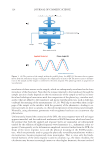
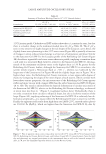
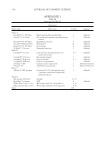
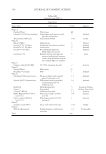
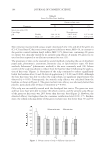
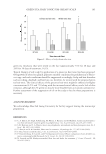
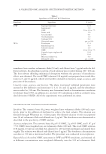
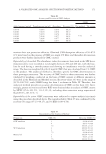
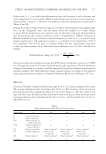
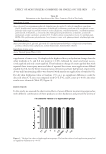
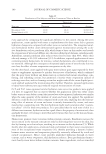
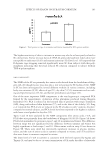
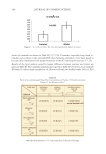
LARGE AMPLITUDE OSCILLATORY SHEAR 133 onset of the apparent yield stress (peak in elastic stress), I3 and I5 steadily rise. There is also evidence of very minor thixotropy, with a slight downward trend in stress as a func- tion of time in steady torsional experiments (with and without sandpaper). Figure 3 also shows that the intrinsic cohesiveness of the Refreshing Gel Cream might infl uence the tan δ values and LVR plateau, where both values suggest the presence of a stable micro- structure hence, considering all minor effects, the rheological changes affecting sensorial appeal for the Refreshing Gel Cream are almost certainly related to direct changes in the dynamically shearing microstructure. Evidence of the microstructural stability in the LVR is visible in the frequency sweep data, which show that G’:G” 10:1 and that G’ and G” are essentially parallel across the tested frequency range. The Buttery Cream. It is provided in a jar, meaning that the user retrieves the product, more than likely, with the fi ngers. As the surface of fi ngers and skin are typically warmer than ambient conditions, the impact of temperature on the sensorial experience is critical. The apparent yield stress, as judged by stress sweep methodology, was τ0 = 92 ± 6 Pa. Standard rheological methods for evaluating thixotropy (preshear and recovery, steady torsional) showed a decrease in viscosity as a function of steady shear rate, taking more than 5 min to recover from preshearing. By using a marker, it was shown that the sample plug fl ows at 25°C, meaning that the sample slips at both walls of the discs instead of uniformly deforming hence, the total stress plateaus because the energy of the motor is no longer fully translated to the entirety of the sample. The transient stress growth over- shoot maximum at 25°C was 1560 Pa (highest magnitude of all four prototypes) for rough and 1006 Pa for smooth discs (±10 Pa), corroborating the manifestation of plug fl ow. Steady torsional data from smooth and rough surfaces also showed that wall slip is present at low shear rates. Because low shear rates correspond to very initial spreadabil- ity, cushion evaluation, etc., slip layers are important factors in correlating rheology with sensory perception. At 25°C, the I2/I1 harmonic ratio also suggests some small asymmetric fl ow at oscillatory shear rates less than 4 s-1. Below yield, the small asym- metric contributions from the even harmonics may be indicative of the formation of a smooth and consistent slip layer. Figure 3. Summary of selected standard rheological results (smooth surface). SR = stress ramp result End LVR (%) = approximated with intersecting lines method.
Purchased for the exclusive use of nofirst nolast (unknown)
From: SCC Media Library & Resource Center (library.scconline.org)