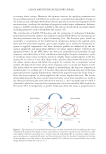
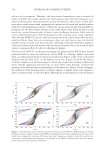
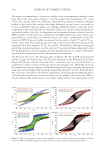
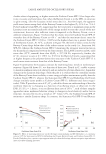
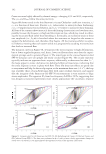
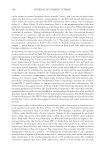
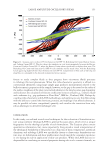
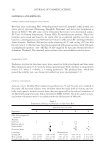
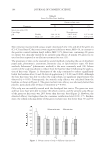
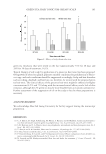
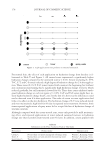
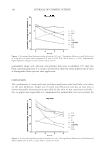
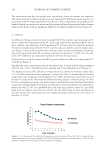
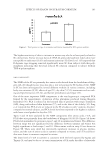
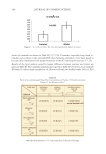
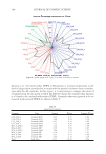
JOURNAL OF COSMETIC SCIENCE 144 indicates Newtonian fl ow. A perfect plastic response, which is rare in a cosmetic formula- tion, produces ϕ = 1. Figure 10 compares data with no electrolyte to data at 32°C with 500 nmol/cm2 of so- dium chloride applied to the surface of the parallel plate (transducer side). It is apparent that σ versus ϕ data from the Lissajous contours, which has been plucked from a single Lissajous plot, distinguish the impact of salt on the stresses sensed by the instrument transducer. Other than the Sunscreen Gel SPF-50, all formulations have at least one chemical component that may be infl uenced by the presence of electrolyte. Without elec- trolyte, the Refreshing Cream, which contains an anionic thickener, shows a slow transi- tion from a viscoelastic gel to a Newtonian fl uid however, the stresses appear much higher than the Sunscreen Gel SPF-50. In the presence of salt, the maximum stress drops from 463 to 279 Pa, putting the stresses of the Refreshing Cream nearer to that of the Sunscreen Gel SPF-50 (242 Pa). The Buttery Cream also contains an anionic thickener in its water phase although the rheology of the water phase of an emulsion may be less af- fected by salt levels than a cross-linked polyacrylic acid thickened hair gel, it is evident that the stresses induced at higher shear rates are lower in the presence of the electrolyte. This could be related to increased surface area and the intended breakdown of the emul- sion at higher shear rates. The σ versus ϕ gradient for the Cushion Cream SPF-15 formu- lation is different than the others and suggests a transition to fl ow, but with a higher stress response. Salt impacts the profi le only at high ϕ, which may be related to slight changes in the size of the acrylate beads—thereby introducing the possibility of forming a lower viscosity slip layer. At low strains, the even harmonic intensity salt data (I2/I1) was also followed to monitor asymmetrical wall-slip trends. For the salt data at 1% strain, the following values were obtained: Refreshing Cream (0.082) Sunscreen Gel SPF-50 (0.070) Cushion Cream SPF-15 (0.043) and Buttery Cream (0.022). Typically, the higher the magnitude of I2/I1, the greater the asymmetric fl ow hence, interfacial slip, which may be a product of Figure 10. Plot of σ versus ϕ to view the impact of electrolyte on the transition of the microstructure to a nearly Newtonian fl uid. Comparisons are made for systems tested at 32°C with no salt for Sunscreen Gel SPF-50, Refreshing Gel Cream, Buttery Cream, and Cushion Cream SPF-15.

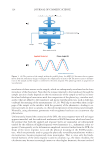
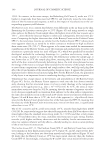
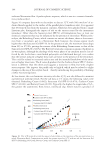
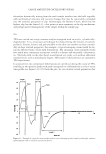
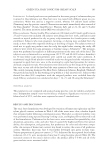
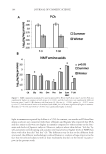
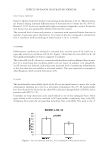
LARGE AMPLITUDE OSCILLATORY SHEAR 145 electrolyte dynamically mixing from the steel–sample interface into the bulk, arguably adds asymmetrical structure and viscosity changes that may be conceivably comingled into the sensorial perception of slip. Interestingly, the Buttery Cream, which has the highest slip, has the lowest I2/I1—this points to more symmetry in the slip mechanism, and perhaps greater homogeneity of the sample within the sample gap. TPA TPA was carried out using a texture analyzer equipped with an acrylic, cylindrically- shaped probe. It is a very practical technique for characterizing the textures of cosmetic products. Creams, lotions, and gels available in the skin-care market can vary consider- ably in their textural properties. For example, a typical antiaging cream would be dis- tinctly different from a body milk formulation. The antiaging cream normally would have much more consistency or structure as well as a distinct rub-out profi le, cohesiveness, etc. The body milk, on the other hand, would spread very easily, even without additional external forces, such as spreading by fi ngers. These types of characteristics are captured in TPA experiments. In a typical test, two compressive deformations are carried out during the course of TPA, resulting in two positive peaks (each peak corresponds to a deformation) in a force versus time profi le (see Figure 11) (22). From the plot, we can calculate several parameters that Figure 11. Example of a typical texture profi le analysis curve denoting specifi c length, peak height, and area measurements used to calculate textural attributes.
Purchased for the exclusive use of nofirst nolast (unknown)
From: SCC Media Library & Resource Center (library.scconline.org)