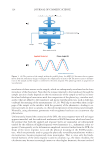
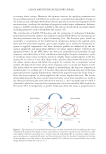
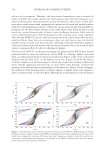
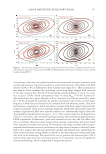
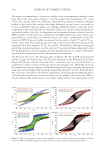
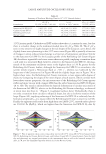
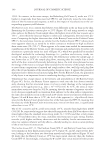
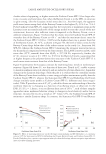
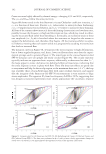
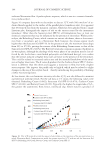
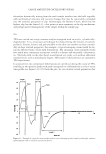
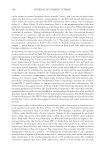
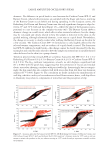
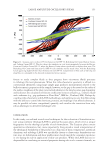
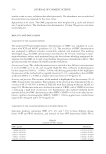
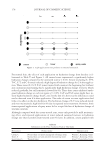
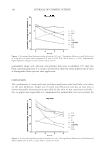
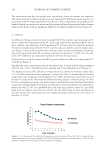
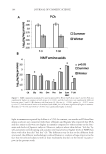
JOURNAL OF COSMETIC SCIENCE 142 Cream are more highly affected by thermal energy—changing 43% and 40%, respectively. The e3/e1 and σ’max follow the same proclivity. Figure 8B shows trends in the third harmonic viscous Chebyshev coeffi cient intensity, v3/ v1, as a function of shear rate. Positive v3/v1 values relate to intracycle shear thickening v3/v1 = 0 implies linear viscous behavior, and v3/v1 0 relates to intracycle shear thinning. All four of the textures show intracycle shear thickening characteristics at low shear rates, possibly because the frequency is high and the strains are low, which may result in vibrat- ing the structured fl uid rather than shredding it. Eventually, an oscillation strain or shear rate amplitude (i.e., λ0⋅ω) is breached where the structure no longer has the means to support the deformation, and, therefore, fl ow begins. All four textures exhibit viscoplas- tic behavior, meaning that each system yields to a progressively cascading microstructure that leads to increased fl ow. The Lissajous curves in Figure 9A–D represent the stress response to high deformation, but at lower angular frequency, and, hence, lower oscillatory shear rates than the experi- mental settings used to generate Figure 4. The inner loops in the viscous Sunscreen Gel SPF-50 Lissajous curve are upright and nearly circular (Figure 9A). The circular trajectory typically indicates an apparent elastic response additionally, at shear rates less than 1 s-1, the loops appear to rotate clockwise into deformed elliptical trajectories, indicating that the stress response is more in phase with fl ow. These low shear rate effects are partly due to very minor wall slip. In the no-slip region, at the maximum shear rate (~4 s-1), the loop tips resemble those of near-Newtonian fl ow with some residual elasticity, and suggest that the integrity of the Sunscreen Gel-SPF-50 microstructure is very sensitive to large strain amplitudes. The apparent σ’0 from low-frequency LAOS is 29 Pa, suggesting that low-frequency transient experiments more closely approximate the viscoelastic response Figure 9. Lissajous plots for (A) Sunscreen Gel SPF-50, (B) Refreshing Gel Cream, (C) Buttery Cream, and (D) Cushion Cream SPF-15. The data were performed at ω = 1 rad/s to more closely approximate changes in steady-state viscoelasticity. σ0 approximates the apparent location of the apparent yield stress.

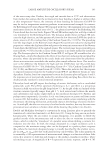
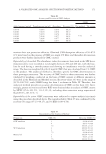
LARGE AMPLITUDE OSCILLATORY SHEAR 143 of the stress ramp data. Further, the rough and smooth data at 25°C and observations from marker data express that the inclination for shear banding is higher at ambient than at skin temperature—hence, the intensity of shear banding for Sunscreen Gel SPF-50 may be tied to temperature-sensitive gradients in microstructural strength. In contrast, the Refreshing Gel Cream (Figure 9B) responds with twice the maximum stress and with much more elasticity. At shear rates of 1 s-1, the physical network of the Refreshing Gel Cream bends but does not break. Figures 5B and 9B further imply that wall slip is indeed very minimal for the Refreshing Cream. The Lissajous profi le shown in Figure 9B indi- cates the high elasticity, and the apparent σ’0 from the low shear rate LAOS data (peak in elastic stress) is 93 Pa, rivaling that of the Cushion Cream (σ’0 = 102 Pa). The prevailing line-like loop shapes in the Buttery Cream (Figure 9C) system are indicative of plug fl ow properties—where the slip layers fl ow and protect the waxy microstructure of the Buttery Cream from the full brunt of the applied strains. The vertical inner loops eventually por- tray yield (σ’0 = 63 Pa), but the accuracy of the response is no doubt masked by interfacial slip. The Lissajous plot for the Cushion Cream SPF-15 in Figure 9D resembles that of a fl owing fl uid—clearly this illustrates the effects of low shear rates inducing slip and plug fl ow processes, where slip provided by the acrylic beads and cohesiveness from the polymeric- driven microstructure overwhelm the weaker plate-sample adhesion forces. One trend to note is the difference (Δ) between the high and low LAOS shear rate (σ’0) yield data: Sunscreen Gel SPF-50 (Δ = 7 Pa), Refreshing Cream (Δ = 7 Pa), Cushion Cream SPF-15 (Δ = 24 Pa), and Buttery Cream Cream (Δ = 23 Pa). These data indicate that the response to imposed transient strain for the Cushion Cream SPF-15 and Buttery Cream are time dependent. Further, based on comparisons between the Lissajous plots in Figures 4 and 9, the responses are at least partially masked by interfacial slip and plug fl ow effects that no doubt partially translate to initial sensorial properties. Electrolyte levels and pH impact the rheology of anionic thickeners, such as crosslinked poly(acrylic acid). The pH for optimum thickening is 6–7, and there is a precipitous decrease in bulk viscosity as the pH drops below 5.5. As the pH of the acid mantle of the stratum corneum typically ranges from pH 4–5, local interactions between the mantle and carboxylates may induce slight shifts in the interfacial rheology (19). Further, and perhaps more importantly, electrolyte levels vary from person to person and from season to season (20). Salt melting, which is caused by water-soluble cations interfering with the electrostatic thickening mechanism, profoundly impacts the rheology of anionic thicken- ers. As with pH, the effect on viscosity is localized at the interface, but may become more pronounced as an emulsion is broken down while shearing the product into the skin. Ewoldt and McKinley developed a convention for using Lissajous plots to quantify the transition of a structured material to its fl ow state (21). Using the loop area in an elastic Lissajous plot, where the area relates to energy dissipation, it is possible to follow the gradual cascade of the microstructure and to relate the data to variations in measured stress—which is what the “transducer” of a panelist senses when rubbing a cosmetic for- mulation into the skin. In brief, the energy dissipated in a single oscillation cycle is compared to the maximum energy that can be dissipated in a perfect plastic response (ϕ)—where the maximum dissipated energy is visually described by the smallest rectan- gle (in a σmax vs. γmax plot) that each Lissajous loop can fi t within. The scalar quantity, ϕ, is essentially a 2-D representation of microstructural changes as a function of shear. Like stress, ϕ is sensitive to wall slip and changes at the product–transducer interface, where salt melting occurs. A magnitude of ϕ = 0 represents an elastic response, and ϕ = 0.785
Purchased for the exclusive use of nofirst nolast (unknown)
From: SCC Media Library & Resource Center (library.scconline.org)