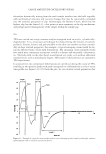
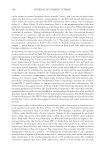
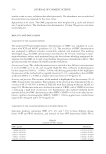
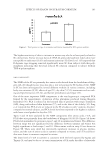
JOURNAL OF COSMETIC SCIENCE 150 The initial tactile perception of the Refreshing Gel Cream is a “cool to touch” sensation. Pressing down with the index fi nger, it was noted that the product is adaptable and easy to manipulate. There is a slight cushion that is similar to that of Sunscreen Gel SPF-50. During rub-in, there is a perceptible quick break. It should be noted that quick break processes are usually observed due to a dramatic change in feel that is associated with a discernible variation in the structure of the product, resulting in a cooling effect (rapid water evaporation), or change in physical state from a semisolid to a lower viscosity liq- uid. In the case of the Refreshing Gel Cream, a cream gel to liquid phase transition is the sensorial cue. It should be noted that shearing between two plates does not instigate the cream to liquid transition—factors from the skin surface appear critical to the perceived spreading rheology. The initial perception of the Buttery Cream is that it has discernible viscous resistance. It is very matte, indicating that it has a dry feel. It does, however, start to thin with contin- ued rubbing and thinning of the fi lm, which is a gradual process and not noted as an abrupt collapse of structure. As mentioned below, this is probably why the Buttery Cream is ranked fairly low on quick break. It has a viscous characteristic during rubbing, which is distinct from the Refreshing Gel Cream (lighter feel) and Sunscreen Gel SPF-50 (the lightest feel). The Buttery Cream is a wax-based structure, therefore, there is no sustained cushion. Usually waxy structures require greater preliminary forces to break down the structure, but then they transition quickly to a fl uid—especially if melting transitions are encountered. This phenomenon is clearly evident if one examines the Lissajous plot shown in Figure 4C, which undergoes a more drastic shape change than the other products ex- amined. As with the Refreshing Cream, the skin surface environment conspicuously im- pacts the rheological outcome. The Cushion Cream is best characterized as slightly elastic with some pickup when the index fi nger is forced downward on the product and then retracted. It maintains its shape when placed on the skin, thereby illustrating its robust microstructure. It is a thick treat- ment with more fl ow-resistance characteristics than the other samples. The initial feel characteristics reveal a large viscous component as the product thins, while during the secondary and fi nal rub-in, a powder-like texture is experienced. There is no quick break, and the product absorbs into the skin rather quickly. Also, there is no tack, and the rich formula remains very dry throughout the sensorial test. The texture of the Cushion Cream is based on a hybrid polymer and wax structure however, the polymer is the dominant structuring agent. In general, cushion is related to elasticity and fl exibility, properties common in polymers. Waxes, on the other hand, are crystalline, less tough, and require greater initial forces to manipulate form. Comparing the sensorial and rheology data, we can make several conclusions about the relationship between these two data sets. The mean quick break sensorial data ranks as follows: Refreshing Gel Cream (5.4 ± 0.6) Sunscreen Gel SPF-50 (2.4 ± 0.9) Buttery Cream (1.3 ± 0.5) = Cushion Cream SPF-15 (1.3 ± 0.5). As already mentioned, quick break is a parameter related to the early perception of a change in structure. As judged by τ0, ZSV, σ’max, and the trends in Figures 5 and 9, the Sunscreen Gel SPF-50 has the soft- est microstructure. The soft microstructure potentially masks dramatic changes as the sample is spread onto the skin. The Refreshing Cream, on the other hand, has a rather cohesive structure, even though it is softer than the Buttery Cream and Cushion Cream SPF-15 however, the Refreshing Gel Cream is sensitive to the chemistry of the skin sur- face and appears to melt when sheared. The transition from a cohesive soft solid to fl ow is

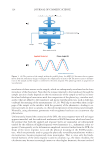
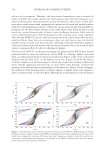
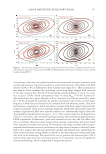
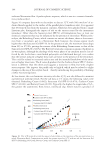
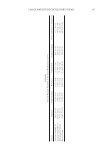
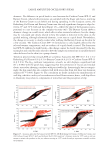
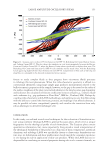
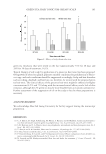
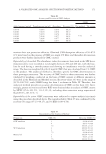
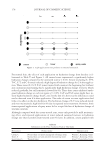
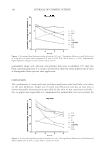
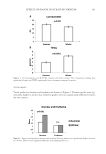
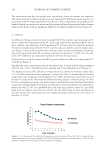
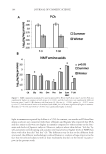
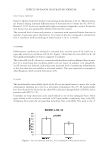
LARGE AMPLITUDE OSCILLATORY SHEAR 151 dramatic. No difference in quick break is seen between the Cushion Cream SPF-15 and Buttery Cream, where both prototypes are sampled with the fi nger and, hence, warming of the Buttery Cream occurs before and during spreading. In the Lissajous curves, the Refreshing Gel Cream and Buttery Cream own the only signifi cant changes in slope be- tween 25° and 32°C with salt data (Figure 13)—where the slope of the Lissajous is pro- portional to a net decrease in the complex viscosity (η*). The Buttery Cream shows a dramatic change in overall stress, which affects other sensorial attributes, but the change may be very rapid and closely related to how the sample is delivered to the skin or, the gradual melting, although ultimately dramatic, is not seen as a quick break. Nevertheless, the change in viscosity is clearly evident after rubbing the Buttery Cream on the skin for a few seconds. The Cushion Cream SPF-15 formulation is only slightly affected by the salt and warmer temperature, and no evidence of a quick break is noted. The Sunscreen Gel SPF-50 exhibited a slight break—this change cannot be clearly discerned by the Lis- sajous plot and could be more related to how the sample microstructure is initially sheared when delivered to the skin (via a pump chassis). Trends in perceived slip versus LAOS are as follows: Sunscreen Gel SPF-50 (7.6 ± 1.3) Refreshing Gel Cream (6.6 ± 0.5) Buttery Cream (4.8 ± 0.5) Cushion Cream SPF-15 (4.6 ± 0.9). The σmax (ambient temperature, smooth, no salt) displays a signifi cant link (R2 = 0.992) with the panel data, suggesting that the summation of viscous and residual elastic stress after shearing correlates with perceivable slip. Interestingly, but not surpris- ingly, the slip panel data also correlate well with stress data from low shear rate Lissajous analyses (R2 = 0.905 Figure 9). The correlation no doubt includes the manifestation of wall slip, which is a reality at lower shear rates for all four textures hence, wall slip effects in rheometry may relate to components of initial feel and the perception of slip. Figure 13. Lissajous plots for (A) Sunscreen Gel SPF-50, (B) Refreshing Gel Cream, (C) Buttery Cream, and (D) Cushion Cream SPF-15 with and without NaCl (500 nmol/cm2). Systems tested at 25°C and no salt are meant to mimic the product in the jar, whereas testing at 32°C with electrolyte represents a model on-skin environment.
Purchased for the exclusive use of nofirst nolast (unknown)
From: SCC Media Library & Resource Center (library.scconline.org)