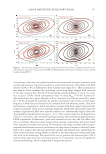
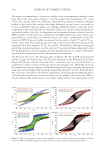
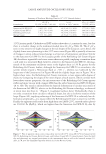
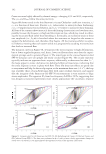
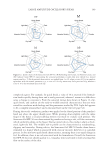
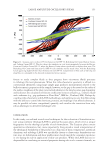
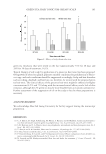
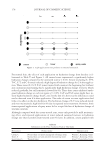
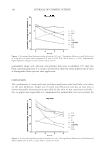
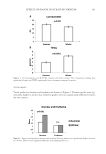
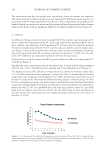
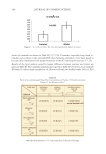
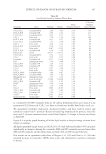
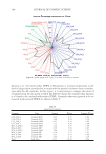
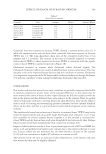
JOURNAL OF COSMETIC SCIENCE 152 Cushion is ranked sensorially in the following order: Cushion Cream SPF-15 (6.4 ± 1.3) Sunscreen Gel SPF-50 (5.2 ± 0.5) = Buttery Cream (5.2 ± 0.5) Refreshing Gel Cream (3.6 ± 0.6). After removing Sunscreen Gel SPF-50 from the array of textures, it is evident that the cushion characteristic correlates with ZSV (R2 = 0.974), and steady torsional with rough surfaces (R2 = 0.995). From the LAOS data, the cushion data correlate well with the stress data at 32°C and salt (R2 = 0.958), but less so with the 25°C no salt data (R2 = 0.783). In low shear rate LAOS testing (maximum 4 s-1) with no salt, the shapes of the Lissajous plots were very different, and so were the stress maxima. The stress maxima data correlated well (R2 = 0.994) with the cushion data for Refreshing Gel Cream, Buttery Cream, and Cushion Cream SPF-15. In the fi nal analysis, the TPA and rheology data did not correlate well with the expert panel’s cushion data for the Sunscreen Gel SPF-50 formulation. Light feel appears to be a more complex parameter as it is confounded by mid-to-late rub- out parameters markers such as dry time, play time, and tribology could have an infl uence on the perceived texture. However, although correlation of ratings with LAOS and stan- dard rheology was scattered, it appears that the impact of the formulation with the in-vivo skin environment infl uenced the light-feel ratings for the Refreshing Cream. More intriguing is the perception of the Cushion Cream SPF-15, which has a high resistance to spreading at fi rst, but becomes powdery and dry as the emulsion breaks and components vaporize and wick into the stratum corneum. All said, the overall sensorial rating for light feel appears to point to perceived mid-to-late feel properties of the Cushion Cream SPF-15. Finally, the Sunscreen Gel SPF-50 and Buttery Cream are perceived as having the same light feel properties—evidently these are rated in the mid-to-late spreadability zone, after the Buttery Cream melts and interacts with skin surface electrolyte. The Sunscreen Gel SPF-50 is oily and has a long play time, giving ample time to rate its average resistance to spreading. In summary, the sensorial data correlate with changes that are observed in the Lissajous plots as well as in the magnitudes of other rheological parameters. Rheological analyses, while very instructive for examining the perceived intensities of textures, do not allow differentiation in emotional or hedonic ratings, such as acceptability, color, odor, shine, cooling/warming, moistness, or matte effects further, fi ne morphological properties of texture, including grittiness, smoothness, and graininess, are not well suited to rheologi- cal discrimination. Instead, rheology best correlates with the kinesthetic sensitivity of the muscles in the skin as the microstructure and/or viscosity of a product changes as a func- tion of applied shear (23). Additionally, LAOS testing brings us much closer to the picto- rial evaluation of a number of textural attributes that traditionally could only be monitored by expert panels, or estimated by a bevy of instrumental outcomes. For ex- ample, overlaying Lissajous plots of the four prototypes and qualitatively observing rela- tive stress trends in the loop trajectories facilitate a cursory appraisal of textural properties, including cushion, spreadability, elasticity, stress dissipation, and viscosity (Figure 14). Ultimately, most traditional rheological data confer abstruse information about a single point in rheological time in contrast, the Lissajous curve can be imagined as an unpretentious textural fi ngerprint that in one glance conveys a rheological snapshot of a formulation as its microstructure viscoelastically adapts to the infl uence of increasing shear strains. NEXT STEPS: TRIBO-RHEOMETRY Although outside the scope of this work, which focuses on correlating elastoviscoplastic rheological transitions, Kavehpour and McKinley (24) describe a novel triborheometry

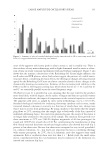
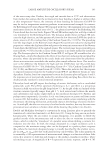
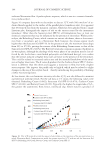
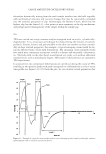
LARGE AMPLITUDE OSCILLATORY SHEAR 153 fi xture to study complex fl uids as they progress from viscometry (fl uid) processes to tribology (friction) phenomena. When this tribo-rheometric geometry is affi xed to a conventional rheometer, using large sample gaps produces measurements related to the bulk viscometric properties of the sample however, as the gap is decreased to the order of the surface roughness of the plate (or attached substrate), the data becomes gap dependent and facilitates the calculation of friction coeffi cients between a fl uid (e.g., cosmetic fl uid) and a substrate (e.g., pig epidermis or Vitro-Skin®, IMS Inc., Portland, MA). Perhaps by coupling tribo-rheometry with LAOS methodology, and applying to very thin fi lms along with the ability to control the chemistry, porosity, and topology of an affi xed substrate, it may be possible to better comprehend, quantify, and visualize the transition from early rub-in (rheology) to after-feel (tribology) (24). CONCLUSION In this study, we outlined several novel techniques for the evaluation of formulation tex- ture using nonlinear rheology (LAOS) to generate Lissajous plots, which serve as unique fi ngerprints for the rheological profi le of each formulation. The Lissajous plots contain quantitative information, but, more importantly, they provide a visual interpretation of the rheological breakdown of the products as a function of shear, temperature, interfacial chemistry, and tribology. LAOS was specifi cally chosen to characterize formulation tex- ture since its deformation and shear profi les most closely match the consumer experience in vivo during the rub-in application of skin-care products. While the LAOS data are in- dispensable for correlating to sensorial properties during rub-in of a cosmetic formula, we Figure 14. Lissajous curve overlay (25°C) for Sunscreen Gel SPF-50, Refreshing Gel Cream, Buttery Cream, and Cushion Cream SPF-15. The plot shows the similarity in total stress magnitude between the Buttery Cream and Cushion Cream SPF-15, where the Buttery Cream softens signifi cantly at higher shear rates. The Refreshing Gel Cream and Sunscreen Gel SPF-50 scale similarly and are much softer, with the Refreshing Cream appearing slightly fi rmer than the Sunscreen Gel SPF-50. Complexities in fl ow, such as wall slip and plug fl ow, are comingled in the depicted instrumental stress response.
Purchased for the exclusive use of nofirst nolast (unknown)
From: SCC Media Library & Resource Center (library.scconline.org)