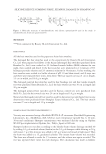
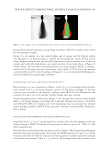
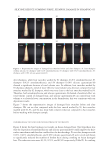
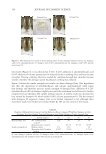
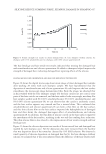
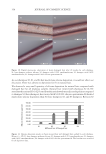
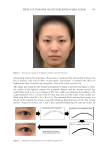
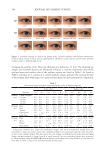
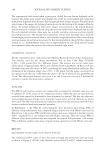
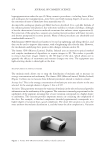
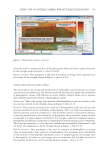
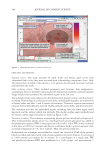
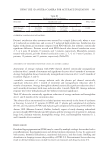
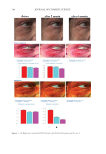
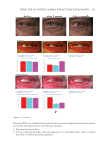
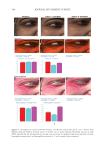
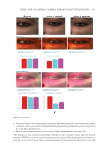
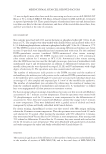
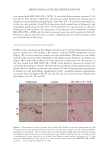
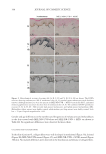
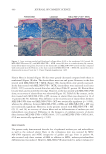
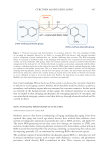
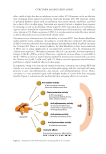
349 Silicone Reduce Combing Force, Flyaway, Damage in Shampoo change before and after shampoo using Image J software. Three hair swatches were tested for each shampoo sample. Figure 2 is an example of a hair swatch photo and its image used for flyaway control test. Breugnot et al. had developed a method for measuring the volume of hair swatch using computer software that separated the high-density and low-density areas of the hair swatch, and called the high-density area (green portion in the right image of Figure 2) “bulk volume,” the low-density area (red portion in the right image of Figure 2) “flyaway,” and the area of the green plus the red portions “total volume” (12). In this study, we used a similar method and the same wording as Breugnot et al., and calculated the flyaway area and total volume area using Image J software. HAIR BREAKAGE TEST AND HAIR TENSILE STRENGTH TEST*** Hair breakage test was conducted as follows: 1) the 10 g, 30 cm damaged hair swatches were treated with 1 g of testing shampoo, rinsed off and dried overnight 2) the hair swatches were mounted on the dynamic combing tester SK-7A (Techno Hashimoto) and combed 100 times and 3) the number of fallen broken hairs was counted. Tensile strength test was conducted as follows: 1) the damaged hair swatches were washed with 1 g of testing shampoo and rinsed off 2) the hair swatches were kept at 20oC±5oC and 65%±10% RH for 24 hours and 3) the maximum load was measured at the hair tensile breakage point by AGS-X Series electronic universal testing machine (Shimadzu, Kyoto, Japan). DIGITAL MICROSCOPE OBSERVATION AND SILICONE DEPOSITION TEST Single fiber from 2 x 1 g, 27 cm damaged hair swatches after 28-time shampoo wash was observed using a VHX-7100 (Keyence Corporation of America, Itasca, IL, USA) at 1,000 times magnification. Hair swatches used for deposition test were treated as follows: All the natural and damaged Asian hair swatches were previously cleansed by 10% SLES solution at 0.6 g per 2 x 1 g hair swatches and rinsed off. One set of natural and damaged hair swatches was dried overnight for baseline measurement. Then 2 x 1 g natural and damaged Asian hair swatches were Figure 2. An example of a hair swatch photo and its image used for calculation for flyaway control test.

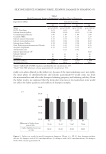
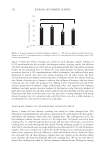
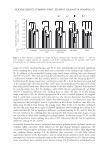
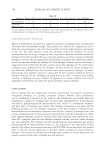
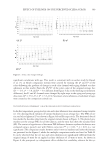
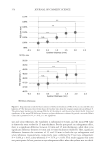
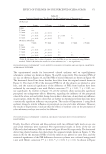
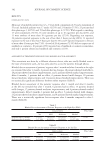
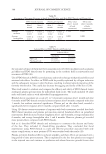
350 JOURNAL OF COSMETIC SCIENCE washed with 0.6 g shampoo samples, rinsed off, and dried overnight. Gloves were employed during shampooing, and the hair samples were carefully handled to avoid contamination. The baseline was extracted for all samples’ deposition data. The amount of silicone adsorbed by the hair was determined by Inductively Coupled Plasma Optical Emission Spectroscopy (ICP-OES) Spectrometers (AMETEK, Inc., Berwyn, PA, USA). The hair samples were cut and digested in 65% nitric acid and diluted with high purity water before the analysis. A working standard curve was made according to the National Institute of Standards and Technology standard, and the amount of silicon was calculated at a silicon-specific wavelength. The concentrations of silicones were derived from the amounts of silicon by multiplying with a factor from the calculation according to silicone molecular weight (factor for amodimethicone is 2.67 factor for silicone quaternium-18 is 3.38). As the factor for dimethicone (PDMS) is 2.64 (13), we think our calculation is right. HAIR SWATCH SENSORY TEST Damaged hair swatches weighing 2 x 1 g and measuring 27 cm were washed (with 0.6 g of shampoo) and dryer-dried 28 times to mimic consumer habits. Eight internal panelists performed the evaluation. RESULTS AND DISCUSSION SHAMPOO SAMPLE PREPARATION AND ITS BASIC PHYSICAL PROPERTY The model transparent shampoo samples are prepared as Table I. Microemulsions containing 0.21%, 0.42% amodimethicone and 0.18% silicone quanternium-18 were added to the formulation. The addition of 0.21% amodimethicone and 0.18% silicone quaternium-18 slightly reduced the viscosity of shampoo compared to the control without silicone however, the reduction was not significant. The addition of 0.42% amodimethicone reduced the shampoo viscosity significantly. The viscosity of shampoo was built by the packing of anionic surfactant micelle and supported by amphoteric surfactant, nonionic surfactant, and cationic polymer 0.42% amodimethicone added in the shampoo may cause the loose packing of the micelle. The addition of 0.21% amodimethicone didn’t affect the shampoo viscosity significantly, therefore by adjusting the quantity of amodimethicone, the viscosity reduction should be minimized. All the shampoo samples were very transparent, and the transmittance rates were very high, as shown in Table I. This result demonstrated our first hypothesis: both amodimethicone and silicone quanternium-18 were in a microemulsion state, the particle size was very small (less than 100 nm), and the microemulsions themselves were very transparent and stable, therefore once added to shampoo the overall transparency was not affected. Figure 3 shows shampoo lather test results. Addition of 0.21%, 0.42% amodimethicone, and 0.18% silicone quaternium-18 did not affect the lather quantity and stability compared to the base shampoo sample without silicone. Both amodimethicone and silicone quaternium-18 used here were microemulsions their particle size was less than 100 nm. We hypothesized that the particle size was too small to puncture the shampoo’s foam membrane, and the shampoo’s foaming ability and stability would hardly be affected. The results indicated this is the case. In addition, as both amodimethicone and silicone quaternium-18 were in the microemulsion state, it also demonstrated that both microemulsions were very
Purchased for the exclusive use of nofirst nolast (unknown)
From: SCC Media Library & Resource Center (library.scconline.org)