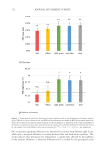
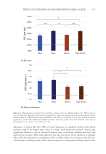
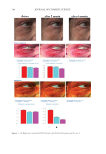
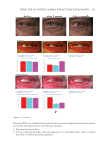
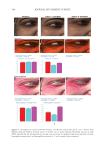
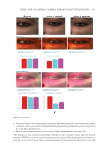
374 JOURNAL OF COSMETIC SCIENCE whitening effect. Additionally, this result suggests that the two influences on perception may be produced by different mechanisms. DISCUSSION As described in the experiments, an eyeliner has two illusory beautification effects: perceptual eye enlargement and sclera whitening, and these effects depend on the color of the eyeliner. Matsushita et al. studied the perceptual eye enlargement effect of eyeliner in detail (3). They concluded that the eye enlargement effect is likely a visual illusion of assimilation, in which the eye becomes assimilated to the eyeliner. The results of Experiment 1 support this idea the thicker black eyeliner made the eye area larger by assimilating the shadow of the eye contour. When the thickness of the eyeliner reached 2.0 mm, some participants could not feel the eye enlargement effect because it was too thick to assimilate with the contour of the eye. As a result, the mean PSE did not increase, and variability increased. As evident from the experimental results, the eye enlargement effect seems to be strongly affected by eyeliner color lighter colors used in Experiment 2 showed an approximately 2.0% eye enlargement effect, while darker colors used in Experiments 1 and 3 showed an approximately 4.0% eye enlargement effect. This indicates that the lightness of the eyeliner is difficult to assimilate if it is close to the shade of the eye contour. There may be a more complex perceptual mechanism behind the sclera whiteness perception. The results of Experiment 3 showed that the influence of perceptual sclera whiteness may be affected by chromaticity rather than lightness of the eyeliner. A comparison of Experiments 1 to 3 for the eye enlargement effect revealed that eyeliners with lower lightness tended to be more effective. This implies that there might be some kind of contrast illusion effect on the sclera color and the applied eyeliner color. However, the results of Experiment 1 indicated that the influence of perception is not a simple lightness contrast because the thickest eyeliner (2.0 mm) did not show a larger effect. If the influence on sclera whiteness perception is induced by the lightness contrast, the perceptual color change may be increased by an increase in the surrounding field size (8–11). A possible mechanism other than lightness contrast may be the effect induced by the boundary line, such as the Craik–O’Brien–Cornsweet effect (17). The test-field lightness is affected by the boundaries created by the on-off channel in the human vision system, and using eyeliners to clarify the outline of the eyes might work on this mechanism (18). However, as described in Experiment 3, there should be other perception mechanisms regarding the eyeliner chromaticity coordinates. The increase in perceptual sclera whiteness caused by blue eyeliners is considered color assimilation. Monnier and Shevell reported that surrounding rings alternating between two chromaticities produce a strong shift in the color appearance of the centered ring by an additive integration from the chromatic assimilation effect of the proximal rings and the chromatic contrast effect of the distant rings (19–20). The pupil, sclera, blue eye line, and surrounding skin may have created a similar pattern to this illusion. Herein, the comparison stimuli for perceptual sclera whiteness measurements were prepared by modulating the L* and b* channels of the sclera. Therefore, the assimilation of the blue channel signal to the sclera area should change the PSE toward white color. A survey of makeup technique articles on the web also showed that the most common makeup technique used to make the sclera look whiter was using navy eyeliners and

375 EFFECT OF EYELINER ON THE PERCEIVED SCLERA COLOR mascara (e.g., Japanese makeup technique websites only (21), surveyed by Google search in March 2020). The results of the experiments presented here support the empirical findings of makeup artists. However, the present study was only conducted on artificially generated facial images, i.e., the average face image with eye and makeup manipulation. The present results may differ from visual effects occurring on real faces, owing to the use of an average face. For example, high-frequency features such as hair and edges of facial features are not clear in facial images that undergo the averaging process. Therefore, in this test, the eye-contour–sharpening effects of the eyeliner may have been more pronounced than the actual facial phenomena. Additionally, the experimental results obtained by an average face only reflect the makeup effect for a single eyelid shape however, there is variation in Asian eyelid shape (22,23). A study on more realistic conditions, such as varied real facial images with real makeup, is required as the next step in this investigation. Additionally, final verification of the makeup effect should be conducted by assessing the face of real users, not a facial image on a monitor. The influence of perceptual sclera whiteness might be a cross-cultural cue for facial impressions. Porcheron et al. reported that the change in contrast between the eyes and the surrounding skin is a common sign of aging in Caucasian, Chinese, Latin American, and South African populations, and that facial contrast is a common cross-cultural cue for perceiving age (6). As reported in earlier studies, sclera color is an important factor of facial contrast (7,24). However, it has a limited influence on the attractiveness of one’s appearance, and more scientific studies on empirically known factors for visual impressions (e.g., estimated interpupillary distance, gaze duration, etc.) are necessary. Although the present study illustrates only a small part of the enormous changes caused by makeup, the accumulation of such research will support the effectiveness of already- developed makeup products based on a great deal of experience and will provide clues for developing more innovative makeup products. REFERENCES (1) R. Mulhern, G. Fieldman, T. Hussey, J. L. Lévêque, and P. Pineau, Do cosmetics enhance female Caucasian facial attractiveness?, Int. J. Cosmet. Sci. 25, 199–205 (2003). (2) R. C. E. Michael, Measuring the physical in physical attractiveness: quasi-experiments on the sociobiology of female facial beauty, J. Pers. Soc. Psychol. 50, 925–935 (1986). (3) S. Matsushita, K. Morikawa, and H. Yamanami, Measurement of eye size illusion caused by eyeliner, mascara, and eye shadow, J. Cosmet. Sci. 66, 161–174 (2014). (4) S. Ueda and T. Koyama, Influence of eye make-up on the perception of gaze direction, Int. J. Cosmet. Sci. 33, 514–518 (2011). (5) A. Porcheron, E. Mauger, and R. Russell, Aspects of facial contrast decrease with age and are cues for age perception, PLoS One, 8, e57985 (2013). (6) A. Porcheron, E. Mauger, F. Soppelsa, Y. Liu, L. Ge, O. Pascalis, R. Russell, and F. Morizot, Facial contrast is a cross-cultural cue for perceiving age, Front. Psychol. 8, 1208 (2017). (7) R. Russell, J. R. Sweda, A. Porcheron, and E. Mauger, Sclera color changes with age and is a cue for perceiving age, health, and beauty, Psychol. Aging 29, 626–635 (2014). (8) A. L. Diamond, Foveal simultaneous brightness contrast as a function of inducing-and test-field luminances, J. Exp. Psychol. 45, 304–314 (1953). (9) A. L. Diamond, Foveal simultaneous contrast as a function of inducing-field area, J. Exp. Psychol. 50, 144–152 (1955).
Purchased for the exclusive use of nofirst nolast (unknown)
From: SCC Media Library & Resource Center (library.scconline.org)