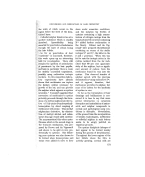
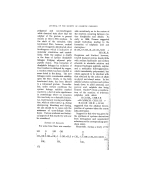
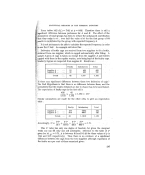
::E•::i!?Oxidation of d•thtod•glycollid acid in :•:i::i•alkahne soluhon, Schoberl and W•es- •'•:J•:•!•'?" nern isolated thioglycollic acid, oxalic ...... and hydrogen sulphide. On uantitative grounds they concluded a primary hydrolysis of the had occurred with forma- on of thioglycollic acid and a acid. Decomposition of sulphenic acid might then occur •n one of two ways ' .S.OH -- R.CH,.SH q- R. COOH + H•S R.CH,.S.OH- R.CHO + H,S 1933 onward SchSberl et al. the reaction of many disul- and in 1939 Sch6berl and i:Rambacher concluded that all cys- :i'tine derivatives are decomposed by •i::il (alkali into thioIs and sulphenic acids. i?/ Subsequent reactions might involve ?'?'i'iiberation of hydrogen sulphide from thiol, if labile, or from the sulphenic ii:.:!•acid to leave methylene and aide- hyde groups respectively. The sul- ?::!! Phenic acid 'might also give off sul- 'i.!!': i'phur leaving an alcohol. These reactions are summarised in the following equations: R.CH,.CH,.SH-- R.CH ß CH, + H•S -+ R. CH•.SH q- R.COOH q- H•S R.CH•.S.OH - R. CHO q- H•S R.CH•.S.OH - R.CH•.OH q- S Such a view explains the results of both the Bergmann and Sch6berl schools and throws considerable light on the action of alkalis on keratin. Earlier work by Marriott and by Speakman suggested that in the caõe of hair the secondary DISULPHIDES AND MERCAPTANS IN HAIR CHEMISTRY reactions taking place after the initial disulphide hydrolysis can, under certain conditions, give rise to the formation of new, stable linkages between the polypeptide chains. In a study of the effect of pH on this rebuilding, Stoves•', • showed that at 35 ø C. only a small number of new bonds are formed in hair treated for 24 hours with alkali at pH values less than 10'5. Above this pH, solutions give rise to sufficient rebuilding to prevent super- contration of the hair in boihng bisulphite solutions. This investiga- tion also clearly showed that the new linkages are of two types, one of which is stable to boihng for 4 hours in N/10 hydrochloric acid. The isolation of lanthionine •* HOOC.CH (NH •). CH •.S.CH •. CH (NH ,).COOH by acid hydrolysis of wool which had been boiled for an hour in 2 per cent sodium carbonate solution, estab- lished the presence of a sulphide linkage as the acid stable type, a possibility originally suggested by Speakman and Whewell? The mechanism of formation is 'not known, but in view of the observa- tion by Nicolet and Shinn •* that under the influence of alkali, serine may be converted to dehydroalanine which can react with benzyl mer- captan to give the compound C•H•.CH •.S.CH •.CH(NH •).COOH, it is possible that an alcohol residug formed by loss of sulphur from sulphenic acid, loses the elements of water to form combined amino- acrylic acid which combines with a_ thiol residue to give a sulphide linkage: 173,

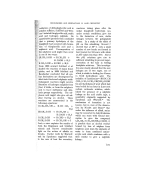
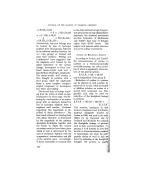
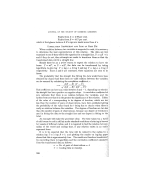
JOURNAL OF THE SOCIETY OF COSMETIC CHEMISTS CH.CH,.S.OH -+ S q- CH.CH •.OH -+ C: CH, q- H,O • . + HS.CH,.CH CH.CH,..S.CH,.CH • . Alternatively, the newAinkage•may be-formed by loss of hydrogen sulphide from thiol groups, followed by an addition reaction between the C: CH, groups so formed-and other thiol '. residues. Phillips and Cuthbertson" have suggested that the sulphenic acid, formed by.'the initial hydrolysis of' the cystine linkage, decomposes to form com- bined amino-acrylic acid and a hypothetical dihydrogen sulphoxide. The amino-acrylic acid.. residue is then thought to-combine .'with a thiol group, while the sulphoxide forms' a more complex inorganic sulphur compound, or decomposes into water and sulphur. ' The second type of linkage result- ing from the action of alkali. on hair is believed to be of the type -N:CH- arising by condensation of an amino group with. an aidehyde formed by loss of hydrogen sulphide from a sulphenic acid residue.. Evidence supporting this hypothesis is de- scribed'in detail elsewhere2' The final result obtained on treating hair with alkali, therefore, is determined by..the magnitude of the primary disulphide hydrolysis, together with the extent to which' the various secondary reactions have taken place which in turn'. is determined by the time of treatment, together with the temperature• concentration and pH of the solution used. Accordingly, it seems reasonable to conclude that in the older methods of high tempera- ture permahent waving using alkaline assistants, the. chemical mechanism involves'formation of lanthionine and Schiff's base type of linkages rather than '-SNIt-'. bonds. This subject is at present Under examina- tion in the author's laboratory. "ACTION OF REDUCING AGENTS According to Fruton and Clarke •s the interconversion of 'cystine to cysteine is a thermodynamically reversible process, the' redox poten- tial of which is apparently character, istic of the general system- . R.S.S.R. q- 2H -+ 2R. SH and is independent if the group R. •'Redu.ction' of cystine .to. cYsteine can be effected in acid solution by means of tin or zinc, while in neutral or alkaline solution an excess of second thiol compound, 'e.g., glyc011i•' acid, may be used •eduction of •he"disu•phide'linkage in. proteins' ' ' •.' . R.S.S.R. q- 2R'SH-- 2R.SH q- This reaction, analogous .to that?i between thiophenol and 2-2'dinitrø'::•i diphenyl disulphide studied Lecher in 1920, was used in the earl?½i• 1930's by du Vigneaud and bY!i Goddard and Michaelis for reducingl the disulphide linkage of proteinS:i such as hair, wool and feathers. In: passing it is of interest. to n6te that , o .... kerahn •s charactenstmally res•stan.,•.•i to enzymolysis, but when the polyX i • peptide chains' of. wool or hair freed by'reduction of the disulpkid! linkages,- the.' protein is. rapidl•
Purchased for the exclusive use of nofirst nolast (unknown)
From: SCC Media Library & Resource Center (library.scconline.org)