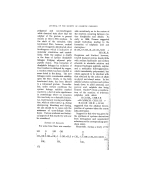
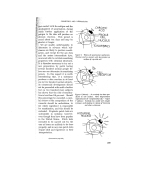
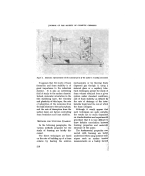
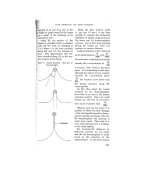
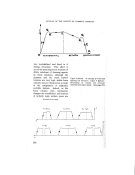
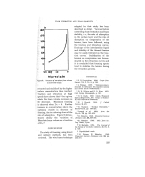
FOAI•I FORMATION AND FOAM STABILITY 2000' The height of the lamina ß creases and reached a maximum M 22 mm. at •, after which a further in concentration decreases height of the lamina. Using Na a very small lamina obtained at M At higher con- i•:. 600 !!centration the lamina increases in height, reaching a maximum value •,•? of 16'6 mm. at . At the same time • •,the traction •urves show that the' •'i•?tension rises as the lamina extends. •"i]i:!11. Traction curves studies at low i'.i:•:•!: :and at high speeds on Na oleate and •? Na laurylsulphat. e lead to the con- • i.clusion that both reagents give rise ?: to extensive foaming over a definite •)::!: concentration range ' •}•:'. 2000 100 :•:::: ':ilfør Na oleate, M M for Na 600'100 ,::i laurylsulphate. ?•:. At concentrations higher than 100 ' : the volume of the foam decreases, . presumably due to an increase in the viscosity of the solution which slows ß :. down the rate of adsorptior• of the molecules from the bulk phase to the surface layer. Furthermore, traction curve ex- periments at low speeds demonstrate that the Na oleate foams are much more stable to drainage and thin- ning than those of the alkylsulphate. Retraction at High Speeds The retraction curve is obtained when a lamina is returned back to the liquid surface before its maximum extension. This is carried out by reversing the movement of . the liquid surface so that the frame immerses in the bulk of the solution. Retraction permits the study in further detail of the properties of the surface layer. Photographic recording shows that the lamina may either behave reversibly or irreversibly. • In most cases, how- ever, an irreversible behaviour is observed, the tension being markedly lowered as a result of the retraction (see _Figure 6). The tension recorded' in R• is markedly logrer than in R. Using alkylnaphthalene su/phonate • • the drop in tension ¾• -- ¾•, = D¾ may easily reach 15 to 20 dynes per cm. for the most dilute systems. As' the concentration of the solute increases, D• decreases and tends to become zero. Tiffs is observed with Na oleate, for example, when the con- centration is equal to or higher than M Over this range the surface 100 behaves reversibly on traction and retraction, as shown in Figure 7, the tension of the laminee remaining constant, since the 'solution has reached its maximum surface pressure. ' Dx is high when the adsorbed molecules on the lamina do not easily desorb from the surface layer. Thus, on retraction, the surface concentration increases and conse- quen. tly the surface tension is lowered. It appears that irreversibility is caused by the fact that the molecules present in the surface layer are in a 223

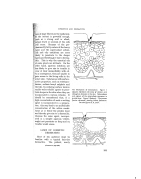
JOURNAL OF THE SOCIETY OF COSMETIC CHEMISTS way insolubilised and fixed in it during retraction. This effect is one of the most important features of dilute solutions of foaming agents. In these solutions, although the dynamic and the static surface tensions are very high, stable foam columns may be obtained as a result of the compression of originally unstable lamin•e. Indeed, a• the foam column rises, mechanical changes are established, and lamime of initially large surface areas are Figure 6 (above) ß An example ol • irreversible behaviour on retraction. Figure 7 (below): Reversibility on traction and retraction exhibited with sodium aleate. (See page 223:) 224 (Continued on next page)
Purchased for the exclusive use of nofirst nolast (unknown)
From: SCC Media Library & Resource Center (library.scconline.org)