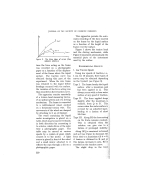
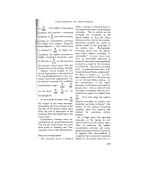
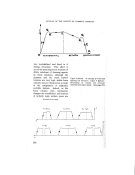
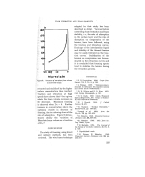
'?i'::Figure 8. Variation o• mersoloce •oam volume :: •::• retracted and stab•l•se8 by the higher :• •'sudace concentration then reached. ?/•:•'Tract•on and •etract•on at high ?speeds have shown that' • •or a given •:'' solute the •oam volume increases as .. ':•: Dy decreases. •aximum foaming ß ?•' is observed when Dv • 0. Yurther •:•: increase in concentration above the ß :•" optimum results •n decrease •of ' loanting, due to a slowing down of the •: rate of adsorption. Yigure 8 demon- strates clearly the •erso]ate foam volume as a of Dy. • CONCLUSION The study of foaming, using direct and indirect methods, has been reviewed. The wire frame technique FOAM FORMATION AND FOAM STABILITY adapted for' that study has been described in detail. Various factors controlling foam formation and foam stability, i.e., the rate of adsorption in the surface layer and the-rate of desorption on compression of the lamina, have been followed, using the traction and retraction curves. Drainage of the interlamellar liquid and stability of the thinned laminse may be easily followed on the trac- tion curves. Stabilisation of the lamin•e on compression was demon- strated on the retraction curves and it is concluded that foaming agents tend to stabilise the lamina during the retraction process. REFERENCES • D.G. Dervichian. 1944. Corps Gras Savons, Vol. 2, No. 6, p. 164. 2 j. Plateau. 1873. "Statique experi- mentale et th•mique des liquides soumis aux seules forces moleculaires." a R. ]E. Wilson and E. D. Ries. 1923. Coil. Symp. Monograph, p. 161. 4 •. O. Clark. 1947. Chem. Research Special Report I%. 161. Dept. of Scienti- fic and Industrial Research. 5 E. J. Burcik. 1950. J. Colloid Science, 5, 421. 6 R. Matalon. "Surface Chemistry," Butterworth, pp. 195-201. ? Lenard et al. 1924. Ann. der Physzk, 74, pp. 381-404. 8 R. Matalon. 1948. Memorial Services chirniques etat, 84, 345-351. 9 R. Matalon. 1948. 15th June Dr. Ing. thesis, Lyon. x0 R. Matalon. 1951. The Journal of the Society of Cosmetic Chemists, II, No. 3, p. 122. n Unpublished work. •a M. Raison, R. Matalon. 1948. Memorial Services chimiques etat, 84, pp. 353-371. 225

SOME CURRENT PROBLEMS IN TOILET SOAP MANUFAGTURE By JAMES BATHER* IT WAS the Roman historian, Pliny, who stated that the Gauls were the original inventors of the art of soap- making, which they introduced into Italy after their successful invasions of Gaul. Goats' fat and the ashes of the beech tree were the essential ingredients of the epoch, while the subject of odour appeared only to have received attention at a much later period. Prior to the invention of soap, the ancients employed plant fibres and juices of a detergent nature, as well as various types of silica such as fuller's earth, which was rubbed upon the skin and clothes as a means of absorbing grease. The Mediterranean nations em- ployed fuller's earth even up to the beginning of the eighteenth century as a cleansing medium in the bath. In the eighth century, soap was made chiefly in Italy and Spain, and it is somewhat remarkable that nearly five hundred years elapsed before soap making was introduced into France by the Phoceans, a mixed but talented race of Grecian and Egyptian origin. Marseille was the chosen city for the introduction of soap into France, *Consulting Chemist and Perruiner, London. 226 owing to the facilities afforded of obtaining olive oil, and a crude soda ash obtained by calcination of various maritime plants, both of which pro'ducts were to be found in great abundance along the shores of the Mediterranean. .•' The exact period at which soap was first produced 'in England appears obs'cure, although it is 'frequently given as the fourteenth century, when it was made upon the French system. The first British ß Patent referring to soap manufacture"i was taken out in 1622 under the. title of Castile Soap by Messrs. ß Jones and Palmer, who claimed a process of making hard soap without:ß, the aid of heat. From this period up' to the present time, however, soap: patents must run into hundreds ofi• thousands, this being one of the most. :111, i prolific subjects treated in the patent lit erature. For an unduly long period art of soapmaking was empiricM?i and real progress was made after the invention of Leblanc's:i?'•i process for the manufacture of soda?? from common salt, which was developed by James Mudpratt St. Halens, a then small town in the? heart of industrial Lancashire. The!i•j truly scientific production of soap_?i
Purchased for the exclusive use of nofirst nolast (unknown)
From: SCC Media Library & Resource Center (library.scconline.org)