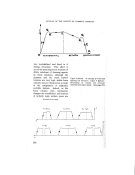
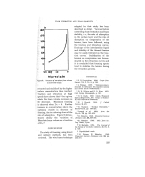
!::of the tubes should be connected to a •'•:•:_._. •!i mercury manometer, the other fitted •.With a stopcock so that the bottle •-'•:: •!i•!•can be opened or closed to the •!•'external atmosphere. The bottle •':•5!•::"shoald be placed in an incubator •:a• 60 • C. and lef[ for about 16 hours &?•m order to get thoroughly heated .:•?•. . . . •½•':•'•hrou•h and •he a•r ms, de •he bottle expanded. The stopcock is •hen •Closed and the pressure developin• •?• .:::" . •'•:• •:•?determ•ned by •he mercu• mano- •x•'•/:•}:?(•meter. In the case of a pa•icular :'z:½• •('"P'ølyethylene bottle, it was found that four days, the mercu• had to a height of over 10 •. It be appreciated that even in this Space of time the pressure developed quite significant, in spite of the the polyethylene bottle had •.a thickness of appr6ximately 0'05 in. •' :: 'SUMMARY From the foregoing investigation ß it can be deduced that if a poly- ::i.:ethylene sac be employed as a con- i:.: .itainer for any preparation containing ::• ½.' water, an internal pressure will •ii!i:!'ii::):•develop at a rate depending on the thickness of the walls and the actual ?:!i:i•':'conditions under which it is stored. If the container is freely exposed to :!::5?::i(the air, then the rate of swelling will increase as the temperature rises. It PACKAGING MATERIAL will also increase with increased movement of the air and with increase in dryness of the external atmosphere. Thus, the ideal environ- ment for storage is a cool, damp place free from draughts. In practice, however, the polyethylene package should be enclosed in an outer container which will protect it from variations in external humidity and temperature as well as from draughts. In England, it is sufficient if the polyethylene sacs of suitable thickness are packed in a rigid strawboard container. In warmer countries, especially those where the relative humidity is likely to be very low, further protection is necessary. Enclosing the sac in an outer one will give very good results, the double sac being, of course, packed in a good ' strawboard carton. Where the polyethylene is thick, as for example in the case of bottles, the use of a good quality carton will probably suffice to prevent any serious development of pressure. The author wishes here to record that the work which forms the basis of this paper was carried out by Mr. J. H. Walker, B.A., B.Sc., in the laboratories of the County Perfumery Co., Ltd., Stunmore, Middlesex, England. 169

THE ROLE OF DISULPHIDES AND MERCAPTANS IN HAIR CHEMISTRY By J. L. STOVES, ProD., M.Sc., F.R.I.C.* ArAsT from a small amount Of methionine, the whole of the sulphur present in keratin fibres can be accounted for as cystine, the dis- position of this amino-acid within the fibre being such as to form a bridge between peptide chains: CH.CH2.S.S.CH2.CH Many estimations of the sulphur content of keratin fibres have been made and it is now definitely estab- lished that different animal fibres contain varying amounts of sulphur. Neglecting differences due to histo- logical variations, the significance of which has been discussed else- where,',' variation in the sulphur content of hair from the same species is now regarded simply as indicating variation in the number of cystinc disulphide'linkages between the peptide chains. An argument against the presence of such linkages in keratin has been based on the fact that chemical reactivity of protein sulphur is much greater than that of sulphur in free cystine. As already indicated? however, this increased reactivity of protein sulphur can be readily understood in view of the nature of the groupings attached to the cystine linkage in hair. * Chemical Consultant. 170 CYSTINE AND HAIR GR0W•H Since keratin contains a relatively high percentage of cystine .(c. 15 per cent in human hair) it has been : suggested, from time to time, that"/i hair growth would be stimulated by supplying to the diet preparation'sil/il rich in sulphur and cystine. Very:i f i conflicting results have been obtained when this form of therapy has been applied to human beings. Difficul- •.! ties of experimental technique the fact that cystinc or sulphur'•(• deficiency is only one of several•:i • possible causes of poor hair growth-i goes far to explain these variables: results. In the cosmetic field interesC!: has long centred round the possibilit71'i of stimulating hair growth by exter•: nM application of the essential con.-: stituents of keratin. Recent work•i:i• on cutaneous absorption, e.g.,Valett• in Paris, Hermann, Su!zberger Baer in U.S.A., has shown that unde• • t ,, certain conditions' penetrasols based on propylene glycol, xylol, an hydr02:i! tropic substance like antipyrine a wetting agent of the sodium ary alkyl sulphonate types possible to convey the most vari'•d! substances through the epiderm!•: Penetration in all cases takes pla6 via the hair follicles, passage throug]
Purchased for the exclusive use of nofirst nolast (unknown)
From: SCC Media Library & Resource Center (library.scconline.org)