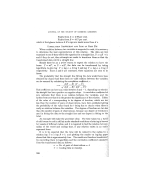
SOME CURRENT PROBLEMS IN blend or in a suitable solvent as benzyl alcohol. for colouring matter, only a fast-to-alkali colour mid be employed. Again, it is economy to purchase anything the finest quality, as'the cheaper may contain many impurities in the more expensive variety, been eliminated by sufficient Aniline dyestuffs are chiefly although only those with alkaline milling resistance and uate manufacturers' proof of should be used. A simple yet a most reliable one, is to 50 grammes of the soap base' 5 grammes of soda ash to a litre distilled water and gently heat maintain at a temperature of C. until observations are corn- The soap base employed course, have been already TOILET SOAP MANUFACTURE coloured, then as "fastness" is usually based upon an "8" scale, any soap can be calculated as to the degree of fastness to alkali. Then if the degree of the dyestuft itself is known (and it should be requested -from the makers), on'e aims at employing an alkaline fastness from 4 to 5 or even higher. The test given will soon reveal whether the soap will remain constant or not, during the normally expected shelf-life of the final product. The dyestuff used, and of whatever nature, must also, of course, be employed in a solution form that has been filtered so that no extrane- ous matter or fine particles of dye- stuff are left for subsequent incor- poration in the soap base, a fault that usually gives rise, within a few weeks or months, to more or less clearly defined spotting.

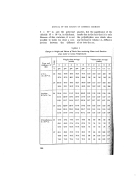
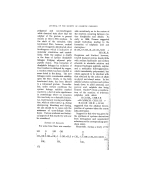
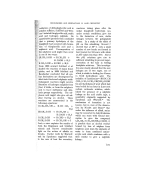
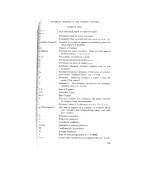
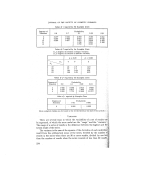
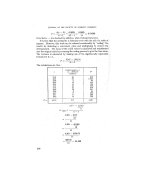
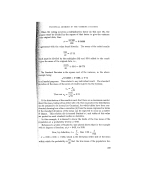
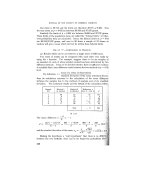
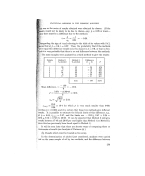
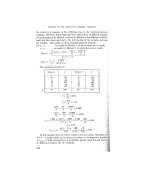
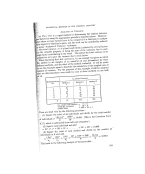
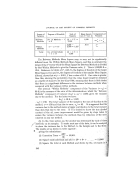
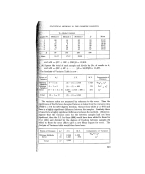
STATISTICAL METHODS IN THE COSMETIC INDUSTRY' AN INTRODUCTION By A. W. MIDDLETON, B.Sc., Ph.D., F.R.I.C.*' Tins ARTICLE is an attemp• to give cosmetic workers an outline of a very few of the possible applications of statistical methods to their work. Space does not allow of any very fundamental approach to the subject, but it hoped that readers will be able to apply the technique of the examples given to similar problems of their own and that they will be encouraged to make! • : use of the bibliography for further study. * * Statistical methods have very wide application .and are the by which the maximum amount of information can be obtained from a given?::i set of experimental results consistent with any desired degree of probability. i] The general principle of statistical analysis for.the judgment of the signifi2i! !? cance of any difference between two or more sets of observations is adoption of the "Null Hypoth½sis"--that there is no difference between the?• sets of observations--and the subsequent calculation of the probability thaC• in any particular case the variations found between the sets observations could have been obtained by chance. If this chance':)i'i• is small, the conclusion is dra/wn that the sets of observations differ and that the different. treatments given the sets have a significah•'•):i effect. It can be considered that a significant difference between sets observations exists when it is probable that only once in twenty times woulCi•{ the particular data have been obtained by chance (p= 0.05). Oth•"•}•! commonly used "levels of significance" are probabilities that the would be obtained by chance once in a hundred times (p -- 0.01) and in a thousand times (p = 0.001), the level being chosen by the ex[ to meet the particular degree of accuracy that he requires. For cosmetic work the writer has found p -- 0.05 satisfactory. •,• For easy reference, the symbols used and the tabular data required the proper understanding of the techniques to be described are collecte ß together and shown on the opposite page. * Chesebrough Manufacturing Co. Ltd., London.
Purchased for the exclusive use of nofirst nolast (unknown)
From: SCC Media Library & Resource Center (library.scconline.org)