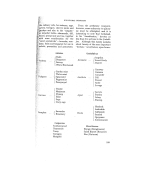
NON-FLORAL PERFUMES .•?'•as "something added to a prescrip- i}!ftion to aid the operation of the i!:,'•pnncipal ingredient,' and I think :limit well worth while to observe, in the fi•fundamental non-floral character of •/these adjuvants, the function of the :i!!:¾1hrge range of pharmaceutical essen- •!*.!i::'i:•ifial oils, gums, balsams and resins, i•f•,?iand to reallee just how closely '• •iiilPerfumery is still allied to the "art •?•?of the Apothecary." •?•:•:. Although it is perhaps due to the ?•: odour classi[cation of Rimmel (18•5) }•}•:{hat the position and importance of ??he adjuvants became apparent, it is •?•'ønly when some attempt is made at ?•?):OSegregation that a pattern begins to •.•}:?merge from which the transition •)•mechanism 0f one group to another :?:begins to be obvious.' The utility '•}::•of this can also be perceived when •t hybrid effects are considered, for :• :::.instance, in either allocating a niche •: :: to synthetics of unusual od0ur, or •:.:':: producing according to inclination, ?./::e.g., oenanthic-verdure or balsamic- honey notes. •):::' ' The following order is suggested as •:: a cyclic pro•ession, as it will be :•' noted from this sequence that the /•'•' basic odour tone of any one group is not only largely dependent on, but is :•:::linked with that of the preceding group as well as the following. THE ADJUVANT CYCLE 1. Folial-nutty 8. Woody 2. Verdure •. Smoky 3. Oakmoss-hchen 10. Leather 4. Fern 11. Animal 5. Earthy 12. Resinous •. Fungal 13. Spicy-nutty 7. Rooty 14. Balsamic 15. Herbaceous 10. Citrus 1•. Amber 20. Fruity 17. Honey 21 Oenanthic 18. Aldehydic 1. Folial~nutty Although each of the above groups will allow for some subdivision, it will be found that there are several sections which require more elaborate and detailed treatment, these are: (a) the folial nutty verdure, (b) her- baceous and (c) fruity groups. THE FOLIAL-VERDURE GROUP' The green or folial note is perhaps best represented by the aroma of violet leaves absolute, and usually in conjunction with such alkyne esters as methyl-heptine and methyl- octine carbonates, but there are, however, auxiliaries of a green character which have comparatively recently come into prominence, such as nonadienol and its aldehyde and "leaf alcohol" ([•-hexenol and its- homologues) as well as hexyl-heptyl esters and ethers. Upon these items many green-leaf coronal bases may be formulated, which when incor- porated with due restraint in com- positions, confer desirable light and subtle touches of greenery and fresh- ness, free from the blatant and heady tendency of the alkynes. Another group of verdure toners which can also be used with very pleasing and natural effects are combinations of the various acetale of phenylacetic, hydratropic, heptyl and methyl-heptylacetic aldehydes, especially in conjunction with the formic, acetic and propionic esters 189

JOURNAL OF THE SOCIETY OF COSMETIC CHEMISTS of geraniol, citronellol and terpineol and from such linkage are evolved bases with definite characteristics, such as the Verts de fleurs, de Lilas, de Gardenia, d'Oranger, des f6rets and so on. ß Further shadings of considerable value in muguet, mignonette,, gar- denia and tuberose 'Compositions can be based upon some of the foregoing items by the addition, for instance, of di-hydro pgeudo-ionones which give the deeper and richer tones of ivy-leaves, while the sweet, dry and powdery note of vine-leaves can be introduced with methyl heptenone and hexylenic aldehyde finally, the dull and heavier nuances closely simulating chrysanthemum, dahlia and tomato foliage, which notes are so useful in the heavy undertones of the citrus-incense-rose fantasies, can find a ready counterpart in iso- amyl heptyl ether and neryl butyrate. It is also interesting to observe at this point the interpolation of the "nutty" cadence, not the spicy- cachou aspect, but rather that inflection of the coconut, hazelnut a•nd walnut tone, because the funda- mental odour, based upon •'-nonyl and duodecyl lactones, plus the unctuousness of heptaldehyde acetals, and the amyl and butyl- benzyl ethers, can according to inclination either remain nutty, or emerge as an odour characteristic of decorticated twigs and the hollow stems of water plants. For instance, the fragrance of iso-propyl phenylacetic, phenylpro- pyl, cyclamen and cuminic aldehydes, plus that of such alcohols as cedrenol, 190 santalol, coriandrol, and esters like hexyl benzoate, all closely simulate the fresh, damp, sappy, pithy and cortexal odour. This sapid, succulent odour tends towards-the verdure note, which is rather that of the freshness of vegetation than the aroma associated with particular leaves, and is per- haps particularly well exemplified by appropriate dilutions of heptyl caproate or iso-propyl acetophenone (methyl-cumyl ketone), as well as by. the more culinary odours of freshly sliced French beans, cucum- ber and melon rinds, which charac- terise such esters as hexyl caprylate and hexenyl formate. There is also another folial shade which is a composite. This is to be found in the sweet, &y and powdery note of rose leaves and dried rose petals, to wh. ich, in particular, the phenylethyl and phenylpropyl ace- tates, propionates, cinnamates and the acetals of the corresponding : aldehydes, are largely contributory...:: ODOURS OF MOSSES AND LICHENS The mousse de chine odour,? borders on those of the verdure!?: group and, although there are botanical sources of the lichens from:'• which the commercial extracts manufactured, yet the characteristidi•:'½• ' odour can be observed in the methyl? ethyl and particularly the iso-buty[' • esters of everninic acid, as also the p.-methyl, iso-propyl and ß . butvl qmnohnes. Furthermore, farnesyl and fenchyl?•l alcohols and their acetates
Purchased for the exclusive use of nofirst nolast (unknown)
From: SCC Media Library & Resource Center (library.scconline.org)