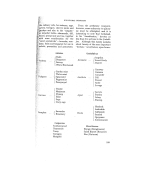
DISULPHIDES AND MERCAPTANS IN HAIR CHEMISTRY hydrolysed by trypsin into its con-, nt amino-acids. Hair medulla, has few if any, disulphide is, on the other hand, read- digested by trypsin. .Recently, it has been shown that treatment of fibres with reagents of forming certain types of non-sulphur containing linkages the medulla can render these cells resistant to tryptic digeS- tion. 'ø Stabilisation of disulphide can be achieved by thiogly- acid reduction followed by with dihal/des. '• 'A further form of disulphide link- reduction is that brought about by the action of sulphites and bisul- :?Phites2• 5•!:R.S.S.R. + Na,SO,-- R.S.Na + :::,: ' NaO.SO, S.R. + NaHSO.- aSH + ! }!i: )'::?:i. NaO.SO2.SR. •?--•!-!{,',:: The sod'ium-S-cysteine sulphonate is ':!½!•ii: /i?Unstable and decomposes when }?.}:'Warmed with acids to give sodium 5ii} I}:: bisulphate and cysteine, while alkali ,,?:::.(•!gives sodium bisulphite and sul- i ?'i:iphenic acid. Human hair fibres ?•: treated with bisulphite-sulphite solu- ?i:i'itions pH 3-11 at 22'2 ø C. showed -•f:•if?! maximum weakening at pH4'5 and }•11: :!:: 11. =' When the extent of cystine i !'::(:::?iinkage breakdown is not excessive, :??:loss in resistance to extension of ??) bisulphite treated hair can be com- ::•½-: :::pletely restored by after-treatment 'i!}!: with aqueous solutions of benzo- ::5':-:' quinone, or formaldehyde pH8. This :::(::. restoration results from formation ()::: . of new linkages by reaction of the •(-:' quinone with thiol and amino groups, •i!:i as well as from re-formation-of ). ß cystinc linkages by a partial reversal of the original disulphide break- down? , • The work of Phillips et al. •-• on the action of bisulphites. on wool sug- gests that the disulphide linkages are not all equally reactive, and the view has been expressed that the combined cystine of wool .can be divided into ß four subfractions, termed A, B, !2, and D differing under certain experimental conditions in their rate and mode of reaction with sodium bisulphite and thioglycollic acid. These differences in reactivity may arise from differences in side- chain environment, fraction (A+B) being• associated with polar side- chains, whereas (12+D) is associated with non-polar side-chains. MERCAPTANS AS P.W. ASSISTANTS Reduction of cystine disulphide hnkages by means of sulphites or thiol compounds is of immediate interest to the hair cosmetologist owing to the use of these materials in permanent waving, while certain thiois find further use as depilatories. Practical factors governing the use of alkalis, sulphites and mercaptans as waving assistants have recently been discussed •* and in view of the . ever-growing use of thiol compounds in cold waving it seems. desirable to limit the present consideration to this group. The predominance of high temperature waving up to the time of the 19130's was not due to lack of attempts to develop cold waving methods, but rather to an unfortun- ate choice of chemical reagents. 175

JOURNAL OF THE SOCIETY OF COSMETIC CHEMISTS Alkaline assistants such as borax, carbonates, phosphates, ammonia or ammonium salts, in the concentra- tions used for high temperature waving were not satisfactory at lower temperatures unless used for long periods ranging from 4 to 24 hours. Attempts to use solutions of greater concentration resulted in excessive damage to the hair. Obviously then, ß a waving mechanism not depending' on initial disulphide linkage hydroly- sis is required for cold waving, and an indication of the correct approach was obtained when ammonium hy- drogen sulphide, which brings about keratolysis by reduction of cystine linkages, proved to be a more speedy reagent. The malodorousness of this material, however, resulting from liberation of hydrogen sulph!de by hydrolysis proved a serious dis- advantage. Moreover, sorption of sulphide by hair gave rise to a dis- agreeable odour whenever the hair was re-wet ted, while continued reduc- tion of cystine linkages caused relax- ation of the hair fibres so that the wave became less tight with each re-wetting. As already indi- cated, work in the biochemical and textile fields had demonstrated the use of mercaptans for reduction of the disulphide linkage in scleropro- teins, and in 1940 cysteine hydro- chloride at a pH not less than 10 formed the basis of a patent speci- fication. *• While of considerable theoretical interest this process does not appeai- to have received any wide application, probably owing to the fact that the material is costly, the solution is unstable, leaves a dusty deposit on the hair, and although the hair is well waved it is very dull. z, McDonough, ø-'• in a U.S.P. specifica- tion filed in 1941, but not granted until 10 years later, then showed that satisfactory cold waving could be obtained using mercaptans of general formula R.SH, where R is an organic group such as ethyl or benzyl, in solutions of 1-10, per cent concentration and pH7-9'5. More- over, substitution in the alkyl or aryl radical gave products with less objectionable odours. Such substi- tuent groups may be polar (acidic or basic) or non-•polar. For example' (i) Carboxyl or sulphonic acids, nitro, chloro or halogenated groups. (ii) Primary, secondary or tertiary..: amino groups. (iii) Alcohol, aidehyde, keto, este? or ether groups. '• ß •: In general, the polar •ompounds containing a carboxyl group give .? excellent waving results when used in the form of the ammonium salts. It has been found, however, that the':i:i! corresponding sodium and potassium.i! • salts, even in ammoniacal solution !'•)i are much less satisfactory, and the:.?:• same applies to ethanolamine salts?: i•i As will be considered in detail alkaline earth salts of certain of thio-acids possess depilatory perties, e.g., calcium thio In the case of mercaptans water solubilising non-polar such as. glyceryl mono-mercaptan I it is interesting, in view of presen! developments in one solution waving methods, 'to note that Donough states that the removal' mercaptan is so complete by 176
Purchased for the exclusive use of nofirst nolast (unknown)
From: SCC Media Library & Resource Center (library.scconline.org)