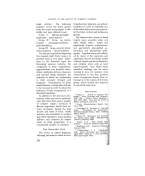
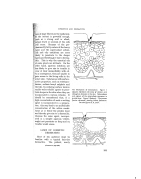
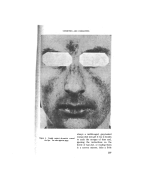
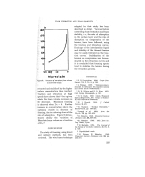
Figure 4. Simple contact dermatitis around the lips. See also opposite page. always a middle-aged, grey-haired woman (but men get it too !) decides to undo the ravages of time and, ignoring the instructions on the bottle of hair-dye, or reading them in a cursory manner, dabs a little 207'

JOURNAL OF THE SOCIETY OF COSMETIC CHEMISTS of the dye behind her ear and asks her husband to inspect the result a few minutes later. As no reaction will be visible after this short time, she assumes that all is well and proceeds to dye her hair. She retires to bed, satisfied with her operation, but, in the early hours of the morn- ing, she wakes feeling as if her scalp was on fire. She is further alarmed by the fact that she can scardely open her eyes, due to the consider- able swelling of her eyelids. After an anxious night she then presents herself to the nearest skin clinic, where the dermatologist can usually make the •liagnosis as he passes her by. Similar reactions follow exposure to other agents and the site of the eruption may vary with the part of the skin which comes in contact with the offending substance. It should be remembered that thick- skinned areas are less likely to show inflammatory changes than are thin- skinned areas, such as the eyelids. It is quite a frequent experience, for example, to find a patient, sensitive to the dye in nail lacquer prepar. a- . tions, who never shows skin changes in the hands at all. The eruption is usually seen on the thinner skin of the eyelids, which may become quite swollen as a result of contact with the dye, brought about, for example, by the nervous habit of tapping or rubbing the lids with the fingers. Some primary irritants may in their turn become sensitising agents. A common example of this is seen in industry with chromium. Chrome ulcers or "chrome holes" are usually due to small amounts of chromic acid or other chromium salts which reach the living cells of the prickle layer through a small abrasion or incised wound in a worker's hand. -The presence of these salts produces a local painless ulceration of the skin which slowly enlarges unless the lesion is treated. Some individuals, however, subsequently develop a rash composed of vesicles which are intensely irritating, in the neigh- bourhood of and remote from the original chrome ulcer. They have become sensitised to chromium and then, wherever chromium comes into contact with their skin, they develop an irritating dermatitis. The mechanism involved in sensi- tisation is not fully understood, but it would seem that many substances have the property of forming loose complexes with the proteins in the skin of susceptible subjects. ,.This protein complex acts as an antigem Antigens are substances which in some way disturb protein synthesi s in the cell, so that antibodies are produced instead of normal proteins l )• Haurowitz mentions that the surface • of antibody molecules is adapted.:., complementarily to the determinantli: _ molecular groups on the surface of?i the antigert molecule. These appear•:•} to be strongly polar groups consisting:.:11i mainly of negatively charged acid!? groups. Such groups must posse ss' ' a deB. nite shape in order to causei.) sensitisation, thus Landsteinor has shown that the flexible parafftiY chain of a fatty acid cannot act as anl antigen. Furthermore, there always a latent period between thel 208
Purchased for the exclusive use of nofirst nolast (unknown)
From: SCC Media Library & Resource Center (library.scconline.org)