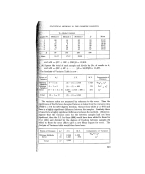
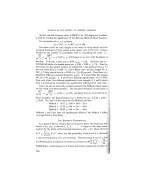
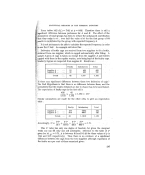
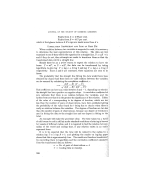
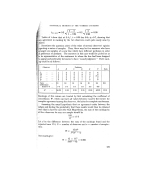
JOURNAL OF THE SOCIETY OF COSMETIC CHEMISTS CH.CH,.S.OH -+ S q- CH.CH •.OH -+ C: CH, q- H,O • . + HS.CH,.CH CH.CH,..S.CH,.CH • . Alternatively, the newAinkage•may be-formed by loss of hydrogen sulphide from thiol groups, followed by an addition reaction between the C: CH, groups so formed-and other thiol '. residues. Phillips and Cuthbertson" have suggested that the sulphenic acid, formed by.'the initial hydrolysis of' the cystine linkage, decomposes to form com- bined amino-acrylic acid and a hypothetical dihydrogen sulphoxide. The amino-acrylic acid.. residue is then thought to-combine .'with a thiol group, while the sulphoxide forms' a more complex inorganic sulphur compound, or decomposes into water and sulphur. ' The second type of linkage result- ing from the action of alkali. on hair is believed to be of the type -N:CH- arising by condensation of an amino group with. an aidehyde formed by loss of hydrogen sulphide from a sulphenic acid residue.. Evidence supporting this hypothesis is de- scribed'in detail elsewhere2' The final result obtained on treating hair with alkali, therefore, is determined by..the magnitude of the primary disulphide hydrolysis, together with the extent to which' the various secondary reactions have taken place which in turn'. is determined by the time of treatment, together with the temperature• concentration and pH of the solution used. Accordingly, it seems reasonable to conclude that in the older methods of high tempera- ture permahent waving using alkaline assistants, the. chemical mechanism involves'formation of lanthionine and Schiff's base type of linkages rather than '-SNIt-'. bonds. This subject is at present Under examina- tion in the author's laboratory. "ACTION OF REDUCING AGENTS According to Fruton and Clarke •s the interconversion of 'cystine to cysteine is a thermodynamically reversible process, the' redox poten- tial of which is apparently character, istic of the general system- . R.S.S.R. q- 2H -+ 2R. SH and is independent if the group R. •'Redu.ction' of cystine .to. cYsteine can be effected in acid solution by means of tin or zinc, while in neutral or alkaline solution an excess of second thiol compound, 'e.g., glyc011i•' acid, may be used •eduction of •he"disu•phide'linkage in. proteins' ' ' •.' . R.S.S.R. q- 2R'SH-- 2R.SH q- This reaction, analogous .to that?i between thiophenol and 2-2'dinitrø'::•i diphenyl disulphide studied Lecher in 1920, was used in the earl?½i• 1930's by du Vigneaud and bY!i Goddard and Michaelis for reducingl the disulphide linkage of proteinS:i such as hair, wool and feathers. In: passing it is of interest. to n6te that , o .... kerahn •s charactenstmally res•stan.,•.•i to enzymolysis, but when the polyX i • peptide chains' of. wool or hair freed by'reduction of the disulpkid! linkages,- the.' protein is. rapidl•

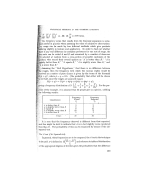
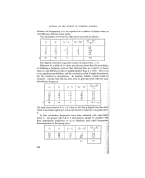
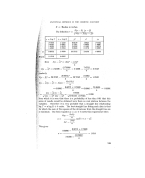
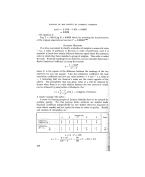
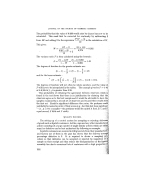
DISULPHIDES AND MERCAPTANS IN HAIR CHEMISTRY hydrolysed by trypsin into its con-, nt amino-acids. Hair medulla, has few if any, disulphide is, on the other hand, read- digested by trypsin. .Recently, it has been shown that treatment of fibres with reagents of forming certain types of non-sulphur containing linkages the medulla can render these cells resistant to tryptic digeS- tion. 'ø Stabilisation of disulphide can be achieved by thiogly- acid reduction followed by with dihal/des. '• 'A further form of disulphide link- reduction is that brought about by the action of sulphites and bisul- :?Phites2• 5•!:R.S.S.R. + Na,SO,-- R.S.Na + :::,: ' NaO.SO, S.R. + NaHSO.- aSH + ! }!i: )'::?:i. NaO.SO2.SR. •?--•!-!{,',:: The sod'ium-S-cysteine sulphonate is ':!½!•ii: /i?Unstable and decomposes when }?.}:'Warmed with acids to give sodium 5ii} I}:: bisulphate and cysteine, while alkali ,,?:::.(•!gives sodium bisulphite and sul- i ?'i:iphenic acid. Human hair fibres ?•: treated with bisulphite-sulphite solu- ?i:i'itions pH 3-11 at 22'2 ø C. showed -•f:•if?! maximum weakening at pH4'5 and }•11: :!:: 11. =' When the extent of cystine i !'::(:::?iinkage breakdown is not excessive, :??:loss in resistance to extension of ??) bisulphite treated hair can be com- ::•½-: :::pletely restored by after-treatment 'i!}!: with aqueous solutions of benzo- ::5':-:' quinone, or formaldehyde pH8. This :::(::. restoration results from formation ()::: . of new linkages by reaction of the •(-:' quinone with thiol and amino groups, •i!:i as well as from re-formation-of ). ß cystinc linkages by a partial reversal of the original disulphide break- down? , • The work of Phillips et al. •-• on the action of bisulphites. on wool sug- gests that the disulphide linkages are not all equally reactive, and the view has been expressed that the combined cystine of wool .can be divided into ß four subfractions, termed A, B, !2, and D differing under certain experimental conditions in their rate and mode of reaction with sodium bisulphite and thioglycollic acid. These differences in reactivity may arise from differences in side- chain environment, fraction (A+B) being• associated with polar side- chains, whereas (12+D) is associated with non-polar side-chains. MERCAPTANS AS P.W. ASSISTANTS Reduction of cystine disulphide hnkages by means of sulphites or thiol compounds is of immediate interest to the hair cosmetologist owing to the use of these materials in permanent waving, while certain thiois find further use as depilatories. Practical factors governing the use of alkalis, sulphites and mercaptans as waving assistants have recently been discussed •* and in view of the . ever-growing use of thiol compounds in cold waving it seems. desirable to limit the present consideration to this group. The predominance of high temperature waving up to the time of the 19130's was not due to lack of attempts to develop cold waving methods, but rather to an unfortun- ate choice of chemical reagents. 175
Purchased for the exclusive use of nofirst nolast (unknown)
From: SCC Media Library & Resource Center (library.scconline.org)