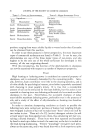
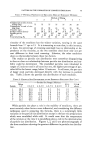
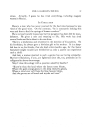
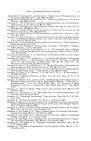
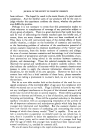
12 JOURNAL OF THE SOCIETY OF COSMETIC CHEMISTS of purified lanolin. The esters which constitute the bulk of lanolin are composed of sterols, triterpenes, and aliphatic alcohols combined with acids whose variety and complexity have created baffling problems of identifica- tion. Lanolin also contains small amounts of hydrocarbons, free fatty acids, and free alcohols. It is generally accepted that the free alcohols have the same relative composition as the bound alcohols present in the esters. Table 1 lists analytical data by various investigators for different types of wool fat. It should be noted here that Bertram (1) analyzed two crude wool fat samples of the type commonly used for the manufacture of U.S.P. TABLE I--ANALYTICAL DATA lVOl• VARIOUS TYPES Or WOOL FAT C•ANUS) 50UI•CE OF DATA TYPE WOOL FAT ACID NO. SAP. NO. IODINE NO. HYI)ROOLYL NO. BERTRAM CRUDE (A.E,•,C.) 11.9 IIq'.6 5q'.'/ 52.5 BEIZT•AM CRUDE •A•TgALIAN) ,• .•lj J02.• •.3 •.0 •'• NElL (•ITISH) I.O 94.6 31.9 -- LOWER LANOLIN 8.R 0.4 - 22 - HEH• LANVIN 8.R I.O•x •'• 18•o•2 - ("NEUlIAL AMERICAN •NEUTRkLCA•,•R•.•)8 C140LES'rEROL 1LANOLI# US.R-AI PRODUCTS,,•LANOLIN U.S.P.- A2 INC. • kkNOLIN U.S,P.-A$ • LANOLIH U.S.P.-8• I LANOLIN U.S.P.-B 2 k,LAHOLIH U.S.P.-B 3 1.0
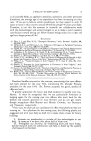
CAHe•a,q•A 97.5 29.8 27.7 0.9s 88.7 21.4 27.6 I 89.9 g9. 8 29.9 I 91.8 - 39,8 I 89.1 - 36.3 ß I 97.5 28.1 31.9 I 953 27.4 I 99.0 26.0 33.8 lanolin, one of these was an American crude, the other an Australian crude. The American crude has unusually high values for iodine number and hydroxyl number. Arlington Mills crude is a solvent extracted type which, because of color and odor, is not suitable for lanolin production, but was used by Weitkamp (2) in his work which will be detailed later. Neutral wool fat, as analyzed by Drummond and Baker (3) and our laboratory, is the most desirable for lanolin production since very little treatment is needed outside of improving color and odor. Data for British refined lan- olin as published by Lower (4) and by Hembrough (5) is listed along with that for six American lanolins, three from each of two producers which were analyzed in our laboratories. Large variations are to be expected from different lanolins which have their origins in widely scattered areas of the earth on many breeds of sheep. These variations may be further developed by methods of wool scouring and processing. The analysis of lanolin usually consists of chemical determinations of acid number, saponification number, and iodine number in addition to the physical measurements required. The hydroxyl number which is a measure

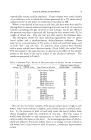
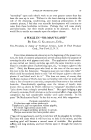
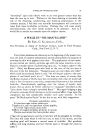
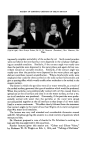
NEWER CONCEPTS OF LANOLIN COMPOSITION 13 of free hydroxyls has evidently not been considered very important in the past and was rarely determined. The importance of the hydroxyl number will become evident in the latter part of this paper. Even careful study of the analytical data does not shed much light on the composition of lanolin. For instance, the iodine number indicates that some unsaturation is present, but doesn't tell in what part of the ester the double bonds are located. The hydroxyl number is indicative of free hy- droxyl groups but doesn't tell us whether these are present on free alcohols or on hydroxyesters, and the sapor•ification number indicates the presence of esters but tells us nothing of their structure. The elucidation of the chemical structure of the various components which form lanolin has been attempted by many investigators whose find- ings are quite contradictory. It may truthfully be said, in this instance, that disagreement is the rule rather than the exception. The logical first step in a study of lanolin composition is the splitting of the esters by means of saponification into component alcohols and soaps of the fatty acids. The saponification procedure has been carried out by many methods, the end products varying considerably depending on the nature and concentration of the alkali or alkaline earth, and other factors such as media, temperature, time, pressure, agitation, and presence of inert gas. L^•o•.m A•.coHo•.s Let us now examine the lanolin alcohols which constitute approximately 50% of lanolin. In the analytical data for lanolin alcohols, on Table II, TASLE II--AI•ALYTICAL DATA FOR LAI•OLII• ALCOHOLS SOURCE OF DATA IOOINE NO.(w) HYDROXYL NO. MEAN MOL. WT. ORUI4MONO & BAKER 6,9.1 - - ER•A, - 145.3 392.3 LOWER •'5.5 •ee E•TERN •O•L •B. - I•.• • 375 U.S. •. A•IGULTU• 0 CHOLESTEROL PRODUCTS •9.•
A•EmCAH 1•.5 •8• the iodine numbers are listed in the first column. Most of the double bonds of lanolin are located in the alcoholic fraction, and some of them, especially in the triterpene alcohols, are quite resistant to iodine, resulting in very er- ratic results when the Wijs method is used. We prefer the more reactive Hanus method which gives us reproducible results. Note there is good
Purchased for the exclusive use of nofirst nolast (unknown)
From: SCC Media Library & Resource Center (library.scconline.org)