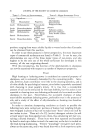
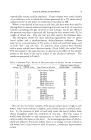
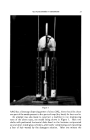
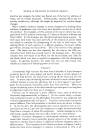
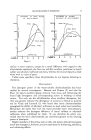
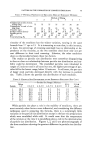
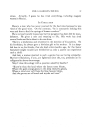
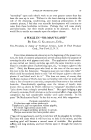
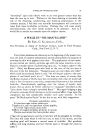
SEMIQUANTITATIVE ANALYSIS OF LIPSTICK 5 components and (2) that the analyst is handicapped by the inadequate library of infrared curves of materials related to cosmetics. The other analytical instruments have comparable drawbacks. The method to be described utilizes differential solubility to effect frac- rionation into major groups (marked with Roman numerals) with subse- quent chromatographic separation of the components within a particular group. Figure 2 represents a diagrammatic scheme of the proposed analysis. Naturally the lakes and pigments are insoluble in all organic solvents. All other components of the mass are soluble in trichlorethylene. The exact amount of lake plus pigment is ascertained by treating a weighed sample of lipstick with trichlorethylene, filtering and extracting the residue in a Soxhlet apparatus with trichlorethylene and acetone respectively, to remove any adhering base and dye. The trichlorethylene-acetone insoluble material represents the lake plus pigment (Group I). The trichlorethylene soluble fraction is then extracted with water. The commonly cited powerful dye solvents which are water soluble thus become separated into the aqueous layer, Group II, Figure 3. Group II Water-Soluble Fraction (tetrahydrofurfuryl alcohol, tetrahydrofurfuryl acetate,* propylene glycol, and polyol containing fraction) I Decolorize with charcoal Aliquot A Aliquot B Aliquot C Aliquot D Test for Periodate Barium Use either to detect presence presence test for silico- of tetrahydrofurfuryl acetate of primary propylene tungstate by means of a positive saponi- alcohols glycol test for fication number polyols • •- or '•""• Use for the quantitative de- termination of the polyols by means of the precipitate it forms with barium silico- • • tungstate THFA quan. Azeotropic distil- by vacuum lation for quantL distillation tatire determina- tion of propylene glycol * Tetrahydrofurfuryl acetate quantitatively by calculation from saponification number after it has been positively identified. Figure 3 The trichlorethylene soluble-water insoluble material is heated to evap- orate off the solvent. The residue is then extracted with cold acetone. The dye and oils of the ester variety go into acetone solution while waxes, lanolin, and the parafl:inic hydrocarbons. remain insoluble. This latter insoluble fraction has been designated Group 1II, Figure 4. The, acetone-

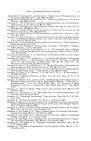
6 JOURNAL OF THE SOCIETY OF COSMETIC CHEMISTS Aliquot A Liebermann- Storch test for the detection of lanolin Group III Cold Acetone Insoluble (wax, lanolin, and hydrocarbon containing fraction) Aliquot B* Concentrated sulfuric acid __ Paraffinic Fraction Non-paraffinic- sulfuric acid digestion mixture * Should the analyst so desire he may determine the waxes by the Zweig and Taub method. Figure 4. soluble portion can be further fractionated by treatment with naphtha in which dye, castor oil and certain other oils are insoluble. Group V, if it is present, may consist of a variety of compounds, many of them esters. However, elaboration on this fraction is beyond the scope of this paper. Its softening point, consistency at room temperature and saponification value give helpful clues concerning its composition. Further analysis of Group I is of no interest. Impurities are precluded, certified colors only being permissible. Matching color does not require chemical analysis. Figure 3 deals with Group II, the aqueous fraction. The bromo acids generally found in lipstick are not water soluble. Any trace which might appear in the aqueous layer may be removed by decolorizing with charcoal. This fraction is then divided into three small (A, B, C) and one large ali- quot (D). Aliquot A is spot tested for the presence of primary alcohols (6). Aliquot B is subjected to the periodate test in order to detect the presence of propylene glycol (7). Aliquot C is tested with barium silicotungstate to detect the presence of polyols (8). If the test for a primary alcohol is positive and neither glycol nor polyols are present, it is probable that the alcohol is tetrahydrofurfuryl alcohol. I do not know of any test which is specific for the tetrahydrofurfuryl radical or its alcohol. If no primary alcohol is detected Aliquot D should be saponified for the purpose of de- tecting the presence of a water-soluble ester such as tetrahydrofurfuryl acetate. Approximate quantitative determinations (85-95%) of these water- soluble compounds may be ascertained, as follows: To determine propylene glycol: Add to a fresh sample of lipstick, a hydrocarbon such as xylol and carry out an azeotropic distillation. The propylene glycol separates from the hydrocarbon in the distillate and is measured volumetrically. The Dean-Starke (9) distilling apparatus is most suitable for this operation. Confirmatory tests such as boiling point,
Purchased for the exclusive use of nofirst nolast (unknown)
From: SCC Media Library & Resource Center (library.scconline.org)