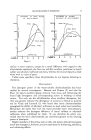
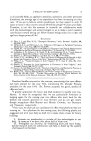
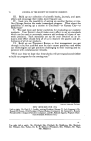
SEMIQUANTITATIVE ANALYSIS OF LIPSTICK 7 refractive index, specific gravity, and solubility in solvents may be ascer- tained. To determine polyols: They may be determined by weighing the yel- low precipitate which forms with barium silicotungstate, or, by weighing the residue after the water has been driven off. Determinations of the physical constants on the residue will further confirm its identity. To determine tetrahydrofurfuryl alcohol: Carry out a vacuum dis- tillation on a fresh sample of lipstick. The initial distillate should contain the low boiling THFA and some perfume. Determine the volume of the mixture. Shake this fraction with water and determine the volume of the water-insoluble fraction. The difference in volume should represent the volume of THFA. Upon evaporating off the water in the water-soluble fraction its identity can be confirmed by its physical constants. Figure 4 deals with Group III. The cold acetone insoluble residue is the "wax" fraction. A Liebermann-Storch test for the detection of lanolin is performed on Aliquot A. Although the waxes can be identified and determined by the Zweig and Taub method, the most significant factor concerning this acetone-insoluble fraction is what percentage of it is par- affinic in nature. Treatment of Aliquot B with concentrated sulfuric acid will show the percentage of aliphatic hydrocarbon present. Group (Hydrophylic oils) Dilute with trichlorethylene and filter through aluminum oxide Elute with trichlorethylene, benzene-acetone, and meth- anol, respectively Trichlorethylene Benzene-Acetone Methanol Eluate Eluate Eluate (castor oil) (dye) Figure 5. Figure $ deals with Group IV. This naphtha-insoluble portion will contain the dye and castor oil, if present. Using aluminum oxide, the castor oil will be eluted with benzene-acetone or ethyl ether and the dye subsequently with methanol. As stated previously, Group V is beyond the scope of this paper. The method of analysis which has been described quickly divides the mass into major fractions thus permitting the examination of only those portions which are of interest. Nevertheless, this method affords the op- portunity for an exhaustive analysis, if desired. Harry (10) has defined a realistic and practical evaluation of analysis of an unknown in these words:

8 JOURNAL OF THE SOCIETY OF COSMETIC CHEMISTS "Having determined the general fundamental composition of the product it is not necessary for the duplicate preparation to be of ex- actly the same composition. So many individual substances possess qualities which can be regarded as belonging to one class (e.g., humec- tants, vegetable oils, stearate emulsifiers, hexitol derivatives) that the research chemist can instinctively select the one best suited to the purpose required or can probably suggest replacement of this by one of several differing substances without prejudice, except possibly to cost." CONCLUSION Chemical analysis makes possible a critical survey of existing produc rs. This knowledge, combined with insight into consumer needs and desire.s•, gives the impetus to the development of theories for achieving such objec- tives. These theories, aided by the challenging assortment of newly avai% able raw materials, are the basis for experimentation and progress in an ever- expanding industry. Thus armed, progress in lipstick development is inevitable. (1) (2) (3) (4) (5) (6) (7) (8) (9) (10) BIB LIOGRAPHY V•lon, Pierre, La Parr. Moderne, $:3, 45 (1953). Unsigned article, Perfumery & Essent. Oil Rec., 44, 315 (1953). Hoshall, E., •. ,4ssoc. O:•cia1,4gr. Chemists, 24, 879 (1941). Zweig, S. & Taub, A., Ind. Eng. Chem., ,4hal. Ed., 12, 9 (1940). Wilks, Paul, ,4m. Perfumer & Essent. Oil Rev., 6:1, 181 (1953). Feigl, Fritz, "Qualitative Analysis by Spot Tests," New York, Elsevier publish. Co. (1946), p. 324. Feigl, Fritz, Ibid., p. 326. Shaffer, Critchfield, and Nair, 5•. Arm. Pharm. ,'lssoc., :39, 344 (1950). ,'I.S.T.M. Standards, Part 5, 44, A.S.T.M., 9546 (1952). Harry, R. H., "Modern Cosmetology," Niw York, Chemical Publishing Co., Inc. (1947), p. 449.
Purchased for the exclusive use of nofirst nolast (unknown)
From: SCC Media Library & Resource Center (library.scconline.org)