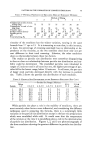
16 JOURNAL OF THE SOCIETY OF COSMETIC CHEMISTS of the sources listed did not determine saponification number, hence the ester number cannot be calculated. Had the hydroxyl number been deter- mined by Weitkamp (2) it probably would have given him a different con- ception of his original fatty acids and had iodine determinations on these fatty acids been carried out our knowledge of lanolin would probably be further advanced. .Although the data of Lower (12) is presented and discussed in this paper it is well to point out that the fatty acids, according to his 1947 publication contained 15ø-/o of unsaponifiable matter which we must assume to be al- cohols. From the manner in which the acids reported on by the other in- vestigators were treated, we feel safe in assuming that these contained no alcohols. In our own experiments th• fatty acids were tested and gave negative Liebermann Burchard reactions the absence of steroIs being taken as indicative of the absence of alcohols. It will be noted that various authors, particularly Bertram, report a sizable hydroxyl number indicating that their fatty acids contained con- siderable amounts of hydroxyacids. These are acids which contain a free hydroxyl group in the molecule in addition to the carboxyl group which is characteristic of acids. • The alpha hydroxyacids, to date the only type identified in lanolin, when under the influence of heat or of an acidic catalyst, convert by esterification into cyclic esters, or, by condensation into polyesters. The result of these reactions is to decrease the hydroxyl and acid numbers with a proportionate increase in the ester number. Although beta hydroxyacids have not been isolated, it is possible that these are present in the original lanolin. These are saturated acids which undergo dehydration to form unsaturated acids. Since we are dealing here with fatty acids which were treated with heat and acid, we now have to take the possible effects of this treatment into con- sideration in visualizing the original structure of the fatty acids. From the iodine number as shown in the last column of Table IV, it is evident that unsaturated acids are present. Truter (13) in 1951 estimated that these represent about 15ø-/o of the total fatty acids. We question whether unsaturated acids are present in the original fatty acids to the ex- tent of 15%. Our doubt on this point is due to our findings that the degree of unsaturation is readily affected by the treatment of the fatty acids. Fatty acid samples were prepared by us from the same fatty acid soap but under different conditions. The data on these acids are to be seen on the bottom two rows of Table IV. Separation of the first sample was carried out under the usual drastic conditions that is, acid treatment for an ex- tended period of time and a fairly high temperature. The preparation of the second sample on the bottom row differed only in that milder conditions were observed. In each case the reaction was carried to completion. Note

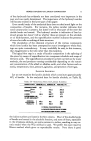
NEWER CONCEPTS OF LANOLIN COMPOSITION 17 that the iodine number of the second is lower than that of the first by what we consider to be a significant amount. This suggests the presence in the original material of beta hydroxyacids which were converted by the more drastic conditions to unsaturated acids. Also note that the second sample has significantly higher acid and hydroxyl numbers than the first, suggest- ing that milder conditions have resulted in less polyester and/or cyclic ester formation from alpha hydroxyacids. It shoul&-be made clear again that although an acid and an alcohol are generally required for esterification--in this instance we have only acids. The ambidextrous •ydroxyacid molecule contains both an alcoholic and an acidic group, and these groups are capable of reacting either with each other or with other acids. Thus, esters can be formed from acids alone. The ester number of our acids is probably due to esters formed in this manner. Assuming this to be the case, we can calculate the acid and hy- droxyl numbers of a lanolin fatty acid mixture in which these esters have been split back into hydroxyacids. If we correct the values for the mildly treated sample on the bottom row of the table in this manner, we obtain the following results the acid number increases to 178, the saponification number remains unchanged at 178, the ester number drops to 0, the cal- culated mean molecular weight as now corrected is 315, while the hydroxyl number rises to 87.3, and per cent hydroxyacids to 49. We have since been able to carry these experiments further by means of an extremely mild catalytic method which resulted in a product with acid and hydroxyl num- bers very close to these calculated values. In turning from the analytical data to the composition of the fatty acids we can use the outstanding work done by Weitkamp (2) in 1945 as a guide. Weitkamp formed the methyl esters of lanolin fatty acids, fractionated them by vacuum distillation, and succeeded in identifying a total of 32 acids. Table V summarizes his data and illustrates the four types of acids TABLE V--CoMPOSITION OF LANOLIN FA'r'r¾ AcIDs (fROM WEITKAMP) NUMBER OF ACIDS SERIES S1'ItUCTIIKiU. FORHULA PERCENT PRESENT c,r½,%.-c00,0=.,.,= c,,-c00,(..*.,) 08 CH• CH• DISTI•ATION LOSS -- 6.0 RESIDUE • 13.0 IO ISO II ANTEISO
Purchased for the exclusive use of nofirst nolast (unknown)
From: SCC Media Library & Resource Center (library.scconline.org)