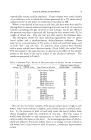
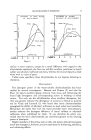
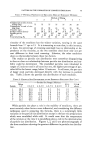
FACTORS ON THE FORMATION OF COSMETIC EMULSIONS 45 its rate of creaming and the amount of creaming and assuming that cream- ing is indicative of stability to some extent, we are able to recommend one method as preferable to others. At the end of 60 days, after being allowed to stand at room temperature without handling or agitation, the e .mulsions were redispersed and the physical properties were again measured. The changes in surface tension, specific gravity, and pH for all of the samples were not significant, varying only a fraction of a per cent if at all. More pronounced changes in viscosity were noticed, ranging from an increase of .9 cps to a decrease of 4.3 cps. The emulsions were then shaken up and rated according to the ease with which they were redispersed, and a panel of pharmacists was asked to evaluate each product on its general appear- ance. These ratings are all tabulated in Table 3, which gives an over-all picture of the emulsions studied. Of the emulsions prepared and studied, Product No. 2 seemed superior in most respects and, from the table, it can be seen that this emulsion rates the highest on all comparisons except particle size distribution and there it ranked second in our arbitrary classification. On the basis of these comparisons, therefore, the following general statements are proposed for consideration:

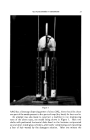
46 JOURNAL, OF THE SOCIETY OF COSMETIC CHEMISTS Fig. 3.--Photomicrograph of Emulsion No. 2 showing particle size distribution of emulsion having the greatest stability. TABLE 3--RATtNG oF EMULSIONS FROM PHYSICAL FACTORS Sample- . Factor I 2 3 4 5 6 7 Original viscosity 1 2 3 4 4 5 6 Viscosiky change after 60 days 7 1 6 3 5 4 2 Surface tension 2 1 7 2 3 5 4 Total creaming, % 3 1 5 2 6 4 3 Creaming rate 5 1 6 2 7 4 3 Particle size distribution,'0-3.9 microns 2 3 6 4 1 7 5 Particle size distribution, 0-5.9 microns 4 2 5 1 3 6 7 General appearance 4 1 4 3 2 6 5 Ease of redispersion 2 1 6 3 4 6 5 The number under each sample indicates its rating as compared with the other products. That is, the number 1 indicates the best rating, 2 the next best, etc. The method of preparation of an emulsion materially affects both its general appearance and viscosity, and the best method of preparation for o/w emulsions is that of pouring the aqueous phase into the oily phase with i'apid and continuous stirring. A stirring speed of 1200-1400 r.p.m. is rec- ommended. The temperature at the time of emulsification influences the viscosity of emulsions and thicker preparations are usually obtained by emulsifying while hot.
Purchased for the exclusive use of nofirst nolast (unknown)
From: SCC Media Library & Resource Center (library.scconline.org)