18 JOURNAL OF THE SOCIETY OF COSMETIC CHEMISTS he found in wool fat. Note particularly that he isolated and identified only two hydroxyacids which constituted 4.2% of his original acids. Weitkamp himself recognized that the great deficiency of the distillation method was the thermal instability of the methyl esters of hydroxyacids, and attributed a 6% loss during distillation to decomposition of these acids, If we add this 6% to the 4.2% found, the total, or 10.2%, is the content of. hydroxy acids we can deduce from his data. This is far below the percentage we obtained from extensive analysis of lanolin acids. The lack of hydroxyl number de- terminations in Weitkamp's data is indeed regrettable. Had he made this determination the degree of acid degradation would have been.:apparent. Turning again to the analytical data for fatty acids in Table IV, it should be pointed out that numerous analyses similar to those detailed on the two bottom rows of the table resulted in a 30 to 40 range for per cent hydroxy- acids. When corrected by the method previously described, which takes into account that acid esters were formed from hydroxyacids, this range be- comes 40 to 50% of the acids. Bertram's (1) extensive analytical data contains high values for hydroxyl number. The fatty acids derived from the American wool fat are pa,ticu- larly high in this respect. Calculating from his data it appears that 98.5% of the acids in the American and 60% of the acids in the Australian samples were hydroxyacids. The latter is fairly close to our corrected values. It is difficult, however, to evaluate Bertram's data completely because of his omission of saponification, ester, and iodine numbers. In 1953 Horn, Hougen, and yon Rudloff (14) actually isolated and identi- fied nearly 30% of hydroxyacids from the acidic fraction of lanolin. These authors used two different separation procedures including the Craig solvent distribution method which would not be expected to degrade hydroxyacids. The acids they identified were the normal hydroxy derivatives of lauric, myristic, palmitic, and stearic acids. FRV. E LANOLIN' ALCOHOLS Turning now to the free alcohols of lanolin, you will note that the bar graph (Fig. 1) represented the alcohols as a fairly small fraction of lanolin. The substantial hydroxyl number of lanolin has led many investigators to erroneous conclusions as to the pekcent of free alcohols present. Some ap- parently considered the hydroxyl number of lanolin to be due to the pres- ence of free alcohols. Even in 1947 Warth (6) in his book "The Chemistry and Technology of Waxes" listed 25% free alcohols as being present in neu- tral anhydrous wool fat. Since this is about the figure one would obtain after dividing the hydroxyl number of lanolin by the hydroxyl number of lanolin alcohols, it is possible that Warth used this line of reasoning. Deuel's (15) excellent book "Lipids, Volume I," published in 1951, also used the 25% figure acknowledging Warth as the source of his data.

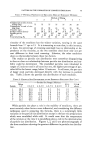
NEWER CONCEPTS OF LANOLIN COMPOSITION 19 TABLE VI--FKEg ALcoaors ov LANOLIN FREE TOTkLFREE OHNo, OFLANOLIN O#tlO. DUE TO FREE ALC CliOLESTEIIOL ALCOHOLS DUE TO FREE ALC. o# #o.oF• X I00 (CAte.) PERSONAL COMMUNICATION - 195• Recently reported direct determinations of the percentage of free choles- terol in lanolin yield the data presented on Table VI. It must be remem- bered that this determination is carried out by the digitonin gravimetric method, which is not specific for cholesterol since lanosterol, cholestanol, and related products will form insoluble digitonides (16). It is apparent from the table that the hydroxyl number which can be attributed to the free alcohols in lanolin is quite low. In the last column we have calculated the percentage of the total hydroxyl number of lanolin which is due to the hydroxyl number of the free alcohols. It will be noticed that even the high- est percentage listed taken from data of the Eastern Regional Research Laboratory (17) indicates that a minor percentage of the,hydroxyl number is due to free alcohols, and the greater part must be attributed to another type of compound, namely hydroxyesters. Hydroxyesters are those esters of acids and alcohols which have a free hydroxyl group in the molecule.. That they may be formed by various com- binations is obvious because of the established presence in lanolin of hy- droxyacids and of diols. In any event, all hydroxyesters have free hydroxyl groups which in these samples are responsible for 83% or more of the hy- droxyl number of lanolin. In terms of per cent composition of the last sample (in Table VI) this represents a maximum of 4% free alcohols, the balance, or 96%, being esters. It would now be proper to look further into the possible structure of the lanolin esters as found in nature. Based on the known variety of alcohols and acids, we can expect a great many combinations ranging from simple monoesters to diesters, cyclic esters, and possibly higher polymeric deriva- 'tires. However, the indications are that the lanolin esters are not random combinations or'the alcohols and acids. There is evidence in the data pre- sented here and in the work of Truter (13) and of Bertram (1) that a sub- stantial part of the lanolin esters are diesters of hydroxyacids. Indirect evidence for the presence of diesters in lanolin can be deduced from the 'relationship between the hydroxyl number of lanolin esters and the hydroxyl
Purchased for the exclusive use of nofirst nolast (unknown)
From: SCC Media Library & Resource Center (library.scconline.org)