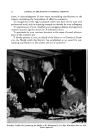
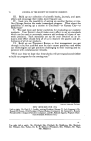
THE MEDALIST'S ADDRESS MR. PRv. smv.•r% MR. TOASTMASTER, Distinguished Eulogists, Members and Guests of the Society of Cosmetic Chemists, dear Friends, Ladies and Gentlemen: TRimswEs ,o o•rE's activity, no matter how laudatory have one dis- advantage they invariably refer to the length of this activity up to a particular climactic point, in this case the momentous occasion of the Medal Award. To this extent one may speak here of a "non-cosmetic" procedure, for the reason that a properly formulated cosmetic is intended to conceal rather than to accent the factor of time. At any rate you have learned tonight that my own activity in the cosmetic field began almost thirty years ago, dating back to a time when cosmetic chemistry, as we understand it today, was in its early infancy. During those years, it has been my earnest endeavor to contribute, within the framework of my association with Lehn and Fink, to a clarification and systematization of a somewhat disorganized assortment of empiricisms which characterized the art of cosmetics of those early days. Please note that I am referring to the "art" rather than to the "science" of cosmetics because I feel that even in view of the current misuse of the term "science," there was hardly any science being squandered on cosmetics in the early twenties. It is gratifying to realize in retrospect that chemists and pharmacists entering the cosmetic field at that time had an opportunity to do some pioneering work by way of directing the formulation of cosmetics into rational chan- nels, of laying the foundation for the standardization and the quality con- trol of both the initial materials and of the finished products, and of de- vising ways and means of promoting the wholesomeness, the safety, and the eflqcacy of cosmetic preparations. This is the place, also, to pay tribute to the pioneering spirit of the managements of those few cosmetic com- panies who were first to recognize the need of placing development, pro- duction, and quality control operations upon a scientific basis, and who in- vited bona fide scientific personnel to join them in this important under- taking. The SocIE,¾ oF CosMy. TIC C•v. mszs has now seen fit to present me with its most coveted gift, its Medal. It would be an understatement to say that I am completely overwhelmed by this act. While I am most grateful to those of the Sociv. T¾'s members who nominated me for this

66 JOURNAL OF THE SOCIETY OF COSMETIC CHEMISTS honor, I want to assure all of you that I consider myself quite unworthy of it. However, since one cannot very well take issue with a fait accompli let me say, in all sincerity, that in accepting the medal I want it to be understood that I am sharing this honor with my former co-workers at the Lehn and Fink laboratories. Most of those with whom I have been associated during the greater part of my connection with the Company's research and development activities are still there. It is my sincere hope and wish that this moment may reawaken their awareness of a long period of fruitful accomplishment accruing to the benefit c•f their Company and to the prestige of the cosmetic industry. With your very kind permission I would like to mention these friends and co-workers here by name: in the chemical division, Lou Gates, Phil Cox, Jon Wolters, Fred Taylor, Jerry Compeau, Ed Tilly and Leo Forim in the bacteriological labora- tory, Mrs. Eleanor Wright and Dr. Shternov. On the administrative level I have been aided and abetted most effectively by Lillian Sippach and there is a very special niche in my heart for Moritz Dirtmar. I salute them here one and all. A cosmetic chemist cannot expect to operate successfully in the splendid isolation of the laboratory. He needs and he benefits by the guidance of those in the sales, advertising and publicity fields who are in the logical position of feeling the pulse of the market, its demands and its trends. In turn the experts in these latter fields frequently seek the chemist's help in laying down ideas from which develop eventually the all-important sales appeals designed to draw the ultimate consumer's attention to the product. It would be impossible for me to name all those in the fields named with whom I have had the good fortune to collaborate both within the Company and outside of it, over a period of years. However, I assure you that I remember gratefully all these men and women whose intelligent and con- structive approach to problems of mutual interest has been to me a source of constant and deep satisfaction. And last but not least, I want to pay my sincere tribute to the captain of the team, Lehn and Fink's president Dr. Edward Plaut whose foresight, wisdom and determination I never ceased to admire over the years of my association with the Company. To the extent that all these good people have inspired me to do the things for which you are honoring me tonight, I want them to feel that the honor is theirs, too. • The rules of the Medal Award require the Medalist to present a paper upon a subject relevant to the interests of this Society so I am compelled to ask your kind indulgence while I am discharging this obligation. I have always been intrigued in the borderline contacts between cosmetics and other specialties such as dermatology, endocrinology, bacteriology, and others. This is why in the following paper I propose to illustrate some of these contacts, thereby hoping to persuade the respective specialists to
Purchased for the exclusive use of nofirst nolast (unknown)
From: SCC Media Library & Resource Center (library.scconline.org)