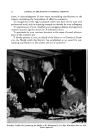
EMIL G. KLARMANN, THE MAN 55 until I met him on the pier in Hoboken, N.J., in the summer of 1924 when he arrived in this country." Having received his Engineer's degree at the age of twenty-one, and his Doctor's degree at twenty-three, he continued his academic work at the Physiological Institute of the University of Halle a.S. under the famous protein chemist, Emil Abderbalden, a disciple of the great Emil Fischer. He was now an old man of less than twenty-three years. A remarkable feat of learning. By this time he had published several learned scientific articles with Abderhalden. In 1924 he came to the United States to continue his biochemical studies at the Rockefeller Institute. Through a coincidence, he learned about a position at Lehn and Fink, then essentially a pharmaceutical manufacturer. If my data are correct he applied for the position and was hired by the elder Gesell, then plant manager. One senses that Emil took the job with perhaps a bit of reservation. After all, had he not come to the United States to continue his studies and academic career? This was industrial work, not exactly a debasement but definitely an adulteration of his original plans. But fate had spun his cloth and the pattern was set. Emil was to be with Lehn and Fink from that day forward. Starting as a research chemist in 1924 he became Chief Chemist in 1926 and eventually vice-president in charge of research. In July of this year he was promoted to vice-president in charge of technical services to handle the ever expanding line of professional products made by Lehn and Fink. It was shortly after 1924 that his regular morning greeting to his secre- tary, was "das Leben ist kein Schleck"--"Life is not a bowl of cherries." But life was to become a bowl of cherries even though it took a while to gather them in truth it took eleven years. Then one day, returning from an archeological trip to Yucatan (where he studied the old Maya temples) fate threw into Emil's path a girl who was returning from a six-week whoopee cruise. At this point, both Emil and Alvine are hush-hush on the developments. And to me it is very confusing. For on the one hand you have a very cultured Austrian student of the arts and sciences. On the other hand you have a problem child who at first chance "flew the coop" as she has admitted--a product of "la belle France"--doing exceptionally well at the time as a toilet goods supervisor and efficiency expert. Can you imagine two opposite phases more difficult to emulsify? I can't. But then none of us can truly evaluate the universal emulsifier LOVE, until we come in contact with it. So it was here. The opposites met and Daniel Cupid took over. Even- tually the wedding bells chimed and a darn good efficiency expert was taken out of circulation. Interestingly enough his secretary of almost thirty years recalls that

56 JOURNAL OF THE SOCIETY OF COSMETIC CHEMISTS after the wedding there was no more of the "das Leben ist kein Schleck." Life was now interesting and with a new happiness. Associates and friends say a great change came over Emil. All at once he became mel- lowed. Where formerly he occasionally gave his less gifted friends short shrift, he now became patient with their shortcomings. He was now anxious to assist all with whom he came in contact. Yes indeed, there came a great change in this man and the change was brought about by a petite French blonde who addresses him as "Chou-Chou." To get particulars about Emil's personal life is like pulling hen's teeth. Worse, he seems to have all his intimate friends and associates absolutely in cahoots with him. You ask them for an anecdote about this man--Emil Klarmann, and they hand you a typewritten statement which has as much meat in it as the stew at a 42nd Street cafeteria. But by talking with them I was able to get a few tasty morsels of gossip which I just can't wait to pass along to you. This sedate scholar had a pretty good voice, and at least two other associates, Moritz Dittmar and Hugo Laschinger, also had properly pitched voices to work out harmonies. Knowing Emil's profound taste in the field of music, I assumed they did operatic choral selections and the like. But no, no indeed. Their specialty was student songs as they are loosely called in Europe. In fact there is one I'd like to know more about myself that discusses "a crocodile that swam in the Danube," sung best in the original German. There was also a Christmas party at the plant one year. The mood was gay. Emil was sitting before a bowl of soup. As he was looking at it to determine the proportions of Vegetable, Meat, Water--kersplash--a hard roll from across the room landed right in the middle of the bowl. His tie and vest were ruined. While his disciplined restraint was sorely tried, it withstood the test. Yes, here is a man of bold decisions. He delights in toil. He thinks much, perhaps even broods on himself, but not for himself. A fiery thinker, he can throw a hail of words in shrewd, yet charitable comment. His is the authority of long experience in thoroughness. His mind uniquely combines idealistic turbulence with clarity of expression, and rhapsodic ambition with practical capacity. Music Like the great Bach who also started with the violin, Emil put aside the instrument under the pressure of mounting responsibilities to devote more time to his work. In its place he turned to passive enjoyment of music through the medium of recordings. It must have been a heavy personal letdown, for starting back, actually in his childhood, he had entertained at concerts of the conservatory, and his fellow officer candidates in the army,
Purchased for the exclusive use of nofirst nolast (unknown)
From: SCC Media Library & Resource Center (library.scconline.org)