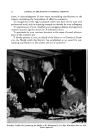
EMIL G. KLARMANN, THE MAN By M. G. DENAvAR. R.E IT ISN'T OFTEN that the contemporary scene is so enriched as tonight. For not only do we have the Medalist whose life is as modulated as a Bach fugue, but we also have in this audience men and women who with him form the high command of his daily labors, his only brother, his vivacious wife, and many scientific friends and adversaries. All these are here to share in the happiness and solemnity of this occasion. Though mindful of my duty to these fine people, I warn you that I shall be the gossiplest babbler where necessary, and shall try to be the most elo- quent orator when discussing our Medalist's virtues. To get unusual vignettes about Emil, I wrote a number of his scientific friends of long acquaintance and his fellow workers. Further, I had the opportunity to talk to some of them. Oddly enough, there was so much agreement among them on all basic facts that one suspected collusion. Well, then what is distinctive of the man or as Rabelais put it, "le propre de l'homme." Graceless hack that I am, let me give you the quintessence of the character of this inexhaustibly fertile genius. Emil Klarmann is a dignified scholar, a cultured European gentleman retaining all of its fine traditions, and a scientist of eminence. He is un- tarnished by years of contact with our Yankee rough and tumble living. Dor•'t mistake him for a "softie." Those who have tangled with him in professional debate have found him as tough as a 75-cent filet. For Emil is sure of his facts and he has them always at hand. His presence anywhere is like a touch of Tyrolian freshness, light and lovely. His Germanic earnestness and sincerity have won him many friends. His modesty and humility are almost a fault. Yes, and beside all this and perhaps more deeply ingrained than any- thing, our Medalist is a musician, a violinist, a fiddler. Seriously, his brother has written that, "he was, and probably could still be, a great violinist." I have never heard him play, but many here tonight have heard him. Born in the land of Baroque, he was naturally endowed from the treasure chest of European culture, Austria. The Klarmanns had two children, both boys, Emil and Adolph. Very little can be learned of Emil's youth. He started his music schedule at the

54 JOURNAL OF THE SOCIETY OF COSMETIC CHEMISTS age of five years and never let up until late in his professional life. Ac- cording to his brother, he was a "good boy," always reliable. In fact his brother wrote, "I remember Mother mentioning brother's sitting between two glass windows, an early proof of his remarkable self control." He went from grade school to a classical Gymnasium, then to the Technological Institute of Bruenn, an M.I.T. of Europe in those days, and eventually to the University of Halle a.S. in Germany. He had many fine friends in Europe, one of whom now lives in a com- munity near Emil. This gentleman, Julius A. Szilard, writes as follows: "I spent two years at the Institute of Bruenn. There I met Milo (our nickname for Emil Klarmann) in the Fall of 1920. He was then starting his third year at the Institute and was already working as an assistant to Professor Frenzel in the Department of Physical Chemistry. Milo was a serious boy, a model student, but at the same time he was interested in other things beside chemistry. He loved music and litera- ture. He was a good violin player. We used to go to concerts and to the opera. One season, our last year in school, we had heard Wagner's 'Tristan und Isolde' about half a dozen times. Students could buy inexpensive tickets that did not cost more than a cup of coffee and a roll in the coffeehouses frequented by the students. These seats were on the two sides of the top gallery from where you could see only half of the stage. By sitting on alternate sides we could see both halves of the stage in two successive performances. But the stage was not im- portant for Milo the music was the thing. "There are two little stories which may be of interest to you. Milo was a most conscientious student but on one nice sunny winter day, when the hills around Bruenn were full of snow, we could not resist the tempta- tion they inspired. Milo got a toboggan and with another friend of ours (who is now in Melbourne, Australia) we went tobogganing to Schreibwald. Schreibwald was to Bruenn what Van Cortland Park was to New York City over thirty years ago. We had a marveJous time until we returned to the city on the trolley. Milo was carrying the toboggan on his back, standing on the steps of the trolley. As we came to the center of the town a bunch of our fellow students spotted Milo and the toboggan. The boys were amazed to see him playing hooky but they rose to the occasion quickly, and among wild warwhoops pulled him, his toboggan, and his two embarrased friends from the trolley car. Thus ended the only day when Milo played hooky from academic duties, at least to the best of my knowledge. "The other story about Milo has to do with predestination. As men- tioned before, he worked at the Department of Physical Chemistry on the vapor pressures of ammonium salts in aqueous solution, and published a paper on this subject with Professor Frenzel. At the same time he showed the practical nature of his mind by developing a method to re- move surplus hair by means of an electro-chemical process. I believe such depilatory methods have been used since then, but Milo's process was the first of which I knew, and I think it shows predestination. His talents were to serve the cosmetic industry. "We graduated in June, 1922, and I did not see Milo for two years
Purchased for the exclusive use of nofirst nolast (unknown)
From: SCC Media Library & Resource Center (library.scconline.org)