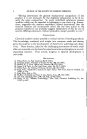
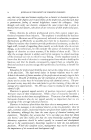
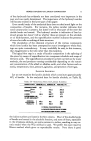
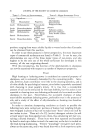
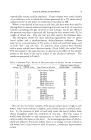
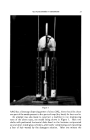
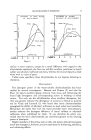
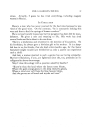
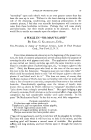
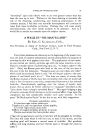
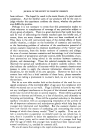
ALKYLOLAMIDES IN SHAMPOOS 35 OSTWALD SAY BOLT BUBBLE BALL MOBILOMETER Figure 2 $TORMER cases, this being an average concentration for commercial shampoos. One can see viscosities rise as the proportion of alkylolamide increases, passing through a peak when approximately a half to two-thirds of the blend consists of the alkylolamide. The amine alkylaryl sulfonate appears to thicken more readily than the amine lauryl sulfate. As a rule, however, sodium lauryl sulfates are even easier to thicken. In order to obtain moderate viscosities at least one-quarter of the blend should be alkylolamide, but perfumes and other additives may in- fluence the final viscosity. It should be noted that the alkylolamide used for thickening the anionic detergents ne•d not necessarily be water soluble, so long as it can dissolve or be solubilized in the anionic solution. As a matter of fact, the less water- soluble types tend to be more effective thickeners in many cases, as for example Ninol 201. In some cases the alkylolamide can even produce stiff pastes rather than viscous liquids, as w•hen certain stearic amides are added to lauryl sulfate or alkyl aryl sulfonate solutions. This effect can, of course, be utilized in formulating all-synthetic paste or cream shampoos without using the con- ventional sodium stearate soaps as thickeners.

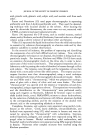
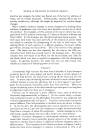
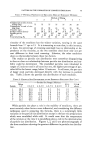
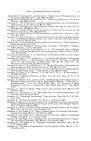
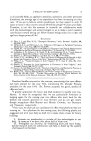
36 JOURNAL OF THE SOCIETY OF COSMETIC CHEMISTS BROOKFIELD VISCOSIMETER Figure 3 VISCOSITY OF ALKYLOLAMIDoe-WAToeR SYSTEMS 'ooo I I NINOL CONCENTRATION, •/o 0 20 40 60 80 100 Figure d• OPACITY Although clear soap or synthetic shampoos have long been the most popular type, the so-called liquid cream shampoos are gaining an increasing share of the market. These products are based mostly on lauryl sulfates (although alkylaryl sulfonates are also used) with an opacifier added, depending on whether a "flat" or pearly appearance is desired. Stearic acid, magnesium stearate, glyceryl stearates, and cetyl alcohol have all been used in this connection, but suffer from various drawbacks. Some are difficult to incorporate without separation, some are foam depressers, most do not give a uniform degree of pearl that can be readily controlled from batch to batch. A number of alkylolamides also show interesting opacifying properties, although this effect does not lend itself readily to quantitative study. It is to be expected that pearliness would be caused by the presence of elongated particles or agglomerates exhibiting optical effects related to flow birefringence, i.e., a change in reflectance when rod-sl•aped particles move through water for example, the silky appearance when a mercurous chloride precipitate is stirred. Although stearates as a class tend to show this effect, the conditions for high pearliness are apparently rather critical, and are probably connected with the type of colloidal aggregation taking place in different systems. Hydroxystearic compounds, for instance, do not pearl as much as stearates in many cases. This is also illustrated by two stearic alkylolamides called Ninol CB60 and Ninol CB10. Although these two opacifiers are quite
Purchased for the exclusive use of nofirst nolast (unknown)
From: SCC Media Library & Resource Center (library.scconline.org)