A METHOD FOR THE SEMIQUANTITATIVE ANALYSIS OF LIPSTICK* By HAZEL BISHOP Haze/Bishop Laboratory, New York 22, N.Y. "P•,oo•,Ess IS OUR most important product." This is the motto of the General Electric Company and must be that of every industry which expects to survive. Progress in product development, to be significant, must be accompanied by adequate methods of analyzing the new product, A search of the literature discloses a paucity of published articles on the sub- ject of cosmetic analysis in general and lipstick analysis in particular. Normally such a dearth of reference material indicates stagnancy in prod- uct development. In the field of cosmetic chemistry, the lack of published information on lipstick analysis probably has several explanations. First, the aura of secrecy surrounding the formulation of all cosmetics discourages even the most inconsequential scientific disclosures. Second, until the advent of non-smear type lipstick, market emphasis had been primarily on color, a factor which made it unnecessary to improve the base. Third, the dominance of the private labder over lipstick formulation and manufacture has humbed the interest of the distributor in lipstick im- provement. Fourth, a new product imposes serious marketing problems which many merchandisers are hesitant to undertake. Indeed, the new lipstick must become a competitor to the old one. Motivated by their recognition of the need for more published literature on analysis, the French Society of Cosmetic Chemists held a conference at the end of 1951 which they devoted to this subject. The principal papers delivered at the time have been published in La Parfumerie Modeme. In the article entitled, "L'Analyse Cosmetique," (1, 2) its author, Vdon, regarded the purpose of analysis as threefold. First, that designed to control the quality of the raw materials second, that designed to control the uniformity of the finished product and, third, that designed to disclose the formulation of products of unknown composi- * Presented at the December 10, 1953, Meeting, New York City. 2

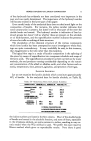
SEMIQUANTITATIVE ANALYSIS OF LIPSTICK 3 tion. This paper will deal only with the analysis of lipstick and will further be confined to the still narrower field of lipstick whose composi- tion is unknown. The extensiveness of the information sought should determine the com- prehensiveness of the analysis. Mere physical inspection will yield clues regarding its probable composition. These clues include a rough estimation of the pigment content, the presence or absence of a powerful dye solvent, high or low wax content, and possibly the type of oil vehicle. When such information is not enough, it is necessary to resort to a chemical analysis, unless one agrees with Hoshall (3) who said, "It is usually much less difiq- cult to duplicate a lipstick of unknown composition by trial and error com- pounding than by the development of a formula after a diMcult chemical analysis." A precise quantitative analysis is impractical. As V•lon has stated, it is nearly impossible to separate the individual components, but one can separate the unknown into fractions and make deductions from tests ap- plied to these fractions. The analysis, suggested by V•lon, is shown sche- matically in Figure 1. V•lon Analysis* Bromo Acids Sample , Petroleum benzine _ Ethyl Alcohol SolubleS' (presumably contains the castor oil) Petroleum Benzine Soluble (presumably represents total base) I C2H•OH * I Ethyl Alcohol Insoluble * Arranged diagrammatically by the author. •' Zweig and Taub used extraction with ethyl alcohol as initial step in their procedure for the separation of waxes. Figure 1. In his analysis, the sample is extracted with petroleum benzine, thereby separating it into bromo acids and base. The waxes in the base are de- termined by the Zweig and Taub (4) method. The castor oil is extracted with benzene, presumably from the alcohol soluble fraction, and determined by acetylation method. It is difiqcult to understand why not only V•lon but Hoshall also used petroleum ether as the initial solvent. As you well know, true waxes, such as carnauba and beeswax are not completely soluble in petroleum ether, nor is castor oil. Perhaps the most conspicuous inade-
Purchased for the exclusive use of nofirst nolast (unknown)
From: SCC Media Library & Resource Center (library.scconline.org)