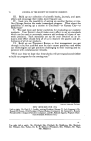
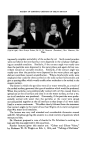
78 JOURNAL OF THE SOCIETY OF COSMETIC CHEMISTS by J. Pickthall on Mar. 5, 1954. Both were held at the Royal Society of Tropical Medicine and Hygiene, 26 Portland Place, London, W.1. at 7 p.m. CHICAGO SECTION NEWS T.E GUES* SPEAKER for the January 12th meeting was Dr. George H. Goodyear, Midwest District Sales Manager of the Glyco Products Com- pany. He spoke on "Use of Chelating and Sequestering Agents in Cosmet- ics." The paper on which his talk was based was written by Dr. Goodyear and Buckley Hathorne, also of the Glyco Products Company. Both men have had extensive experience with sequestering agents, not only in cosmetics but in other industries as well. Dr. Herbert Heinrich, Research Director of the Kolmar Laboratories, Milwaukee, Wis., spoke at the February 9th meeting on "The Future of the Cosmetic Industry." At the March 9th meeting Lester I. Conrad, Technical Director of the American Cholesterol Products, Inc., of Milltown, N.J., was the guest speaker. His subject was "Newer Concepts of Lanolin Composition." Mr. Conrad has done intensive research on the subject and has to his credit several patents on the processing of sterol products and lanolin. He has also written several articles on the applications of sterols to various in- dustries. All the meetings are held at Henrici's Restaurant in the Merchandise Mart.

BOOK REVIEWS LIVID METABOLISM, A Biochemical Society Symposium No. 9, edited by R. T. Williams. The Cambridge University Press, New York 22, N.Y., 1952. 102 pages, illustrated, no index. Price $2.75. Seven contributors cover quite a variety of phases of livid metabolism. The layout and style are a trifle different, and at first a bit confusing. While all the addresses in this symposium are interesting and care- fully prepared, those by Lehninger on the enzymic oxidation of fatty acid and Sinclair on the essential fatty acids and their relation to pyridoxine were found to be espe- cially pertinent by this reviewer. Since certain phases of livid metabolism have cosmetic signifi- cance, researchers will find this book to be a useful reference.--M. G. DEN. THE HAIR AND SCALP, by Agnes Savill. Fourth Edition, The Wil- liams & Wilkins Co., Baltimore 2, Md., 1952. 316 pages, 51/2 X 81/2 inches, illustrated and indexed. Price $5.00. Among some new material is that on cold waving, influence of vita- mins and endocrines, with thorough revision of some of the other ma- terial. The author makes a point of hav- ing most of the published material on the pros and cons of cold waving. There is a question in this reviewer's mind if Speakman is in fact the first cold wave inventor and partic- ularly in connection with the use of 79 thioglycolates, as the author men- tions. This chapter has two new references but no other new mate- rial, though much has been done smce 1945. The very excellent articles on permanent waving, cold method, which have appeared in the Pro- ceedings of the Scientific Section of the Toilet Goods Association and in the JOUkNAL or THE SOCIETY OF COSMETIC CHEMISTS have appar- ently escaped both the author and her Yankee contemporary, Dr. H. Montgomery. On page 63 it is stated that the bromate solution resembles milk-- it may or may not. One also questions the cosmetic value of Dr. Savill's setting lotions. Then as a final blow on this sub- ject, the author fails to appreciate the potential for harm in her sug- gestion for straightening hair on page 64. It is regretted that Professor Ast- bury is unaware of good work (such as that of Pauling) other than that seemingly done by himself and co- workers at Leeds. The question of the numbers and diameter of hairs needs more recent work than that of Wilson and Stel- wagon. The portions dealing with vitamin and endocrine factors are good. Case histories of oily scalps treated with vaccines are interesting. Haw- ever, there is no mention of selenium sulfide in the treatment of sebor- rhoeic dermatitis. The "Hair Dyes" chapter while good could stand an overhaul.
Purchased for the exclusive use of nofirst nolast (unknown)
From: SCC Media Library & Resource Center (library.scconline.org)