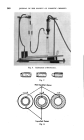
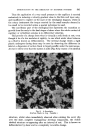
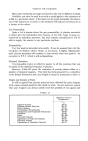
POLYVINYL CHLORIDE AS A PACKAGING MATERIAL •7 Strength, Extensibility and Flexibility The breaking strength and extensibility are normally measured by a device similar to that used for textile fibres. The breaking strength is not, in itself, a very useful measurement, bat extensibility measurements at different temperatures give an indication of the behaviour of a sheeting materiM at various temperatures. This informatio• can have considerable value in the determination of the dimensional distortions that may occur if the printing, filling and welding operations are conducted at different atmospheric temperatures. Impact strength may be measured by any suitable ballistic method. The thickness of sheet P.V.C. used for cosmetic packaging is usually too thick for a fMling ball method, something heavier being required, such as a heavy pendulum. The pendulum is dropped from a series of different heights and the angle of arc needed to break the test sample foun. It will be found that the impact strength of P.V.C. sheet samples varies with temperature, and this information can be very useful in helping to select a suitable polymer, as a major fault of P.V.C. is the readiness with which it becomes brittle at low temperatures. Changes of plasticise• will give rise to differing behaviour at low temperature and a careful selection of plasticiser can often give a sheet with the desired resistance to low temperature, without at the same time being too soft at normM temperatures. Tearing strength is of little importance as the usual thickness of P.V.C. sheeting used has sufficient tearing strength to overcome any practical needs. Refractive Index The refractive index of P.V.C. sheet can be measured by Becke's method,* which depends upon microscopicM examination of the edge of a piece of sheet material immersed in liquids of different refractive index. Care must, however, be taken to choose liquids which do not have the effect of leaching out any of the plasticisers used in the sheet. The measurement of refractive index is not of much general use, but if measured at different temperatures it can give an indication of any molecular rearrangement in the polymer structure as indicated by a break in the refractive index/temperature curve. Any such molecular rearrangement will probably be accompanied by a change in physical properties in the sheet such as a change from flexibility to brittleness. Permeability Probably the most important characteristic of P.V.C. sheeting is its selective permeability. It is permeable to gases, many yapours, some liquids, but not solids. When a solid cosmetic materiM is being packed in P.V.C.,

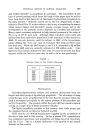
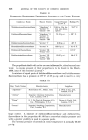
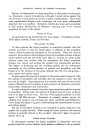
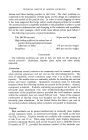
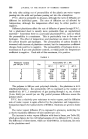
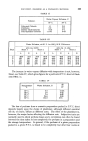
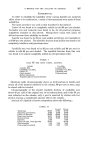
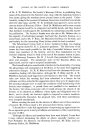
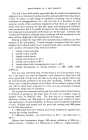
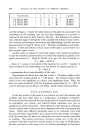
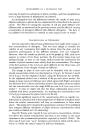
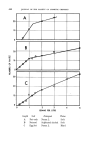
388 JOURNAL OF THE SOCIETY OF COSMETIC CHEMISTS the only risks arising oat of permeability of the plastic are water vapour passing into the solid and perfume passing out into the atmosphere. P.V.C. sheet is permeable to all gases, although the rates of diffusion are different for individual gases. The rates of diffusion are all affected by temperature, although the temperature effect may be either positive or negative. Different plasticisers affect the rate of diffusion of gases through P.V.C., but a plasticised sheet is usually more permeable than an unplasticised material.' Sometimes there is a particular plasticiser/P.V.C. ratio at which the permeability is a maximum. This is particularly true in the case of hydrogen. The effect of temperature and plasticiser are shown in Table I,' for carbon dioxide and hydrogen. The permeability of carbon dioxide is increased with increase of plasticiser content, but the temperature coefficient changes from positive to negative. The permeability of hydrogen shows a maximum at 5 per cent plasticiser content, at which point the temperature coefficient is negative. Each side of this maximum, it is positive. TABLE I Plasticiser content Permeability (P X 109) per 100 pts. P.V.C. Gas. 20 ø C. 30 ø C. 40 ø C. --, __ 0 CO 2 0' 096 0' 102 0' 109 5 CO2 4'00 3'85 3'70 20 CO• 140'0 130'0 ll8'0 0 H• 0'32 0'36 0'40 5 H• 12'20 11'30 10'80 20 H• 8'50 8'60 8'80 The polymer is 100 per cent polyvinyl chloride the plasticiser is di-2- ethylhexylphthalate the permeability (P) is expressed as the number of standard ccs. (0 ø C., 1 atmosphere) of gas passing through 1 sq. cm. of sheet (1 cm. thick) per second per cm. Hg. partial pressure difference across the polymer sheet. P.V.C. has a relatively poor resistance to water vapour, and the diffusion rate of water vapour is again affected by the plasticiser and temperatree. Comparison figures for typical sheets of 0.010 in. thickness are given in Table II. The water vapour diffusion (P) is expressed in grams/sq. metre/day for a relative humidity difference of one hundred per cent. The increase in water vapour diffusion with time is linear, see Table III, which gives figures for two individual samples of two different P.V.C. sheets. The difference of these sheets, which are both 0.010 in. in thickness, lies only in the plasticiser used.
Purchased for the exclusive use of nofirst nolast (unknown)
From: SCC Media Library & Resource Center (library.scconline.org)