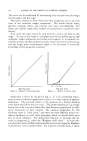
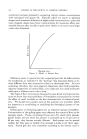
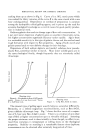
RHEOLOGICAL REVIEW FOR COSMETIC CHEMISTS 315 able accuracy. The Bentone gel is also unaffected by temperature varia- tions, which we would like you to keep in mind when you formulate a face cream for use in cold climates. In your everyday formulating work, we should like to suggest, in closing, a few points which might be useful: 1. When such factors as yield point, extent of thixotropy and changes in body during package aging are in question, the use of a good multi-point method to determine what flow properties you actually have in hand is the most reliable means of collecting fundamental data. We hope it is clear that a measurement taken at a single point, such as at one rate of shear, has ,extremely limited value, even for control purposes. 2. Knowing something of the rheology of the individual components of your formulations should be very helpful. The combining of the flow types we have discussed is often exactly what you are doing to reach an estheti- ,cally pleasing product. 3. Keep a close check on the powerful modifiers in emulsions, pastes and dispersions. Surface active agents, dispersing agents and gelling agents should be checked to determine the relationship between the concentration of the agent and its effect on flow properties. 4. Where systems are pigmented, you can modify the theology effec- tively by changes in the shape, size and specific surface of the particle. Sometimes a different grade of titanium dioxide, iron oxide, talc or whiting may produce exactly the effect you need. REFERENCES (1) Cajori, F., "Sir Isaac Newton's Mathematical Principles of Natural Philosophy and His System of the World," Berkeley, The University of California Press (1947). .(2) Houwink, R., "Elasticity, Plasticity, and Structure of Matter," Cambridge, Cambridge University Press (1940). (3) Green, H., "Industrial Rheology and Rheological Structures," New York, John Wiley & Sons, Inc. (1949). (4) Fischer, E. K., "Colloidal Dispersions," New York, John Wiley and Sons, Inc. (1950). (5) Freundlich, J., 5 t. Soc. Chem. Ind., 5:3, 223T (1934).

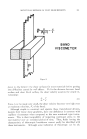
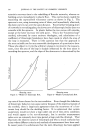
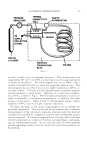
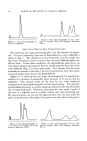
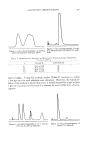
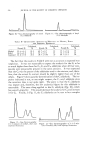
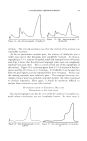
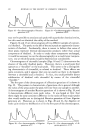
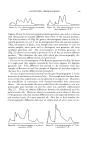
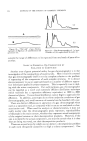
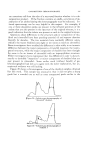
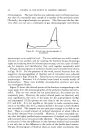
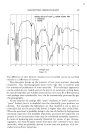
GAS-PARTITION CHROMATOGRAPHY. APPLICATIONS TO ESSENTIAL OILS AND OTHER VOLATILE MATERIALS* By C. L. TEITELBAUM Battelle Memorial [ns/i/u/e, Columbus Z, Ohio THE?,E HAVE BEEN a number of papers on the basic principles of gas- partition chromatography. The purpose of this paper is to discuss the application of. gas chromatography to analysis and research on essential oils and aromatic chemicals as well as other volatile materials. Figure 1 illustrates the basic principles and operation of a gas chromato- graph. It shows the essential parts: a cylinder of helium with a pressure regulator and flow meter sample introduction system, generally with flash heater and a column itself which is in many cases coiled or U-shaped, and is packed with a carefully chosen adsorbent material. Finally there is a detector cell, which is in two parts the reference cell through which the helium passes first, and the actual sensing part of the cell through which the product and the helium finally pass. Basically, there are two ways that the gas chromatograph can be used. It can be used primarily to obtain the chromatogram as a record for quali- tative and/or quantitative purposes. It can also serve as a means of ob- taining samples of various components of mixtures, with the chromatogram as a guide to the operation of the sample-collection system. Examples of chromatograms are discussed in conjunction with Figs. 2 and 3. A gas chromatogram of a sample of octyl aldehyde is shown in Fig. :2. This and the other chromatograms shown later have been changed so that they read from left to right, although, normally, recording machines will record from right to left. The first pip is the air peak then there are two very small peaks, and finally the very large octyl aldehyde peak. This, plus the shape of the major peak, is a good sign that we have quite pure octyl aidehyde. Since the octyl aldehyde peak is so smooth, any other purity would have to be extremely close to octyl aldehyde in retention time in order for its peak to be "hidden " the chances for this are very slim. Figure 3 shows an example of a good separation of a mixture of corn- * Presented at the December 13, 1956, Meeting, New York City. 316
Purchased for the exclusive use of nofirst nolast (unknown)
From: SCC Media Library & Resource Center (library.scconline.org)