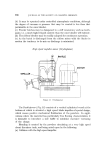
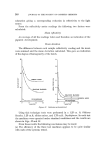
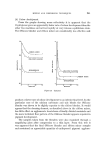
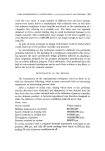
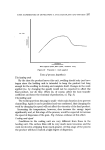
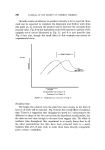
ESTIMATION OF HEXACHLOROPHANE IN COSMETIC PRODUCTS 223 Appendix DETERMINATION OF HEXACHLOROPHANE BY DIFFERENTIAL ABSORPTION Principle Hexachlorophane in solution at pH 3 (unionised) has a lower extinction value than at pH 8 {ionised), whereas the spectra of most other constituents of the toilet preparation are unchanged. Tlxe hexachlorophane content is determined by measuring the difference in extinction which has a maximum at 312 nm. Reagents pH 8 buffer: Dissolve 6.07gtris-(lxydroxy-methyl) aminomethane (2 amino 2-(hydroxy-methyl) propane -1:3-diol) in 900 ml methanol. Add 50 ml 0.SN hydrochloric and make up to 1 1 with distilled water. Nix thoroughly. ptt 1.4 buffer: Add 18 ml glacial acetic acid and 40 ml N hydrochloric acid to 900 ml methanol. Dilute to 1 1 with distilled water and mix thoroughly. Preparation of samples Soap: Accurately weigh about 2g of soap into a 100 ml volumetric flask. Add 10 ml water and warm gently on a water bath until dispersed (1 ml of pH 8 buffer may,be added if necessary to prevent excessive foaming). Dilute to 100 ml with pH 8 buffer keeping the solution at 30-35øC. Dilute one 10 ml aliquot to 50 ml with pH 8 buffer and a second 10 ml aliquot to 50 ml with pH 1.4 buffer keeping the temperature between 30 and 35øC. The solutions at this dilution should be clear and will not gel for at least 1 hr even if cooled to room temperature. Proceed with spectrophotometric determination as soon as possible. Talc: Accurately weigh about 2g of talcum powder into a No. 3 porosity, sintered glass crucible or funnel. Extract the powder with 5 successive portions of 20 ml chloroform, draw each extract through the sinter with gentle suction and collect the combined extracts in a Buchner flask. Transfer to a beaker and remove the chloroform on a steam bath, taking care to avoid volatilisation of the bisphenol. This is best achieved by evaporating almost to dryness, then removing the beaker from the bath and finishing the evaporation using a jet of compressed air. Dissolve the residue in pH 8 buffer and dilute to 100 mi. Dilute one 10 ml aliquot to 50ml with pH 8 buffer and a second 10 ml aliquot to 50 ml with pH 1.4 buffer. Proceed with the spectrophotometric determination. Alcoholic solution: Pipette 10 ml of the alcoholic solution into a 100 ml graduated flask and dilute to volume with pH 8 buffer. Dilute one 10 ml aliquot to 50 ml with pH 8 buffer and a second 10 ml aliquot to 50 ml with pH 1.4 buffer. If a w/w result is required, determine the density of the original solution or weigh a 10 ml aliquot. Spectrophotometric determination Place the solution made up with pH 1.4 buffer in the reference beam and the solution made up with pH 8 buffer in the sample beam. Read the optical density over the range 290-340 nm {33,480-29,410 cm-1). The maximum absorption is at approximately 312 nm (32,050 cm-1) and the E•/r•value at this wavelength is 144. It is advisable to check the E •% value and the wavelength for maximum absorption lcm using a sample of pure hexachlorophane. Calculate the percentage hexachlorophane from the observed reading.

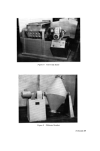
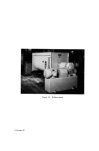
J. Soc. Cosmetic Chemists 19 225-243 (1968) ¸ 1968 Society of Cosmetic Chemists of Great Britain Mixing and dispersion techniques R. G. BAINES and G. COPE* Presented at the Symposium on "Processing and Manu- facturing", organised by the Society of Cosmetic Chemists of Great Britain, at Leamington, Warwicks. on 13th November 1967. Synopsis---The paper is, in the main, a descriptive discourse on various mixing and dispersing processes and is based on work and experience in the field of processing equipment in a wide range of industries. Due to almost limitless variation of products used in cosmetic manufacture specific applications are not, in general, particularised but it is hoped that the information will stimulate thought on appropriate and efficient equipment usage in this constantly developing industry. The comparative simplicity of the mixing of liquid/liquid systems is discussed, and techniques for liquid/solid dissolution and liquid/solid dispersions of various viscosities are outlined. The final section of the paper details basic methods of dry powder mixing and gives comparative experimental data obtained with tumbling type, ribbon blade and high speed impellot mixers. LI•)UID-LI•)UID MIXER Throughout the normal viscosity ranges liquid-liquid systems present no difficulties in producing a satisfactory blend of the various ingredients, and a vast range of simple equipment can be utilised. Basically all that is necessary is to induce movement or flow such that the various components move relative to each other. Probably the simplest form of mixer is a plain cylindrical container which is rotated either about its longitudinal axis or, more efficiently, end over end, thus producing an irregular flow pattern which gives homogenous blending in a minimum period of time. An alternative action is to "shake" *Steele and Cowlishaw Ltd., Stoke-on-Trent, Staffs. 225
Purchased for the exclusive use of nofirst nolast (unknown)
From: SCC Media Library & Resource Center (library.scconline.org)