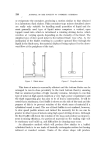
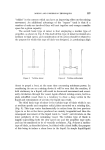
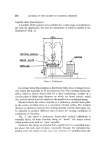
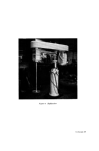
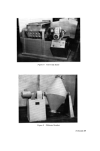
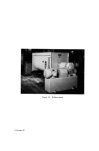
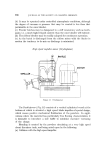
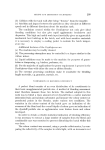
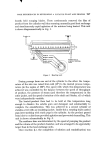
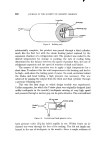
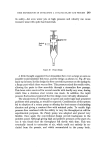
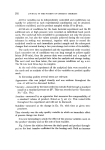
SOME EXPERIENCES IN DEVELOPING A VOTATOR PLANT AND PROCESS 247 loosely held scraping blades. These continuously removed the film of product from the cylinder wall thus ensuring unusually good heat exchange and simultaneously rapid agitation of the mixture being heated. This unit is shown diagrammatically in Fig. 1. Product in Steam in XXXN•P rod uct Stearin out Scraper Blades Product out to •NN•Shaft • • %%• •nt seua•a t [oa2 ket • • vp levSSeU .... talnlng Figure I Heating unit During passage from one end of the cylinder to the other the tempe- rature of the mix was raised from cold (15 ø ) to the desired process tempe- rature (in the region of 100ø). The speed with which this temperature was achieved was controlled by the balance between the speed of throughput of product, the pressure of steam (and therefore the temperature) in the outer jacket, and the speed of rotation of the shaft and blades, all of which were independently variable. The heated product then had to be held at this temperature long enough to dissolve the soluble gum and detergent and substantially to complete the emulsification. This was achieved in a second cylinder of stainless steel with an insulating jacket. Inside this a rotating shaft carried pegs inter-meshing with static pegs in the cylinder. As the product passed from inlet to outlet these provided agitation and prevented channelling. This unit is shown schematically in Fig. oe. The residence time was determined by the speed of pumping the product and the volume of the product chamber, and was arranged to be appreciably larger than in the heat exchange units. Once reaction (i.e. the completion of solution and emulsification) was

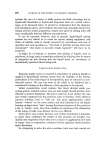
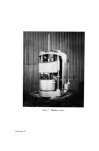
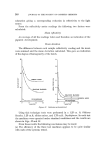
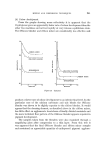
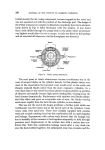
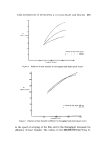
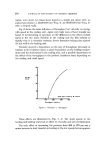
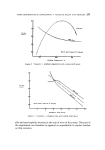
248 JOURNAL OF THE SOCIETY OF COSMETIC CHEMISTS Product Insulation Fixed pegs ototipegProductout[• • Figure 2 Holding unit substantially complete, the product was passed through a third cylinder, much like the first but with the steam heating jacket replaced by the expansion chamber of a refrigeration unit. The product was cooled to the desired temperature for storage or packing, the rate of cooling being determined by the balance between the speed of product flow, the rate of refrigerant expansion and the speed of rotation of shaft and blades. The essence of this operation was to apply a high temperature for a short time. To achieve this the wall temperature in the heating unit had to be high--well above the boiling point of water. To avoid cavitation behind the blades and local boiling, a high pressure was necessary. This was achieved by passing the output from the third and final cylinder through a pressure retaining valve. This was the first stage at which design trouble was experienced. Unlike margarine, for which the Votator plant was originally designed (and unlike toothpaste in the mouth!) toothpaste moving at very high speed and pressure through a narrow gap can be quite abrasive. The conventional •0 • rin. g seal • jTorslon spring Figure $a Conventional back pressure valve back pressure valve (Fig.$a) failed rapidly in use. Within hours an •* channel was worn through the face of the seating. This did not imply any hazard in the use of toothpaste in the mouth--there is ample evidence of
Purchased for the exclusive use of nofirst nolast (unknown)
From: SCC Media Library & Resource Center (library.scconline.org)