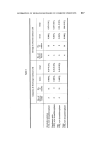
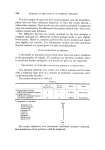
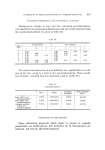
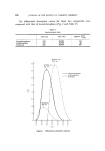
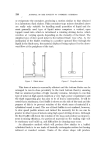
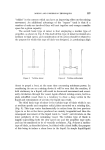
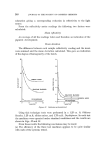
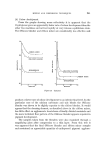
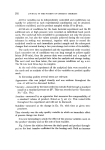
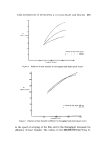
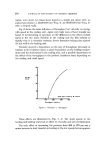
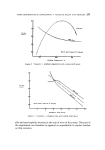
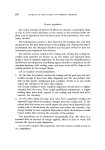
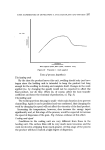
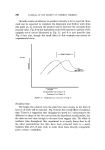
ESTIMATION OF HEXACHLOROPHANE IN COSMETIC PRODUCTS 221 The curve for bithionol is sufficiently different from that of hexachloro- phane to ensure that it will not intefere. The maxima are much closer for hexachlorophane and dichlorophane but if there is a mixture the maximum absorption lies between 307 and 312 nm according to the amounts present, e.g. a 1:1 mixture has a maximum absorption at 310 nm. These results indicate that dichlorophane and bithionol will be detected, should these compounds be present. DISCUSSION The results were generally satisfactory and no account was taken of the type of spectrophotometer used in the collaborative tests. It was found necessary to standardise the procedure fairly tightly to secure comparable results. The addition of likely perfumery compounds showed that there was no significant interference from this source. For the soap sample there was a tendency for the results to be a little lower than expected. However, recovery of hexachlorophane added to untreated soap chips was quantitative and it is considered that the method is satisfactory. A different extraction procedure may be necessary for other types of product containing hexachlorophane, e.g. antiperspirant/deodorant products and toothpastes. CONCLUSIONS Inter-laboratory collaborative tests have shown that the differential absorption spectrophotometric method published by Elvidge and Peutrell is sufficiently accurate and specific for the determination of hexachlorophane in certain toilet preparations, e.g. alcoholic solutions, talcs and soaps, containing hexachlorophane levels between 0.2% and 2%. ACKNOWLEDGEMENTS The Committee are grateful to the following companies and organisa- tions who allowed their staff time and facilities to take part in the collabora- tive work:--Beecham Products U.K., Chesebrough-Pond's Ltd., Goya Ltd., Givaudan & Co. Ltd., Huntingdon Research Centre, The Pharmaceutical Society of Great Britain, and Unilever Research Laboratory- Isleworth. (Received: 18th December 1967.)

222 JOURNAL OF THE SOCIETY OF COSMETIC CHEMISTS REFERENCES (1) Technical bulletin H 7. Sindar Corporation, U.S.A. (2) Ershov, B. P. et al., Khim. Prom. 106 (1957) Anal. Abstr. 5 1904 (1958). (3) Gottlieb, S. and Marsh, P. B. Ind. Eng. Chem. Anal. Edition 18 16 (1946). (4) Mohler, E. F. and Jacob, L. N. Anal. Chem. 29 1369 (1957). (5) Larson, H. L. J. A•n. Oil Chemists Soc. 28 301 (1951). (6) Lord, J. W., McAdam, I. A. and Jones, E. B. Soap Perfumery Cosmetics 26 783 (1953). (7) Achmeteli, H. I. J. Assoc. Offic. Agr. Chemists 48 278 (1960). (8) Gibbs, H. D. J. Biol. Chem. 72 649 (1927). (9) Singer, A. J. and Stern, G. R. Anal. Chem. 28 1511 (1951). (10) Gibbs, H. D. J. Biol. Chem. 71 445 (1927). (11) Stroughton, R. W. J. Biol. Chem. 115 293 (1936). (12) Lykken, L., Treseder, R. S. and Zahn, V. Ind. Eng. Chem. Anal. Edition 18 103 (1946). (13) Morton, R. A. and Stubbs, A. L. Analyst 71 348 (1946). (14) Clements, J. E. and Newburger, S. H. J. Assoc. O•c. Agr. Chemists 117 190 (1954). (15) Mahler, W. J. Am. Chem. Soc. 76 3920 (1954). (16) Childs, R. F. and Parks, L. M. J. Am. Pharm. Assoc. Sci. Ed. 45 313 (1956). (17) Elvidgc, D. A. and Peutrell, B. J. Pharm. Pharmacol. 13 Suppl. 111T (1961). (18) Porcaro, P. J. Anal. Chem. 36 1664 (1964).
Purchased for the exclusive use of nofirst nolast (unknown)
From: SCC Media Library & Resource Center (library.scconline.org)