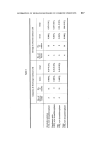
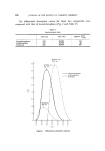
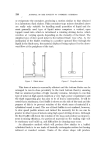
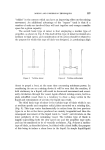
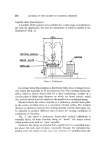
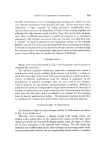
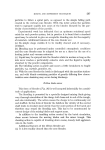
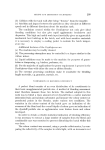
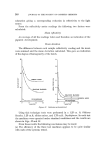
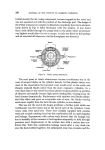
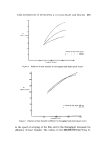
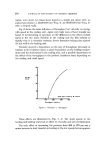
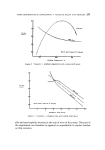
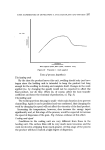
SOME EXPERIENCES IN DEVELOPING A VOTATOR PLANT AND PROCESS 257 No. increase Work applied (Heat, shaft speed, residence time) Figure 10 Viscosity v. work applied Tests of process hypothesis The heating unit By the time the product leaves this unit, swelling should only just have begun since the holding unit is intended to keep the product hot long enough for the swelling to develop and complete itself. Changes in the work applied (i.e. by changing the speed) would not be expected to affect the final product, nor do they. (They do, of course, affect the heat transfer coefficient and hence the economy of production, cf. Fig. 5.) The holding unit The work input from the pegs is small--their main function is to prevent channelling. Again it can be predicted and was confirmed, that changing the work by changing the speed will not affect the viscosity of the final product. Increasing the temperature, however, does increase the energy input significantly and, at this stage of the process, would be expected to increase the speed of dispersion of the gum. Fig. 8 shows evidence of this effect. Cooling unit speed Conditions in the cooling unit are very different from those in the heating unit. The surface films will be very much more tenacious and the work involved in stripping them much greater. At this stage of the process the product will have reached a high degree of dispersion.

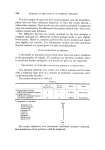
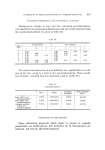
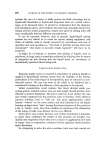
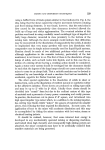
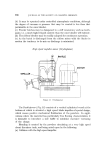
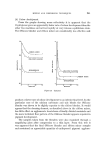
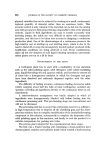
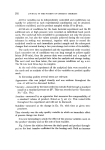
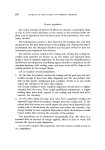
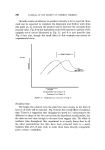
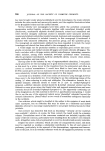
258 JOURNAL OF THE SOCIETY OF COSMETIC CHEMISTS On both counts an influence on product viscosity is to be expected. More work can be expected to complete the dispersion and further work from this point on, to overwork the product and to decrease the viscosity from its peak value. Fig. 8 on this hypothesis could well represent a portion of the complete set of curves illustrated in Fig. 11, and it is just possible that Fig. 9 does also, though the small effect in this example may merely be experimental error. Ex. No. Range Studied • I ß increase Holding Temi•erature (F•gure 8) Residence Time (Figure 9) Figure 11 Hypothetical extension of Fig. 8 Residence time The longer the product is in the plant the more energy in the form of heat or of work will be injected. Fig. 9 shows the overall effect of residence time. There is a suggestion that changing the speed in C unit produces the difference in shape of the two curves that the hypothesis would predict, but the data are not clear enough to do more than suggest this. The effect of residence time throughout this experiment is so nearly linear that in all the other presentations the data have been corrected back to a mean residence time of 3- 6 min, both to make them more directly comparable and to reduce variability.
Purchased for the exclusive use of nofirst nolast (unknown)
From: SCC Media Library & Resource Center (library.scconline.org)