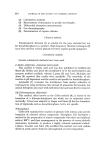
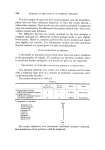
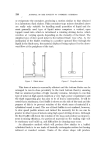
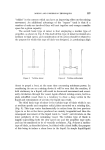
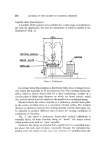
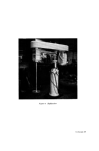
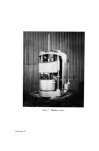
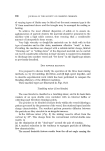
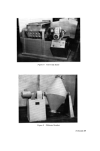
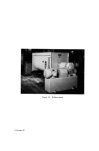
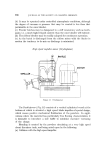
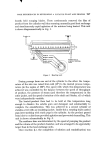
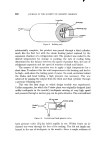
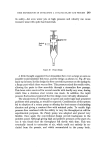
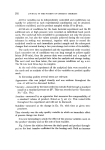
238 JOURNAL OF THE SOCIETY OF COSMETIC CHEMISTS (b) It may be operated under controlled atmospheric conditions, although the degree of vacuum or pressure that may be created is less than that permissible in the cone blender. (c) Powder batches may be dampened to a stiff consistency such as tooth- paste, i.e. a much higher liquid content than the cone blender 'will tolerate. (d) The ribbon blender may be readily adapted for continuous operation. (e) As the batch is discharged from the ribbon mixer with the blades in motion the tendency to de-mix on discharge is minimised. High speed impeller mixer (Drydisperser) BAFFLE IMPELLER I Figure 11 Drydisperser MOTOR The Drydisperser (Fig. 11) consists of a vertical cylindrical vessel at the bottom of which is situated a high speed blade impeller of special design, which causes positive mechanical fluidisation of the powders. In appli- cations where the material has particularly free flowing characteristics it is desirable to introduce a side baffle to minimise excessive vortexing of the charge. Blending is created by the powders circulating at a very high speed about the mixer tank, and being acted upon by the following: (a) Collision with the high speed impeller.

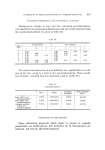
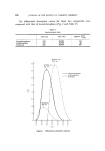
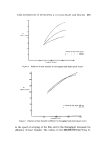
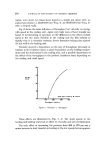
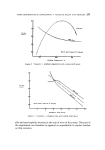
MIXING AND DISPERSION TECttNIQUES 23[) (b) Collision with the tank wall after being "thrown" from the impeller. (c) Attrition and impact between the particles as they circulate at different speeds and in different directions about the machine tank. The conditions created within the Drydisperser not only give ideal blending conditions but also give rapid agglomerate breakdown and dispersion. This high and useful work input inevitably gives an appreciable mechanical heat build-up in the batch, and with heat sensitive materials it is necessary to employ a cooling jacket to restrain the batch temper- ature rise. Additional features of the Drydisperser are: (a) The machine may be readily cleaned. (b) The processing atmosphere may be controlled to a degree similar to the ribbon mixer. (c) Liquid additions may be made to the machine for purposes of granu- lation or dampening, e.g. binders, perfumes, etc. (d) For the majority of applications the power requirement is greater in the Drydisperser than with either the cone or ribbon blender. (e) The extreme processing conditions make it unsuitable for blending fragile materials, e.g. granules, crystals, etc. COMPARISON OF BLENDING EFFICIENCY A perfect blend consists of an even distribution of its constituents in their basic unagglomerated particle size. A method of blending assessment must therefore measure these two factors. The method adopted in this work was to blend a trace amount of red dyestuff into a carrier material (micronised talc and calcium carbonate) and measure the colour content at preselected points in the blender, under various test conditions. The variation in the colour content of the batch gave an indication of the evenness of the blend and the overall depth of colour gave an indication of the dyestuff particle size as agglomerates were broken down and colour developed. In order to obtain a reliable statistical indication of blending efficiency it was necessary to extract a large number of samples from the blend and considerable care was exercised to prevent disturbing the batch whilst this was done. The colour content was assessed, using a powder reflectometer, by com- paring the reflectivity of the samples to white light, with an increase in red
Purchased for the exclusive use of nofirst nolast (unknown)
From: SCC Media Library & Resource Center (library.scconline.org)