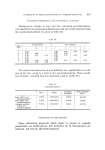
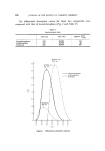
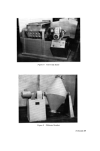
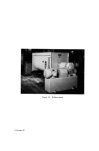
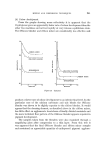
242 JOURNAL OF THE SOCIETY OF COSMETIC CHEMISTS rates, whereas even after two minutes no agglomerates could be detected in the Drydisperser samples. (c) Evenness of blend. The blends rapidly came to an equilibrium degree of homogeneity with all themachines on each system tested. The Drydisperser produced the most even blend, the ribbon mixer was second, and the Oblicone blender mix was the least evenly blended. (Received.' 14th Ju? 1967.) DISCUSSION MR. I•. 3/[. GODFREY: \¾ould you care to comment on your experiences in the dry mixing of powders of high density differences. Did the mixers used have any advantage over ribbon mixers where de-mixing can occur? Mrs. B•,•NTF, s: The tumbling type mixer is very sensitive to de-mixing. \Vith the high speed impellor mixers you have such a high rate of mechanical work and such rapid movement that I would not expect separation. MR. C. G•,M•,•,•,'rG•: Do you have any problems in scaling up your mixing equip- ment from pilot stage to large scale manufacture? Mrs. Cor•: We scale up, or rather we have ideas on scale up practice, which the theoretical chemical engineers may consider a little unsatisfactory. We tend to scale up on experience of the particular machine type, using such factors as peripheral speed of impellors, ratio of impellor diameter to tank diameter, etc. The calculation of power demand is rather more difficult. As a general rule when the power require- mcnt is in doubt we arrange for an excess in power and therefore attempt to cater for any future requirement. Mu. A. Fos'r•m: In colour development you compare a ribbon mixer, the Oblicone blender, and the Drydisperser. The latter does rely on very high speeds, whereas your ribbon mixer is purely a blending operation. It seems to me that if you xvant to compare these would you not have to compare a ribbon mixer in combination with something like a hammer mill, versus the Drydisperser. If you obtain a very much •nore efficient dispersion with this you have one piece of cquip•nent replacing two. Can you comment on that? M•. B•,•NT•zs: That suggestion is perfectly valid but I should explain that in this particular field our interests have been in the development of mixing machinery, ant[ not necessarily of a complete mixing or dispersing process. I think it would be extreme- ly u•cful if comparative information of that kind •vas looked into. DR. A. \¾. MIDDLETON: When you are ball-milling a hard pigment with a soft material, such as talc, does this soft material behave as a liquid or does it get ground as well? M•. B.•x•:s: Ball milling of dry 1haterials to fine particle size is, generally speaking,

MIXING AND DISPERSION TECHNIQUES 243 not very satisfactory because you reach a stage when with a certain particle size there is the tendency for the materials to pack. That problem would depend very much on the two materials that are being milled. In general, the ball mill is not a very satisfactory method for fine grinding of dry powders.
Purchased for the exclusive use of nofirst nolast (unknown)
From: SCC Media Library & Resource Center (library.scconline.org)