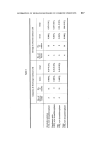
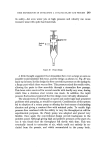
SOME EXPERIENCES IN DEVELOPING A VOTATOR PLANT AND PROCESS 251 total life very short. A large number of different seat and face arrange- ments were tested before a combination with sufficient wear to bed down but sufficient toughness to give long life was found, in the combination of a Langalloy face rotating on a ceramic seat. The latter seat vas specially designed to fit in a metal holding ring to avoid mechanical damage to the fragile material. This combination wore enough to bed down rapidly to a very efficient seal even at 200-250 psi but was tough enough to have a very long life. In spite of many attempts no design of flowmeter could be found which would stand up to the product viscosity and pressure. In concentrating on the techniques needed to eliminate the particular problems inherent in the handling of a toothpaste composition this survey has ignored the more predictable design problems inherent in adapting a plant originally designed for one purpose (margarine manufacture) to use for an entirely different purpose. This is deliberate. Such problems lie in the field of conventional calculations and as such their solution is less likely to fall to the lot of the cosmetic chemist. INVESTIGATION OF THE PROCESS The formulation of the experimental toothpaste used has little to do with the discussion following, which is more concerned with an interesting experiment in interpreting process data. After a number of initial runs, during which most of the problems already discussed were identified and eliminated, it was decided that the time had come for a more detailed look at the influence of process variables on the ultimate product. A factorial experiment was therefore designed to study the influence of those process conditions believed most vital. These were: Process variable Holding temperature of product Speed of blades in heating unit Speed of blades in cooling unit Throughput of product Pressure retained in system Values studied 90/105/120 ø 400/550/750 rpm 410/460 rpm 140/250/350 lb/hr 200/275 psi To avoid excessive work a complete factorial experiment was made at one pressure, 200 psi, and only 20 check readings were made at 275 psi, thus making 74 sets of process conditions in all.

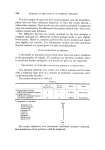
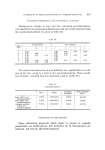
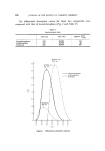
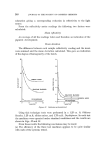
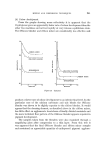
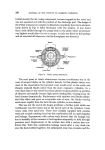
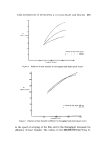
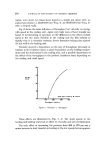
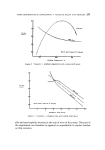
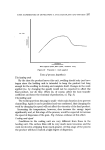
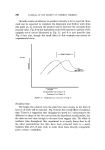
252 JOURNAL OF THE SOCIETY OF COSMETIC CHEMISTS All five variables can be independently controlled and equilibrium can rapidly be achieved so each experimental combination can be attained, conditions stabilised, and the product sampled within 15 to 9,0 min. All 54 sets of conditions for the basic factorial experiment and the 20 additional sets at high pressure were recorded on individual hand punch cards. The cards had been stencilled to accommodate not only the process variables set, but also the values actually achieved during the run (some tolerance in setting was necessary), together with space to record the analytical results on each immediate product sample and the subsequent changes that occurred during a two year storage test review of its stability. The cards were then randomised and the experimental order recorded. Each successive set of conditions was run long enough to achieve equili- brium (5-10 min), then the process data were recorded and a sample of product was taken and packed into tubes for analysis and storage testing. The next card was then taken, the new process conditions set up, a.s.o. The 74 runs took three days to complete. At the end of the experiment all the analytical data were recorded on the cards and an analysis of the effect of the variables on product quality made. In discussing quality several terms are relevant: Appearance--this was judged visually and was uniform throughout the run---it will not be discussed further. Viscosity--measured by the time needed to extrude 5 ml through a standard nozzle at a standard pressure at 9,5 ø. This was recorded as the "Extrusion No." (Ex. No.). Aeration--measured by an apparatus that measures the compressibility of a standard volume of product. Noted as % air v/v. This varied little throughout the experiment and will not be discussed. Stability--measured as the change in Ex. No. with time at given tem- peratures. Thus viscosity was the only quality variable in which an immediate effect of process change was found. It is now interesting to study the effect of the process variables used, on the product viscosity and on the rate of heat transfer. Fig. 5 shows the relation between the shaft speed and product through- put on the heat transfer coefficient for the heating unit. Both an increase
Purchased for the exclusive use of nofirst nolast (unknown)
From: SCC Media Library & Resource Center (library.scconline.org)