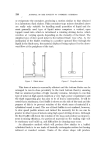
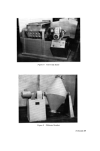
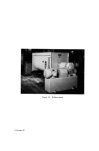
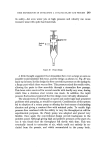
230 JOURNAL OF THE SOCIETY OF COSMETIC CHEMISTS POWDER-LIQUID DISPERSION Definition of dispersion In theory, complete dispersion may be considered to be achieved when each and all individual surfaces of a finely divided solid are coated with liquid. In the terms of this discussion the particle size would be small and in the order of, say, 0.5 to 5 microns. It would at first appear to be a simple matter to achieve complete dispersion as described above but in practice many of the ultimate crystals or particles will be agglomerated or formed into clusters which, if merely stirred into the liquid, will form lumps or "nibs" in the finished dispersion. This tendency to agglomeration can have been brought about in the initial processing of the powder or in certain cases by incompatibility of the solid and liquid phases. In the latter case the addition of a minimal amount of surface active agent may produce a more readily dispersed system, although in a number of practical appli- cations the addition of surfactants may produce undesirable properties in the finished products. In many instances, however, a formulation will contain more than one liquid or solid, and correct addition sequence, found by trial and error, can often effect a considerable improvement in the degree of ultimate dispersion and the reduction of processing time. There is always considerable contro- versy regarding the difference between the terms "dispersion" and "wet grinding", but the latter is usually assumed to mean the reduction of particle size as occurs in wet grinding ball mills or similar machines having relatively moving grinding surfaces with close clearances. Type of mach, ines for powder-liquid dispersion Ball mills and derivatives In the general surface coating industry, i.e. paint, ink and enamel preparation, very considerable reliance is placed on the use of the ball and pebble mill and it is estimated, for instance, that up to 75% of paint pro- duced in the United Kingdom is produced on this type of machine. Perhaps it should be mentioned that in the above industries the pigments used are usually in a fairly divided state but even so the ball mill has been found to be an extremely simple and effective method of dispersion. Although it has been said that the pigments used are finely divided, it should be mentioned that a ball mill is capable of true grinding, e.g. it will reduce the crystal or ultimate particle size of a pigment or extender.

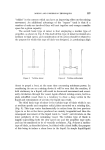
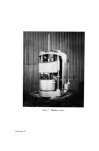
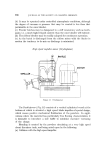
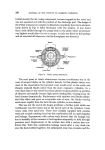
MIXING AND DISPERSION TECHNIQUES 231 Extremely simple in operation, there is no doubt that these machines produce very satisfactory dispersion in a wide range of viscosities and can be considered to be a single process machine. The conventional ball mill is perhaps used to best advantage when dealing with larger batches of material but a recent development is the planetary type ball mill which, by inducing high centrifugal force, will process a given dispersion in about one tenth of the time required by conventional ball mills. Conventional ball mills comprise a horizontally rotating cylinder which is approximately half filled with bails or other grinding media, the milling or dispersion occurring as the result of the relative movement between the balls themselves and betxveen the balls and the inner surface of the con- taining cylinder. A derivative of the ball mill is the sand or bead mill, which comprises a stationary vertical vessel which contains graded sand, very small ceramic bails or glass ballotini. A vertical shaft having disc or similar type stirrers is rotated in the container, causing circulation and "rubbing out" between the surfaces of the sand. This type of machine has the advantage that it may be operated as a continuous process but is not as efficient as the conven- tional ball mill if coarse particles are to be "ground" or dispersed. Colloid and roller mills Both types of mills are used in industry, the former relying on the high shear forces induced between fixed and rotating granular surfaced discs, and the latter by the "nip" caused by intercontact between horizontal roller surfaces. The two machines mentioned above are grouped together for the purpose of this paper, but it should be explained that they are designed for dealing with dispersions of entirely different viscosities. Mixing type dispersions Simple propellor type mixers Readily wettable or dispersable powders may be dealt with satisfactorily with a variety of simple machines and high speed stirrers, and probably the viscosity of the final product will have most influence on these designs. Low viscosity systems can be dealt with by high or even ultra high speed pro- pellors of comparatively small diameter but if an attempt is made to operate this type of dispersion with high viscosity systems, there is a tendency for a "pocket" of highly agitated liquid to occur round the impeller without adequate circulation of the bulk of the liquid.
Purchased for the exclusive use of nofirst nolast (unknown)
From: SCC Media Library & Resource Center (library.scconline.org)