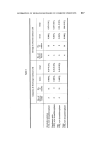
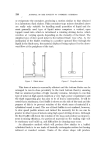
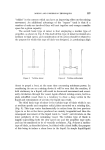
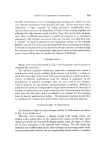
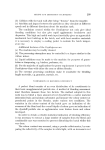
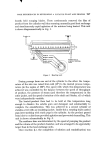
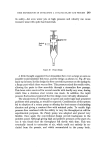
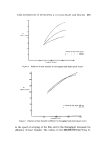
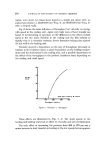
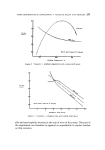
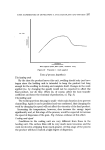
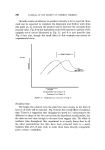
SOME EXPERIENCES IN DEVELOPING A VOT.4TOR PLANT AND PROCESS 249 its safety--for even water jets at high pressure and velocity can cause excessive wear with quite hard materials. '0.•' ring seal Product Flow • out trigure $b Final design A little thought suggested that streamline flow over as large an area as possible would minimise this wear, and the design as shown in Fig. $b was made up in brass. In this design the flow exerted its pressure on the spring via a flange past which there was no flow. This pressure raised the needle valve, allowing the paste to flow smoothly through a streamline flow passage. This brass valve survived for several months with hardly any wear, during which time a stainless steel version was made. In addition, the rapid pressure fluctuations typical of the first design were virtually eliminated. The abrasiveness of toothpaste at speed and under high load presented problems with pumping, as would be expected. Consideration of the system led to adoption of a rotary pump as offering the best means of minimising abrasion and giving a constant flow with minimal pulse. To enable high pressure flow combined with the ability to vary the throughput at will for experimental purposes, the Plenty pump was adopted and proved very flexible. Once again the conventional design proved inadequate to the problem posed. Although giving high and positive pressure at the start of a run it was found that the throughput fell slowly with time. This was eventually traced to extraction of air, which could not entirely be ex- cluded from the premix, and which accumulated in the pump body.

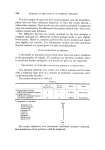
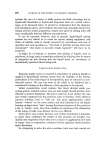
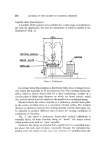
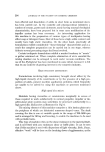
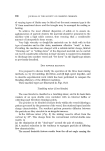
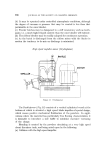
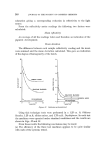
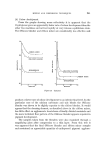
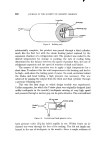
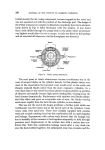
250 JOURNAL OF THE SOCIETY OF COSMETIC CHEMISTS Unfortunately the air, being compressed, became trapped in the rotor and was not squeezed out with the product at the discharge port. The design of the Plenty pump is too complex to illustrate completely here but is schemat- ically shown in Fig. •t. After discussion with the makers, it was found that a hole drilled through the pump body to the point where air pressure was highest would allow the air to escape. A cock was fitted to this passage and air was bled off whenever a fall in throughput was detected. Blades Toothpaste / Fixed liner Centre of •::'• rotation •,• of shaft ß •!. :•'::•' • • .,'..' Product out :•:• of rotor Figure 4 Plenty pump mechanism The next point at which abrasiveness became troublesome was in the wear of scraper blades on the cylinder barrels. At first plastic blades were used, in the expectation that greatest wear would occur on the easily and cheaply replaced blades rather than the more expensive cylinders. In a very short time it was found that these plastic scrapers picked up particles of abrasive and rapidly became high speed rotating files, wearing away the hard chrome dramatically. Replacement with stainless steel blades elimin- ated this effect and gave an acceptable rate of wear, the blades wearing much more rapidly than the hard chrome cylinder, as was desired. This was not the end of the design problems: a further point which was troublesome was the rotary seal at the end of each of the cylinders. Crane rotary seals were used here. These were initially supplied with ceramic seats and ceramic rotating faces but this combination led to rapid chipping and leakage. Experiments with carbon seals showed that the leakage was due to inability of the ceramics to bed together adequately to hold the high pressures used. Replacement of the ceramic face with a carbon face con- firmed this. With this combination leakage ceased after a very short run once the faces bedded together, but subsequent wear was excessive and the
Purchased for the exclusive use of nofirst nolast (unknown)
From: SCC Media Library & Resource Center (library.scconline.org)