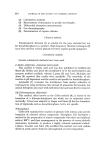
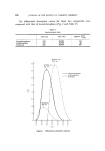
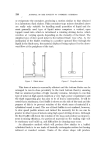
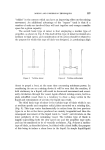
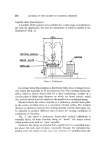
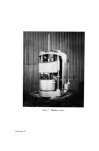
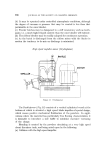
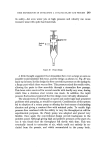
232 JOURNAL OF THE SOCIETY OF COSMETIC CHEMISTS Impeller-shear plate disperser A machine which appears to be suitable for a wide range of applications not only for dispersions, but also for dissolution of solids in liquids is the Hydisperser (Fig. 5). ,. t VERTICAL BAFFLE SHEAR PLATE IMPELLER Figure 5 Hydisperser In its basic form, this comprises a fixed tank with a loose or hinged cover, into which the materials to be processed are fed. The rotating mixing im- peller, which is driven from below by a drive mechanism, consists of a circular plate of fairly large diameter on which are found curved, radial ribs, and the device is in fact similar to the impeller of a centrifugal pump. Mounted above the rotary impeller is a stationary circular shear plate in the centre of which there is a concentric circular orifice. The vertical distance or clearance between the rotating impeller and the shear plate can be adjusted to produce different rates of shear for varying conditions of consistency or viscosity. Fig. 5 also shows a stationary, diametrical vertical bafflewhich is normally fitted, its main function being to "break" the major vortex which would occur with an "open" impeller. As shown, the charge of material flows rapidly but in a controlled man- ner about the tank and circulates repeatedly through the turbulent dis- persion zone the action in this zone can, however, be modified from the

MIXING AND DISPERSION TECHNIQUES 233 standard arrangement by selection of suitable impeller and baffle systems for special applications. The dispersion or mixing of the charge results from an intermix combination of shear attrition and impact force. Shear During repeated passes through the dispersion head the material is subjected to very high shear between the moving impeller and stationary shear plate, and by simple adjustment of this "shear gap" the magnitude of the shear forces exerted may be varied to suit the application. By the same means the flow pattern may also be controlled to obtain optimum performance with charges of widely differing rheological charac- teristics, e.g. with paper coating covering a considerable viscosity and solids content range the Hydisperser flow pattern can be modified to minimise aeration by elimination of any tendency to vortex, whilst still maintaining efficient dispersion conditions. In addition to the shear in the dispersion zone, hydrodynamic shear is also provided due to the different and rapidly changing velocities and directions of movement created within the batch by the Hydisperser's special baffle and impeller design. Attrition In addition the velocity and directional changes cause the suspended particles to collide and rub against each other and therefore promote agglomerate breakdown. This inter-particle attrition is particularly pro- nounced in the turbulent stream emerging from the impeller/shear plate dispersion zone. Application The Hydisperser has been used for a wide range of materials in many industries where the characteristics or properties of the final product can have considerable variations. Thus, while it is obvious that in the production of, say, paper coatings the required property is freedom from undispersed solids, in the case of the preparation of clay slurries for the manufacture of pottery products, efficiency of dispersion will result in a considerable improvement in strength of the pottery article prior to its being fired. Reverting to the preparation of paper coatings it is interesting to note that the adhesive or binder of the clay system is prepared in situ with the aqueous dispersion of the clay itself. The preparation of adhesives, both in aqueous and solvent systems, has
Purchased for the exclusive use of nofirst nolast (unknown)
From: SCC Media Library & Resource Center (library.scconline.org)