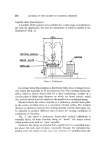
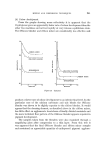
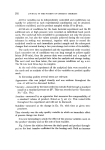
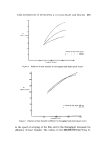
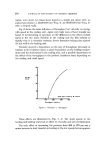
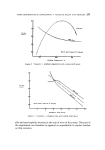
SOME EXPERIENCES IN DEVELOPING A VOT.4TOR PLANT AND PROCESS 259 It will be seen that the effects of the four main variables (i.e. excluding pressure) yield results that agree well with the predictions of the hypothesis advanced. CONCLUSION The purpose of this paper is not to illustrate how to make toothpaste, in fact it has skated round that subject very firmly, but to illustrate how some interesting developments can result from experiments in process develop- ment. Not only were a number of apparently novel design changes made in standard plant as a result of this study, but a working model of the physico- chemical changes in the course of toothpaste manufacture was worked out and found to be in good qualitative agreement with the data from the experiment described. Subsequently many other runs were made, all of which added to the confirmation of this working model. (Received: 14th July 196•.) REFERENCES (1) u.s. pat: 2,751,328 (2) Bolanowski, J.P., J. Soc. Cosmetic Chemists 7 509 (1956). DISCUSSION MR. K. M. GODFREY: The Plenty pump described raises the question where does the air come from? Was it in the product or was it pulled in by a leaky gland? If in the product can we look upon this pump as a successful de-aeration device? Tn•, LECTURER: You can get the air in from leaks in the system (you are sucking with a fairly high suction rate, and this pump will pull 26" vacuum in a really thick toothpaste and any leak promptly gives you blobs of air). If so you just stop itl On the other hand, even the finest toothpaste I have seen still has about 1% air trapped in it. However efficient the vacuum system, this seems to be about the bottom limit of air content for most toothpastes that are commercially handled. Air will gradually be pulled out in a system such as this because you are pulling with a fair vacuum to suck the paste into the pump. I think there are pumps which are reputedly better at de-aeration than this one. The Hamworthy is one, which I am told, is good at getting air out in this way, it is a screw pump, rather like the Mono but with a triple worm. MR. R. L. DAVIES: What are the advantages of the semi-continuous process over the batch process with respect to product quality, and economics of production? ThE LECTURER: The advantages on quality control are to my mind quite sub- stantial provided you can get the ingredients into the plant in the right proportions. The difficulty with a solid-liquid mix is that you can meter liquids very accurately into the plant continuously you can not meter solids very accurately and you are forced to have a fairly large buffer system somewhere before you get to the final mixing stage in order to even out the fluctuations in solid flow. If you can conquer that one then you can have a very much more efficient control of your product quality in a continuous plant as described.

260 JOURNAL OF THE SOCIETY OF COSMETIC CHEMISTS A continuous plant is really only very practical if you run it 24 hours per day, unless you have a very small shut-down wastage. If you have a plant, as described, which has a throughput of 1 • tons/hr then if for some reason you have a shut-down you cannot just stop there is a colossal heat capacity in the metal and you have to run it for a while to take some of the heat out otherwise all sorts of unfortunate things happen. You have quite an appreciable amount of product wasted every time you shut down. It may not be wasted completely if you can blend it back, but on an 8hr cycle you would possibly have 8 or 10% of your production as a re-cycle. This is not an ideal system for maintaining that superior quality control we were talking about. MR. W. F. KIRK: In page 250 you point out that the use of stainless steel blades gave an acceptable rate of wear. Was the level of contamination acceptable? THE LECTURER: Blade wear is one of the things that took me and my colleagues completely by surprise. When we first designed this plant in collaboration with the makers we thought that as we had an abrasive system we would use plastic blades and let the blades wear preferentially - they would be expendable they are very cheap compared with the massive hard chrome cylinders used for the heat exchangers. In fact the plastic blades picked up solid particles because they were softened under the temperature conditions, and converted themselves into highly effective pieces of sandpaper travelling at 400 r.p.m. They wore through the hard chrome in no time at all. It was not until we tentatively tried to use stainless steel blades on a hard chrome cylinder that we reduced wear almost completely. The same thing happened with the wear on the seals at the end of the shaft. There we started with the conven- tional ceramic seals which chattered so much that they chipped big chunks out of themselves. We ended up by having a system in which we had preferential wear - two materials which were differing in their hardness enough to wear and bed down, but were both hard enough to hold the product when rotating at 400 r.p.m. at 200 p.s.i. The Langalloy-hard chrome combination worked out beautifully. Every time we came across a snag in this plant it turned out to have a somewhat (to us, at any rate) unexpected solution. MR. D. B. BRUCe.: Could you comment on the possible use of diaphragm valves and pumps to overcome the abrasion problems, on the basis that the flow through such equipment should be more streamlined. TI•. LECTUR•.R: I have little practical experience of this, mainly because in the system with which this work was done it would be very difficult to find a diaphragm that would stand up to the temperatures and pressures without softening and de- grading. Any diaphragm pump which I have seen that would survive this sort of duty would never give quite such a smooth and un-pulsating flow as the rotating pump described. MR. J. M. BLAKEWAY: Was temperature control of the output from the plant sufficient to use viscosity as an output quality control method? THE LECTURER: No. Most of the work was done on subsequent viscosity measure- ments. The data we have been discussing were not on the product as exuded, because with almost any emulsion system involving a colloid the system sets to a higher viscosity within a matter of hours or sometimes days after you have finished making it. For quality control purposes you can control the exuding temperature very closely (within 1 ø or better), and you control the amount of work very closely, so that if you have put an in-line viscometer in the outlet you will not obtain the viscosity of the
Purchased for the exclusive use of nofirst nolast (unknown)
From: SCC Media Library & Resource Center (library.scconline.org)