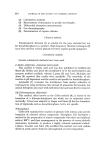
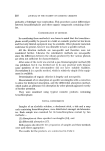
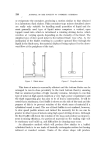
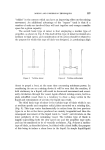
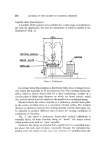
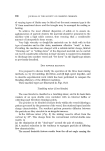
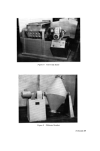
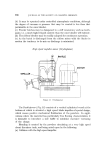
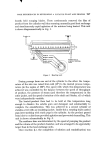
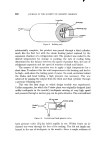
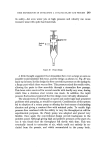
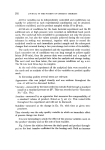
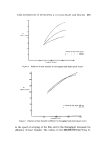
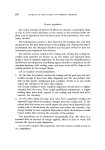
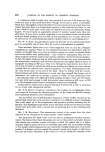
226 JOURNAL OF THE SOCIETY OF COSMETIC CHEMISTS or reciprocate the container, producing a motion similar to that obtained in a laboratory flask shaker. Plain container type mixers described above are really only suitable for handling small quantities of liquid and the most generally used type of liquid mixer comprises a vertical, open topped vessel into which is introduced a rotating stirring device which revolves at varying speeds, depending on the viscosity of the blend. The simplest type of slow speed mixer is the inclined blade type (Fig. 1), the inclination of the blades resulting in a positive upward force through the liquid in the blade area, the matedhal displaced being replaced by the down- ward flow at the periphery of the tank. Figure I Blade mixer Figure 2 Propellor mixer This form of mixer is reasonably efficient and the bottom blades can be arranged to run in close proximity to the tank bottom thereby ensuring that no unmixed portion of high viscosity remains. Attempts to run this type of mixer at high speeds results in a very high power requirement and the shaft supporting gear has also to be of heavy construction. It will be noted that a stationary, fixed baffle is shown on the side of the tank and the purpose of this is to prevent rotation of the whole mass of matehal if a cylindrical vessel is used. The use of fixed baffles is not confined, however, to slow speed paddle mixers and indeed the necessity for its use can be greater in other types of mixers using high speed stirring devices. Although the fixed baffle will check the rotation of the mass and produce an improve- ment in mixing efficiency, the portion of material on the trailing edge will be stationary and build up, and difficulties in cleaning may occur. An alternative method which will produce flow similar to a baffled cylindrical tank is to use tanks of basically rectangular section but having radiused or rounded corners. Tanks of the above shape will produce

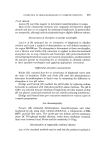
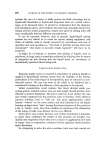
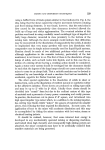
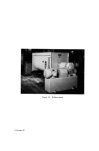
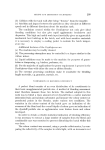
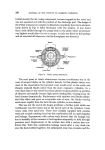
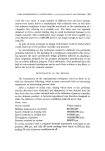
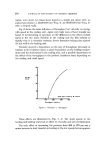
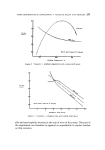
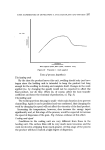
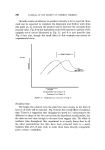
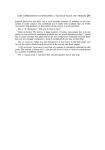
MIXING AND DISPERSION TECHNIQUES 227 "eddies" in the corners which can have an improving effect on the mixing movement. An additional advantage of the "square" tank is that if a number of units are involved they will nest together and occupy a smaller space for a given capacity. The second basic type of mixer is that employing a marine type of propellor, as shown in Fig. oe. The shaft of this type of mixer is rotated at a medium to high speed, and consideration of its action should be related to the purpose for which this type of blade was designed, i.e. producing a high Figure $ Turbine mixer Figure •l Turbine with stator thrust to propel a boat, at the same time consuming minimum power. In considering its use as a mixing device it will be seen that the reaction, if held stationary in a liquid, will result in downward movement and event- ually circulation through the vessel. Again efficient mixing occurs, but in a plain unbaffled vessel there is a tendency to draw a deep vortex in the liquid and entrainment of air into the liquid can result. The third basic type of mixer is the turbine type of blade which is run at medium speeds and comprises radial plates mounted on a rotating disc, (Fig. 8). This type varies fundamentally in action from the two previous types in so far as the forces produced are mainly tangential and thus the consequent movement of the liquid tends to "wash" and circulate on the inner periphery of the containing vessel. The turbine type of blade is largely superseding both the slow speed one and the propellor type units and can be considered to be of versatile usefulness. Fig. •l shows a turbine type of blade, as described above, but fitted with a fixed baffle, the purpose of this being to induce a shear force in the liquid. In simple liquid-liquid
Purchased for the exclusive use of nofirst nolast (unknown)
From: SCC Media Library & Resource Center (library.scconline.org)