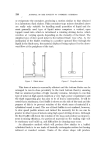
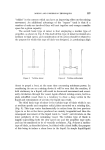
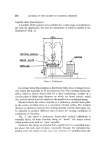
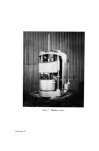
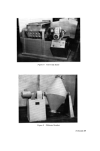
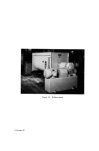
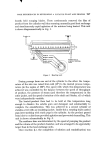
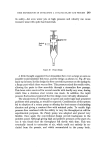
Figure 10 Ribbon mixer •ttcing page 237

MIXING AND DISPERSION TECHNIQUES 237 particles to follow a spiral path, as opposed to the simple falling path created in the vertical cone blender. With this latter action the particles tend to segregate rapidly into zones of the blender dictated by the par- ticular characteristics of the particle. Experimental work has indicated that an optimum rotational speed exists for each powder system, but in practice it is found that a standard speed may be selected to give an acceptable blending rate for the majority of materials. Additional features of the cone blender are: (a) Its simple shape enables it to be readily cleaned and, if necessary, sterilised. (b) Blending may be performed under controlled atmospheric conditions and the cone blender may be adapted for use as a dryer by the use of a heating jacket and vacuum extractor. (c) Liquid may be sprayed into the blender whilst in motion so long as the mix never reaches a particularly cohesive state and the liquid is rapidly absorbed by the powder components. (d) The blending action is gentle and causes a little breakdown to fragile particles, e.g. crystals, granules, etc. (e) With the cone blender the batch is discharged with the machine station- ary, and with blends containing particles of greatly differing flow charac- teristics some demixing may occur during discharge. Ribbon blade mixer This form of blender (Fig. 10j is well accepted industrially for a multi- tude of applications. The blending is promoted by a specially designed mixing blade giving very thorough circulation of the charge both from end to end of the trough, and also rotationally. The action causes the charge to be continuously cut and shuffled. In this form of blender the batch in the vicinity of the central shaft tends to circulate more slowly than the outer portion of the batch and therefore may retard the blending rate. This has to be counteracted by correct design of the mixing blades and support arms. In addition to the tumbling action created by the batch circulation, shear occurs between the moving blades and the mixer trough. This shearing action is capable of breaking down coarse, loosely held agglomer- ates in the batch. Additional features of the ribbon blender are: (a) It is less readily cleaned than the cone blender.
Purchased for the exclusive use of nofirst nolast (unknown)
From: SCC Media Library & Resource Center (library.scconline.org)