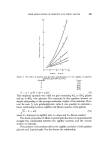
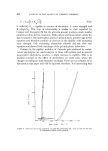
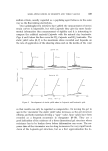
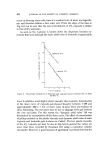
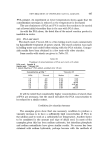
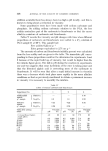
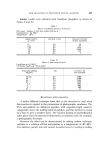
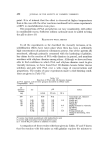
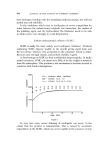
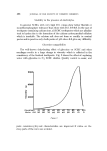
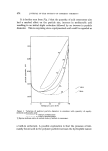
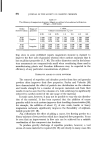
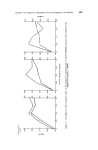
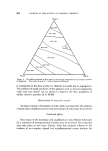
SOME APPLICATIONS OF RIGIDITY AND YIELD VALUES 437 able increase in the viscosity of the interspace fluid, especially at high glycerin concentrations may also cause an increased rigidity due to the increased difficulty of movement of the gelatin chains, relative to the fluid, under an applied stress. Whilst the rigidity is obviously a very valuable parameter for rigid gels such as gelatin similar measurements are of little value on materials such as Laponite which become very fluid once the static yield value is exceeded. Measurements of rigidity at forces below this yield point may be made with relatively dilute gels, but far more information about the funda- mental nature and potential uses of the material may be obtained by studying the rheogram. The significant facts obtainable from this curve are the dynamic and static yield values and the plastic viscosity. With materials such as Lapon- ite the dynamic yield value is the energy input necessary to maintain a constant ratio of shear rate to shear stress in a system whose structure has been destroyed by previous shear. The dynamic yield point gives an in- dication of the degree of internal breakdown in the system and at some rate of shear should reach an optimum value indicating that all the bonds between particles have been broken and the dispersed units consist solely of primary particles. The static yield value on the other hand is the minimum force necessary to initiate flow. This value is not absolute, but depends on the previous history of the gel particularly with thixotropic materials since any des- truction of the internal structure of the gel will take time to rebuild. The increase in the static yield value with age may be due to an increase in the inter-particle linkages, possibly due to slow swelling of the individual particles allowing further particle to particle contacts. The two stages of the primary structural recovery suggest that different types of linkage may be formed in each case. As the first stage of the reaction is the fastest it must involve the linkage most likely to occur spontan- eously and produce the strongest network on which the secondary structure forms. Edge to face links, because they are due to electrostatic attraction between negatively charged surfaces and the positively charged edges of the clay particles, will form the primary links whilst the weaker van der Waal's attractive forces of edge to edge and face to face links will form more slowly and these linkages will predominate in the second stage of gel recovery. The large static yield value of Laponite gels allows solids to remain in permanent suspension and its rapid breakdown on shaking allows easy

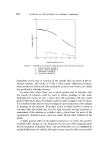
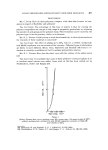
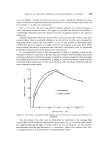
438 JOURNAL OF THE SOCIETY OF COSMETIC CHEMISTS pouring of the material particularly as the rate of gel reformation is not too rapid. The rate of build up of Laponite static yield value is more rapid than with bentonite and little settling of suspended solids would take place. The low plastic viscosity of Laponite gels enables easy pouring in relation to a bentonite gel of similar yield value as the latter has a higher plastic viscosity. ACKNOWLEDGEMENTS The authors would like to thank J. Ocron and P. P. Georgakopoulos for certain experimental results. (Received: $Oth June 1969) REFERENCES (1) Nixon, J. R., Georgakopoulos, P. P. and Carless, J. E. J. Pharm. Pharmacol., 18 283 (1966). (2) Saunders, P. R. and Ward, A. G. Proc. 2nd Int. Conf. Rheol., Oxford p.284 {1954). (3) Chaw]a, B. P.S. Ph.D. Thesis, London (1967). (4) Blixon J. R., Georgakopoulos, P. P. and Carless, J. E. J. Pharm. Pharmacol., 20 521 (1908). ($) Cureper, C. W. Bl. and Alexander, A. E. Austral. J. Sci., A5 146 (1952). (6) Levy, G. J. Pharm. Sci., 51 947 (1962). (7) I-Iovwink, R. Elasticity, Plasticity and the Structure of Matter. 2nd. Ed. p.13 (1958) (Dover Publications, Blew York) (8) Blixon, J. R. and Chawla, B. P.S. J. Pharm. Pharmacol., gl 79 (1969). (9) De Butts, E. H., I-Iudy, J. A. and Elliott, J. H. Ind. Engng. Chem., 49 94 (1957). (10) Barry, B. W. and Shotton, E. J. Pharm. Pharmacol., 119 Suppl., 110S-120S (1967). (11) Neumann, B. S. Rheologica Acta, 4 250 (1965). (12) Cheng, D.C. I-I. Brit. J. Appl. Phys., 117 258 (1966). (15) Veis, A. The macromolecular chemistry of gelatin. 891 (1964) (Academic Press, New York) (14) Bungenberg de Jong, H. G. in Colloid Science. (Ed. Kruyt, H. R.). 2, 335 (1949) (Elsevier, Amsterdam). DISCUSSION MR. A. Mogs: Have you any idea about the rate of formation of the gels? Would you say that in Fig. 6 you have two rates of reaction, the fast reaction immediately you stress the gel, and the slow reaction following? This may not be due to two different structures but to one structure decaying rapidly at first and slowly subse- quently. DR. NIXON: The time for complete formation of the Laponite B gels was 16-20 h at 20 ø, after preliminary high speed stirring with a Silverson mixer. This process was not speeded by heating. With regard to your second point, it is quite possible that there is one structure xvhich undergoes rapid breakdoxvn followed by slower equilibrium and a single line
Purchased for the exclusive use of nofirst nolast (unknown)
From: SCC Media Library & Resource Center (library.scconline.org)