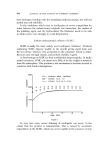
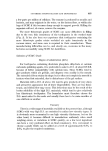
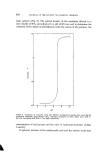
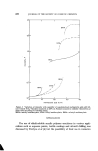
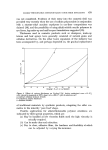
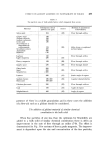
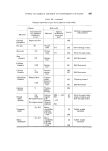
484 JOURNAL OF THE SOCIETY OF COSMETIC CHEMISTS has been suggested therefore that the definition of a glidant must include flow under these conditions (2). Several methods have been employed to assess the effect of glidant addition on flowability and these include rotational viscometry (3), angular characteristics (4-6), and gravity discharge from model hoppers (7, 8). Whilst some of these tests are of limited application in the quantitative assessment of flowability (5, 9) they give an indication of possible effects of glidant addition. A more practical approach has been to investigate tablet weight variation (2, 10). From the reported results it is possible to distinguish between two types of glidants:- 1. Materials chemically similar to the bulk solids to which they are added. 2. Materials chemically dissimilar to the bulk solids to which they are added. It has also been shown that it is possible to improve the flowability of fine powders by the addition of these two categories of glidants (11) and it is suggested that this may be another division of their classification (12). The way in which these materials improve the flowability of bulk solids varies according to the material used. It is necessary therefore firs fly to outline the effects produced by the various types of glidant and then discuss the suggested mechanisms of action. GLIDANTS ADDED TO GRANULAR SOLIDS Before the effect of glidant addition can be assessed it is useful to understand the problems that may be encountered in the handling of granular solids. It is now well established that when considering the gravity discharge of a bulk solid, the rate of flow increases as the particle size is reduced until a size is reached below which flow becomes impaired by the action of interparticulate forces. Furthermore, it is generally accepted that difficulties may arise in flowability when the material is reduced in size to less tfian 1509m. Table I lists some of the critical particle sizes below which flow impairment has been reported. It can be seen that this critical size varies according to the particular material investigated. It may be that problems of flowability could be reduced by a judicious choice of particle size. However, it is often impracticable to use monosized systems. Further- more, it may be desirable to include fine material in a blend, e.g. the

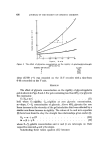
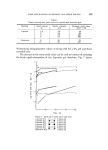
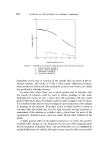
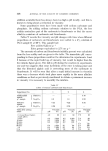
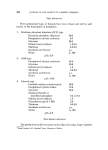
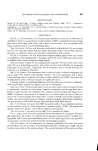
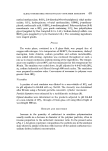
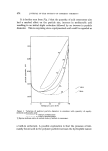
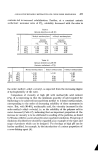
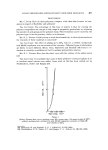
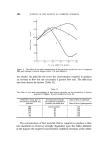
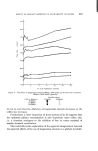
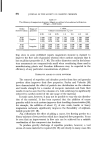
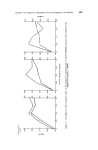
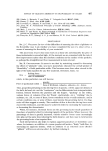
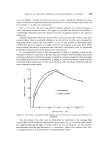
EFFECT OF GLIDANT ADDITION ON FLOWABILITY OF SOLIDS 485 Table I The particle size of bulk solids below which impaired flow occurs Estimated critical Method of assessment Material particle size (gm) Source of flowability Silica sand 204 (25) Flow through orifice Quartz sand Sodium chloride Sodium carbonate Citric acid N-cyclohexyl 2- benzothiazole- sulphenamide Strontium nitrate Acetanilide Ballotini Lactose Light magnesia Heavy magnesia Quartz sand Glass beads Sand Griseofulvin Lactose Sodium borate Boric acid Calcium gluconate Coal Sulphathiazole 150 150 35O 150 175 4OO 35O 5O 120 250 158 250 300 300 200 250 150-300 100-250 (26) (27) (28) (29) (3O) (31) (32) 250 (33) lOO 4OO (34) (35) Slide down a roughened inclined plane Flow through orifice Flow through orifice Flow through funnel Flow through orifice Static angle of repose Angular characteristics Flow through orifices Angle of repose Angle of repose presence of 'fines' in a tablet granulation and in these cases the addition of a flow-aid such as a glidant should be considered. The addition of glidant material of similar chemical constitution to the bulk solid When fine particles of size less than the optimum for flowability are added to a bulk solid of similar chemical constitution there is often an improvement in the rate of flow through an orifice (7-9). The effect is demonstrated in Fig. 1 for systems of heavy grade magnesia. The improve- ment is dependent upon the size and concentration of the fine particles
Purchased for the exclusive use of nofirst nolast (unknown)
From: SCC Media Library & Resource Center (library.scconline.org)