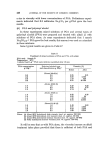
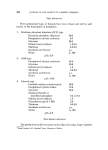
496 JOURNAL OF THE SOCIETY OF COSMETIC CHEMISTS Antistatic effects Many powders acquire a static charge during their handling and it has been shown that the addition of løfo or more of magnesium stearate, polyethylene glycol 4 000 or talc effectively lowers the accumulation of static charge in a number of pharmaceutical formulations (24). (Received.' 2nd January 19( 9) REFERENCES (1) Strickland, V• •. A. Jnr. Drug Cosmetic Ind. 8õ 318 (1959). (2) Augsberger, L. L. and Shangraw, R. F..[. Phar•n. $ci. õõ 418 (1966). (3) Harwood, C. F. and Pilpel, N. Lab. Pract. 17, 1236 (1068). (4) Tawashi, yon R. Pharmazeutische Technologie, 2 64 (1063). (5) Gold, G., Duvall, R. N., Palermo, B. T. and Slater, J. G. J. Pharm. Sci. õõ 1201 (1966). (6) Craik, D. J. and Miller, B. F. J. Pharm. Pharmacol. 10 136T (1958). (7) Gold, G., Duvall, R. N., Palermo, B. T. and Slater, J. G. J. Pharm. Sci., õ,1 667 (1968). (8) Hammerness, F. C. and Thompson, H. O. J. Am. Pharm. Assoc. Sci. Ed. 4'1 58 (1958). (0) Jones, T. M. Mfg. Chemist 30 38 (March 1068). (10) Hansen, G. Arch. Pharm. Chemi. 01 632 (1954). (11) Bulsara, P. U., Zenz, F. A. and Eckert, R. A. IEC Proc. Des. and Der. 3 348 (1964). (12) Jones, T. M. and Pilpel, N.J. Pharm. Phar•nacol. 18 429 (1966). (13) Sumner, E. D., Thompson, H. O., Poole, W. K. and Grizzle, J. E. J. Pharm. Sci. õ5 1441 (1966). (14) Tucker, S. J. and Hays, H. M. J. Am. Pharm. Assoc. Sci. Ed. 48 362 (1959). (15) Farley, R. and Valentin, F. H. H. Powder Technol. I 344 (1967/68). (16) HawksIcy, P. G .W. Inst. Fuel Conf. on Pulv. Fuel 656 (1947). (17) Shotton, E. and Simons, F. M. J. Pharm. Pharmacol. 2 231 (1950). (18) Davis, H. Pharm. J. 150 118 (1943). (19) Irani, R. R. and Callis, C. F. Particle Size Measurement, Interpretation and Application 3 (1963). (John Wiley, N.Y.). (20) Train, D. and Hersey, J. A. J. Pharm. Pharmacol. 12 97T (1960). (21) Jones, T. M. J. Pharm. Sci. 57 2015 (1968). (22) Hardesty, J. O. and Kumagai, R. Agr. Chem. 7 (2) 38 (1952). (23) Whynes, A. L. and Dee, T. P. J. Sci. Food Agr. 8 577 (1957). (24) Gold, G. and Palermo, B. T. J. Pharm. Sci. 54 1517 (1965). (25) Rose, H. E. and Tanaka, T. Engineer, 208 465 (1959). (26) Burak, N. Chem. Ind. London 844. (1966). (27) Jones, T. M. and Pilpel, N.J. Pharm. Pharmacol. 17 440 (1965). (28) Jones, T. M. Ph.D. thesis University of London (1967). (29) Smalley, I. J., Hearer, A. A. and McGrath, L. Trans. Inst. Mining Met. (Sect. C Mineral Process Extr. Met.) 76 183 (1967). (30) Harwood, C. F. and Pilpel, N. Chem. Process Eng. 49 92 (July 1968). (31) Segovia, E. Acta Pharm. Suecica, 4 171 (1967). (32) Kaneniwa, N., Ikekawa, A. and Aoki, H. Chem. Pharm. Bull. 15 1441 (1967). (33) Egrova, V. I. Med. Prom. SSSR. 20 (11) 47 (1966). (34) Brown, R. L. S.C.oe. Monograph No. 14 150 (1961). (35) Nelson, E. J. Am. Pharm. Assoc. Sci. Ed. 44 435 (1955). (36) Gstirner, F. and Pick, C. Arch. Pharm. 300 757 (1967). (37) Czetsch Lindenwald, H. v. E1 Khawas, F. and Tawashi, R. J. Soc. Cosmetic Chemists, 16 251 (1965).

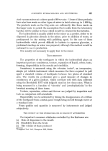
EFFECT OF GLIDANT ADDITION ON FLOWABILITY OF SOLIDS 497 (38) Okada, J., Matsuda, Y. and Wada, Y. Yakugaku Zasshi, 88 647 (1968). (39) Hersey, J. Rheol. Acta, 4 235 (1965). (40) Leoveanu, O., Zaharia, N. and Pilea, V. Rev. Chim. 17 112 (1966). (41) Jones, W. D. Fundamental Principles of Powder Metallurgy (1960). (Edward Arnold, London). (42) Maly, J. Acta Fac. Pharm. Bohemoslovenicae, VIII 81 (1963). (43) Berry, F. and Payne, M. Paper presented to Institution of Chemical Engineers Sym- posium on Aggregation (28th March 1968). (44) Forsythe, R. E., Scharpf, L. G. Jr. and Marion, W. W. Food Technol. 18 153 (1964). DISCUSSION MR. J. C. WILLIAMS In view of the difficulties of assessing the effect of glidants on the flowability may I ask whether you have considered the use of a shear cell as a means of assessing the flowability of your materials? THE LECTURER: I have done some work on a shear cell unfortunately the price of these instruments is somewhat high. At the moment we are concerned with the rate of flow improvement rather than the absolute conditions at the surface of the particles, so perhaps the straightforward flow measurement is more relevant. gIR. R. CHUDZIKOWSKIi It seems to me that by restricting yourself to discussing the effect of "glidants" only, you have (somewhat) obscured the overall picture of "flowability" of bulk particulate solids. This becomes more clear when viewed in the light of the basic equation for any flow (material, electricity, heat), viz: driving force flOW sum of resistances which, in this particular case will become: gravity Flow of particulate solids Sum of frictional, cohesive, adhesive, etc., forces. Thus, properties pertaining to the driving force of gravity, will be apparent density of the bulk, its head, etc. and the "resistances" can be differentiated into interparticulate friction, friction between the particles and the hopper, "packing" at the orifice, various forces of cohesion (Van der Waals', electrostatic, etc.), "sticking" due to moisture, etc. All, or some of these, forces contribute to the overall resistance, and in certain conditions one, or some of them, may become the governing factor. Its diag- nosis will then suggest a remedy. The condition of flow is that the driving force must exceed the resistances, and this may be achieved either by increasing the numerator, or decreasing the denominator. When, for instance, frictional forces are the governing factor small quantities of fines have a beneficial effect by reducing rugosity of the particles. When, however, the percentage of fines is greatly increased, various cohesive forces come increasingly into play (at the same time reducing the bulk density), and they may in turn become the governing factor of an impaired flow. Such interpretation also helps to explain apparent paradoxes of borderline cases where, for instance, an addition of a coarse powder will make a "fluffy" bulk flow, by increasing its apparent density, while an addition of an otherwise most effective "glidant" will have an adverse effect, by further reducing it.
Purchased for the exclusive use of nofirst nolast (unknown)
From: SCC Media Library & Resource Center (library.scconline.org)